What a Unique Selling Point Means for Winning on Amazon
Written by

Cosmy
AI-driven eCommerce Optimization
In a crowded market, a unique selling point is the clear reason a customer chooses your product over all others. It isn't just a feature; it’s the specific promise that makes your product the obvious solution for a particular person with a particular problem.
Think of it as your brand's signature—the one thing you do better than anyone else for a specific audience.
What a Unique Selling Point Really Means for Your Brand

A unique selling point (USP) is the specific benefit that makes your brand stand out when shoppers are comparing options. It’s the direct answer to the question: "Why should I buy from you and not the ten others selling something similar?"
Imagine a street with several coffee shops. One might be known for the fastest service, perfect for commuters in a hurry. Another could have the only ethically sourced, single-origin beans in the city. A third might offer the most comfortable seating with free, high-speed Wi-Fi, making it a go-to spot for remote workers. Each one has a clear, distinct USP.
It's More Than Just Features and Benefits
It's easy to confuse a USP with a feature or a benefit, but they are different. A feature is what your product has, a benefit is what the customer gets, and a USP is the unique reason why your product is the best choice to deliver that benefit.
Getting this right is important. Many brands get stuck talking about features and general benefits, which makes them blend into the background. This table shows the difference.
How a USP Differs from Features and Benefits
Concept | What It Is | Example (For a water bottle) |
|---|---|---|
Feature | A technical part of the product. It’s what your product has. | "Triple-wall vacuum insulation." |
Benefit | The positive result a customer gets from a feature. It's what the product does. | "Keeps drinks ice-cold for 24 hours." |
Unique Selling Point (USP) | The single, compelling reason your product is the best choice for a specific customer. It's why it's the only one that truly solves their problem. | "The only self-cleaning water bottle that uses UV-C light to purify water on the go, ensuring pure taste anywhere." |
As you can see, the USP isn't just about being different; it's about being different in a way that a specific group of customers cares about deeply.
A strong USP turns a generic product into a targeted solution your ideal customer feels they can't do without.
Saying your water bottle has "triple-wall insulation" is a feature. Stating it "keeps drinks cold for 24 hours" is a benefit. But promising it’s the "only self-cleaning water bottle using UV-C light to purify your water on the go" is a powerful USP. It immediately creates its own space in the market.
The Foundation of Your Marketing Message
Once you determine your USP, it becomes the core of your marketing and sales strategy. It guides everything from your Amazon title and bullet points to your ad campaigns, ensuring every message is consistent and clear.
A well-defined USP helps you:
Attract the right customers by speaking directly to their needs.
Justify your price by showing unique value that competitors can't easily match.
Build brand loyalty because customers who choose you for a specific reason are more likely to stay with you.
Ultimately, understanding what a unique selling point means is not just a marketing task. It’s the first step toward building a brand that stands out for its unique value, not just its price. It's how you claim a piece of the market that is truly yours.
Why Your USP Is Critical for Amazon Success
On Amazon's crowded virtual shelves, a strong Unique Selling Point (USP) is more than a marketing term; it's your product's survival plan. Having a good product isn't enough when you're one of dozens of similar items on a single search results page.
A clear, compelling USP is what makes a customer stop scrolling. It’s the one-sentence reason they click your listing instead of the ten others around it. Without one, your product is just part of the background noise.
Stand Out in a Search-Driven Marketplace
How people find products on Amazon is changing. The platform’s search system goes beyond simple keywords. It looks for relevance, authority, and the unique value that solves a shopper's real-world problem.
Your USP is a direct signal to these systems. When you clearly communicate your unique benefit in your title, bullet points, and A+ Content, you are telling Amazon’s search engine exactly which shoppers to show your product to. You get found by customers actively looking for the solution you provide.
A well-defined unique selling point means your product isn't just another option. It's the specific answer to a customer's problem, making it easier for both people and search algorithms to recognize its value.
This is happening now. Amazon's search already drives more product discovery than many other platforms, and brands that clearly communicate their value see better rankings.
Justify Your Price and Build Customer Loyalty
A strong USP does more than get you clicks. It demonstrates your product's value, allowing you to set a higher price without losing buyers. When customers understand why your product is different and better, they are often willing to pay for that unique value.
This changes the dynamic. You are no longer competing only on price. Instead, you're competing on a unique feature, better quality, or an innovative design that others don't have.
More importantly, a powerful USP is the foundation of brand loyalty. Customers who buy from you for a specific, compelling reason are far more likely to become repeat buyers and recommend your brand. It turns a one-time purchase into a long-term customer relationship.
How to Find Your Product's True Selling Point
Finding your product's real unique selling point isn't about a sudden moment of inspiration. It’s a step-by-step process. The strongest USPs are found by carefully examining your product, your market, and your customers.
We break this down into three straightforward steps. This isn't just about brainstorming; it's about filtering out the noise to find the angle that makes your product the only real choice for a specific buyer. It's about finding where your customer's needs, your strengths, and your competitors' weaknesses overlap.
Step 1: Start with the Customer, Not the Product
Before you can be unique, you have to know who you’re being unique for. A strong USP solves a genuine problem for a specific group of people. Trying to appeal to everyone is the fastest way to have a weak, forgettable product.
Answer these questions honestly about your ideal customer:
What is their biggest frustration with the products available now? What are their common complaints?
What are they really trying to accomplish? They don't just want a travel mug; they want their coffee to stay hot during a 2-hour commute.
What values influence their purchase? Are they looking for something sustainable, American-made, or built to last a lifetime?
What unmet needs are other brands ignoring?
Answering these questions gives you a map of problems you can solve. A deep understanding of your customer is the foundation for a message that connects.
Step 2: Dissect Your Competitors
Next, you need to know who you're competing against. This isn’t just about listing their features. It’s about understanding the promises they make and, more importantly, where they fall short. Your biggest opportunity is often found in their weaknesses.
Pick three to five of your closest competitors and start investigating. Find the answers to these questions:
What is their main selling point? Are they the cheapest option, the premium one, or the one with the fastest shipping?
Read their customer reviews—especially the 3-star ones. What are the common complaints? This information is valuable.
What benefits do they highlight in their marketing? And what do they seem to avoid talking about?
Is there a customer group they are clearly not serving well?
A competitor's weakness is your opportunity. If many reviews complain that other garlic presses are hard to clean, your USP could be "The only garlic press that rinses clean in 5 seconds." If you can back that claim up, you have a winning angle.
This analysis will show you the gaps in the market. Knowing what your competitors don’t do well is just as important as knowing what you do. If you want to go deeper on this, our article on how to find the right product keywords can help you spot these opportunities.
Step 3: Audit Your Product with Brutal Honesty
Finally, look at your own product. With a clear picture of what customers want and what competitors are missing, you can now assess your product with fresh eyes. The goal is to find what makes you genuinely different and more valuable.
Be critical. Ask yourself:
What specific feature or quality of your product is truly better than others? Be specific.
Do you use better materials, a more ethical supply chain, or a smarter design that solves a common problem?
Can you offer a stronger guarantee, better customer support, or a superior overall experience?
When you compare your strengths against customer needs and competitor weaknesses, a list of potential USPs will emerge. From that list, choose the single most powerful and defensible point. That becomes the heart of your brand.
How to Craft a Compelling USP for Your Amazon Listing
So you’ve identified your unique selling point. That's a great start. But a USP is worthless if it stays in a strategy document.
The real work is turning that idea into language that stops a shopper from scrolling. It has to be so clear that it gives them a reason to click your product instead of the ten others that look just like it.
This means your USP needs to be everywhere. It should be the central theme of your entire product page, repeated in every spot a customer looks. It's about turning a simple feature into a promise they can't ignore.
Weaving Your USP into Your Amazon Listing
To have a real impact, your USP must be impossible to miss. Think of your Amazon listing as valuable space. You need to place your core message in the most visible spots to grab attention and build trust.
It has to be visible in the search results, reinforced in the bullet points, and then proven visually in your images and A+ Content. Each placement builds on the last, making your unique promise more memorable and believable.
This table shows exactly how to integrate a USP across your listing for maximum effect. Notice how each section reinforces the core promise.
Listing Section | How to Incorporate Your USP | Example (USP: 'Only coffee mug that keeps drinks hot for 12 hours') |
|---|---|---|
Product Title | Lead with the USP to grab attention in search results. | "ThermaMug 12-Hour Insulated Coffee Mug – Keeps Coffee Hot All Day" |
Bullet Points | Use the first bullet point to explain the USP and its main benefit. | "STAYS HOT FOR 12+ HOURS: Our unique triple-wall insulation keeps your coffee hot from your morning commute to your last sip of the day." |
Main Image | Use text or icons to visually show the USP. | An image of the mug with a text callout saying "12-Hour Heat Lock" and a clock icon. |
A+ Content | Create a dedicated section with bold graphics and text that tells the story behind your USP. | A lifestyle image showing someone enjoying hot coffee outdoors, with the headline: "The Last Sip is as Hot as the First." |
By surrounding the customer with your core message, you leave no doubt about why your product is the better choice. It becomes the logical option for their specific need.
From Weak Statement to Powerful Promise
The difference between a generic feature and a high-converting USP is in the specifics—and the confidence of your promise. A weak statement just blends in. A powerful USP is precise, believable, and directly solves a customer's problem.
Let's look at an example. Many products claim to be "durable," but that word has lost its meaning. It's just noise.
Weak Statement: "Made with durable materials."
Powerful USP: "Built with military-grade ballistic nylon to resist tears and abrasions, backed by a 10-year guarantee."
See the difference? The second version is instantly credible. It names the material ("military-grade ballistic nylon"), states the specific benefit ("resists tears and abrasions"), and removes purchase risk with a strong promise ("10-year guarantee").
That's how you turn a simple selling point into a message that drives sales. For a deeper dive into this process, understanding copywriting with artificial intelligence can give you an edge. It all comes down to being specific, making a bold promise, and then proving it.
How to Test and Validate Your Chosen USP
A good idea is not a strategy. Once you’ve identified a potential USP, you must confirm it actually connects with customers. This step separates a guess from a data-backed sales driver.
Validating your USP means putting it to a real-world test to see if it makes people choose your product over another. It’s how you remove your own bias and ensure your marketing message is built on solid ground.
If you skip this step, you risk spending your marketing budget on a promise that shoppers don’t care about. Here are a few straightforward ways to get the data you need.
Run Split Tests on Your Listing
The most direct way to test a USP on Amazon is through split testing, also known as A/B testing. Amazon’s “Manage Your Experiments” tool is designed for this. It lets you run two versions of your listing content at the same time to see which one performs better.
You can test different elements that feature competing USPs:
Product Title: Write two different titles. One might highlight a USP like "100% Leakproof Design," while the other tests "Made from Recycled Ocean Plastic." Let the test run for a few weeks and see which version gets a higher click-through rate.
Main Image: Try two main images. One could have a graphic for "Fastest Charging Speed," while the other highlights its "Featherlight, Compact Size." The image that leads to more sales is connected to the winning USP.
This direct comparison gives you clear data on what message grabs attention and convinces people to buy.
Analyse Customer Language
Your existing customers provide a wealth of information. The words they use can tell you if your chosen USP is on target or completely off. Look through your product’s customer reviews and the Questions & Answers section.
Look for patterns. Are customers consistently talking about the benefit you believe is your USP? For example, if your USP is "The only backpack with a built-in, TSA-approved charger," and you find multiple reviews saying "the TSA-approved charger was a lifesaver at the airport," you have strong validation. This feedback is proof that your USP solves a real problem.
When customers use language in their reviews that matches your USP, it's a powerful signal that your message is clear and connects with their experience.
Use Small-Scale PPC Campaigns
Pay-per-click advertising is a great way to test different marketing angles. You can run small, focused campaigns to see which message performs best. For more details on this, check out our guide on how to optimize your Amazon PPC ads.
Here’s how to do it: create two separate ad groups with identical targeting but different ad copy. Each ad’s headline and text should focus on a different potential USP.
After running the ads for a week or two, analyze key metrics like click-through rate (CTR) and conversion rate. This will tell you which message was more effective at not just getting clicks, but at closing the sale.
Using AI to Sharpen and Monitor Your USP
On an Amazon platform driven by search algorithms, your USP must be as clear to those systems as it is to people. Using modern tools to analyze performance is a competitive necessity. These platforms go beyond basic keyword tools to analyze the signals Amazon uses to rank and recommend products.
Think of it this way: specialized software can see your product the way Amazon's algorithm does. It can pinpoint where your USP gets lost and show you exactly where you need to improve your content. This isn't about guessing; it's a data-driven approach that connects the strength of your unique selling point to your search performance.
The right tools can even show you how your USP compares to the competition in real-time. This is a clear, repeatable process for making sure your message is effective.
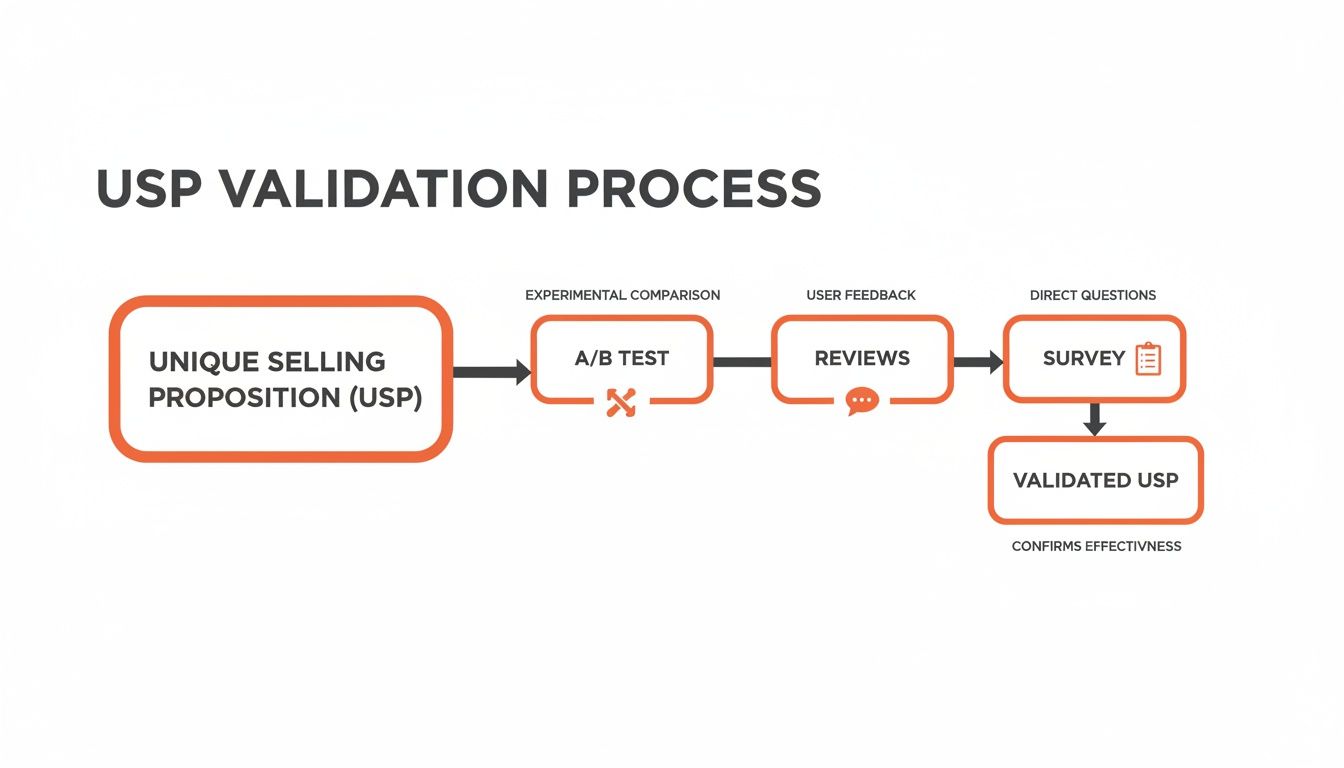
The flowchart shows a straightforward path from an initial idea to a validated USP, combining direct testing with feedback from customer reviews and surveys. It’s a continuous process, not a one-time task.
The advantage of specialized platforms is their ability to decode signals that generic tools miss. The results speak for themselves. Brands that have adopted AI-driven listing optimizations have seen conversion rates increase by an average of 27%. Additionally, 85% of users reported significant improvements in organic visibility in under 45 days.
To maintain your edge, you have to keep learning. A key part of this is mastering AI-powered ad creatives, which gives you direct insight into how your audience engages with different aspects of your USP.
Frequently Asked Questions About Amazon USPs
Defining your unique selling point is one thing, but applying it in a crowded market can be tricky. Here are some straightforward answers to common questions from brands.
What if My Product Is Not Truly Unique?
Almost no product is. The good news is, you don’t need to invent something brand new. Your unique selling point isn't about having a feature no one else has—it’s about owning a unique combination of qualities that matters more to your specific customer than anyone else's offer.
Think about where you can be different in a way that creates real value:
Superior Service: Can you offer expert-level customer support that competitors using generic call centers can't match?
A Stronger Guarantee: A lifetime warranty is not just a policy; it's a powerful statement of confidence that reduces purchase risk.
Your Brand Story: People don’t just buy products; they buy into stories. A family-owned business or a mission-driven brand creates a connection that mass-produced rivals can’t replicate.
Owning a Niche: You don't have to be the best for everyone. You just have to be the best solution for a very specific audience (e.g., "the only travel coffee press designed for rock climbers").
Can I Have More Than One USP?
It's tempting to list every great thing about your product, but this can backfire. You should focus on one primary USP for clarity and impact. This single, powerful idea should be the central theme of all your marketing, from your title to your A+ Content.
Trying to communicate five "unique" things at once just creates noise. Your message becomes diluted, and a confused customer will likely move on.
Think of it as the main headline for your product. You can have secondary benefits that support your core message, but your primary USP is the single, most compelling reason a customer should choose you.
Your primary unique selling point must be the immediate, obvious answer to the question: "Why should I buy this one?" A muddled answer is a lost sale.
How Often Should I Review My USP?
Your unique selling point isn't a "set it and forget it" asset. It’s a living part of your strategy. You should review it at least once a year, or whenever you see a major change in the market.
A powerful USP can last for years, but only if it stays relevant and unique. Triggers for a review are usually clear:
A major new competitor enters your space with a compelling offer.
You notice a change in customer priorities or shopping behavior (e.g., a shift towards sustainability).
Your own brand evolves with a new mission, new products, or a new target audience.
Regularly check that your USP still connects with shoppers and still sets your brand apart. If it starts to sound like everyone else's, it's time to revisit your strategy.
Ready to stop guessing and start seeing exactly how Amazon's AI perceives your brand? Cosmy delivers a data-backed audit that pinpoints visibility gaps and gives you a clear, prioritised action plan to improve your organic ranking and conversion.
Get your free, actionable content audit today at https://cosmy.ai