Mastering ASIN Amazon Search to Boost Sales and Rankings

Written by

Cosmy
AI-driven eCommerce Optimization
An Amazon Standard Identification Number, or ASIN, is the unique 10-character code assigned to every product on the platform. Think of it as your product's digital fingerprint. It's how Amazon tells your item apart from the millions of others.
This code links every piece of data to your product—from inventory levels and warehouse location to customer reviews and sales history.
What Is an Amazon ASIN and Why It Matters for Search
Picture Amazon as a huge library. Without a cataloging system, finding a specific book would be impossible. The ASIN is that system. It’s the unique identifier Amazon assigns to every product listed for sale.
But it's more than just an internal tracking number. For sellers, the ASIN is the central hub for all information tied to a product.
This 10-character alphanumeric code, usually starting with "B0", is the language of Amazon's search algorithm. When a customer searches for "running shoes," Amazon's system looks for the most relevant ASINs to display. Every click, sale, and review your product receives is logged against its ASIN, building its reputation over time.
For anyone selling on Amazon, understanding the ASIN is the first step to making your products discoverable.
The ASIN Is Your Product's Identity
An ASIN does more than just point to a product. It organizes everything about it in a way that Amazon’s systems, including AI tools like Rufus, can understand.
This includes:
Product Details: Your title, bullet points, description, and images are all directly tied to the ASIN.
Performance History: Sales numbers, conversion rates, and customer reviews are all logged against this specific code.
Inventory and Fulfilment: Amazon uses the ASIN to track your stock in its warehouses and manage the entire shipping process.
In short, your product doesn't exist on Amazon without an ASIN. It’s the critical link between your physical item and its digital presence, and it determines how your product is found, viewed, and purchased.
Why It Is Critical for Search
A well-managed ASIN is your most important tool for ranking in search results. When you perform an ASIN Amazon search, you're telling the platform the exact product you want.
Similarly, when a shopper searches for a general term like "wireless headphones," Amazon's algorithm sorts through thousands of ASINs to find the best matches. If your ASIN has a history of selling well for that search term, it’s far more likely to appear at the top of the results. Want to go deeper? Check out our complete guide on the Amazon Standard Identification Number.
Ultimately, every optimization you make—from rewriting your title to adding A+ Content—is about improving the performance signals tied to your ASIN. A healthy ASIN leads to better visibility, which drives more traffic and sales. It's a fundamental part of any effective Amazon strategy.
How ASINs Fuel the Amazon Search Engine
Let's be clear: Amazon’s search algorithm, A9, doesn't just rank keywords. It ranks products—specifically, it ranks ASINs. Understanding this is key to succeeding on the platform.
Every customer action—a click, a purchase, adding an item to the cart, leaving a review—is a signal. That data is recorded and tied directly to your product's unique ASIN, building its performance history.
Think of each ASIN as a candidate in an ongoing election. Every positive shopper interaction is a vote. The more "votes" an ASIN gets for a specific search query, the more Amazon’s algorithm trusts it to satisfy the next customer. That trust translates into higher search rankings.
The ASIN Reputation Score
While not an official metric in Seller Central, every ASIN has what can be called a "reputation score." This score is a summary of all performance data that tells Amazon how relevant and desirable your product is.
The key signals that build this reputation are straightforward:
Sales Velocity: How quickly and consistently your ASIN sells. High velocity indicates strong demand.
Conversion Rate: The percentage of people who visit your page and make a purchase. A high conversion rate shows your listing is effective.
Click-Through Rate (CTR): The percentage of shoppers who see your product in search results and click on it. A strong CTR means your main image, title, and price are attracting attention.
For example, imagine two brands sell identical yoga mats and are both targeting the keyword "eco-friendly yoga mat." Brand A's ASIN has a history of strong sales and a 20% conversion rate. Brand B's ASIN has slower sales and a 10% conversion rate. Amazon will favor Brand A, pushing it to the top of search results because its performance history proves it's the better choice for customers.
The ASIN isn't just an ID number. It's the central hub connecting your product, its performance data, and its potential to be discovered.
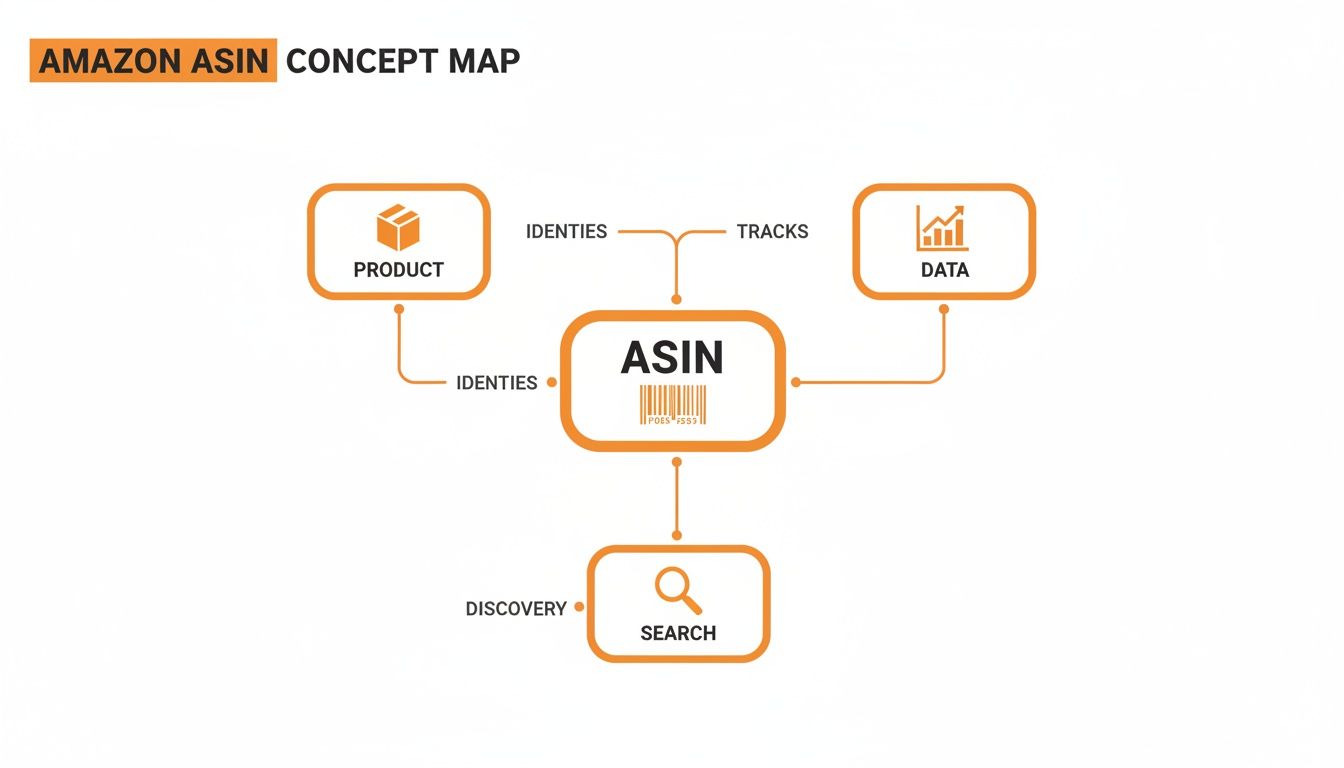
As you can see, the ASIN tracks the data that determines whether your product is found or buried in the search results.
How Performance Signals Impact Your Rank
This concept is especially clear in competitive markets. For example, India's IT category grew to over ₹50,000 crore in 2025. In such a crowded space, ASIN performance is everything. Our data shows that well-optimized listings can increase their keyword indexing by 40-60% in just 45 days.
The result? They achieve 3x greater search visibility than their less-optimized competitors. You can learn more about how to get these results on Titan Network.
This is why effective Amazon SEO is ASIN SEO. Your goal isn't just to rank for keywords. It's to consistently improve the health and performance of every ASIN in your catalog.
This principle also applies to how you structure product families. Using parent ASINs to group variations—like different colors of a phone case—is a smart strategy because it combines all sales history and reviews into one strong reputation score. This can build trust and boost conversion rates by as much as 45%.
By focusing on the metrics that matter at the ASIN level, you are directly giving Amazon’s algorithm the positive signals it wants to see. You're not just hoping to be found; you're ensuring the platform itself, including new AI assistants like Rufus that rely heavily on historical data, actively promotes your products.
Practical Ways to Find Any Product's ASIN
To research competitors or manage your own products, you first need to find the ASIN. It's the key that unlocks all the product data.
Fortunately, Amazon makes it easy to find. Once you know where to look, grabbing any ASIN takes only a few seconds. This is a basic skill for everything from simple inventory checks to detailed competitive analysis.
Here’s a quick reference guide to make it even simpler.
Quick Guide to Finding an ASIN on Amazon
Method | Where to Look | Pro Tip |
|---|---|---|
Product URL | In your browser's address bar, after | This is the fastest method. Just copy the 10-character code (usually starting with "B0"). |
Product Details Section | Scroll down the product page to the "Product information" or "Additional Information" table. | Best when you're already reviewing product specifications. The ASIN is clearly labeled. |
Browser Tools | Use browser extensions that display the ASIN directly on the product page. | Essential for researching multiple products. It saves you from manual scrolling and copying. |
Each method is useful in different situations. Learning all three will help you work more efficiently.
Check the Product Page URL
The quickest way to find an ASIN is in your browser's address bar. Go to any Amazon product page and look at the URL.
The ASIN is a 10-character code that almost always starts with "B0". It appears directly after the /dp/ part of the URL, which stands for "detail page."
For example, a URL might look like this: https://www.amazon.com/dp/**B09G9C5Q3X**/ref=...
In this case, B09G9C5Q3X is the product's ASIN. You can copy that code and use it for your research. It's a direct and reliable method.
Look in the Product Details Section
If you prefer not to look through the URL, you can find the ASIN clearly displayed on the product page itself. Scroll down past the product images and bullet points until you find a section labeled "Product information" or "Additional Information."
This is a table where Amazon lists key details like dimensions, weight, and customer ratings. The ASIN will be explicitly labeled among the other details.
This method is useful when you are already examining a product's specifications. It confirms you have the right identifier without interrupting your workflow.
For brands managing many products, understanding how different identifiers work together is important. For more information, see our guide on how to convert an ASIN to an EAN.
Use Browser Tools or Extensions
If you need to find dozens or hundreds of ASINs for competitor analysis, doing it manually is time-consuming. This is where specialized tools become essential.
Many browser extensions and third-party tools are designed for Amazon sellers. They can automatically find the ASIN and other important data, often displaying it in an overlay on the product page. This eliminates the need for scrolling or checking URLs.
For automating this process on a large scale, a tool like an Amazon Scraper is the best option. These applications are designed to collect this data efficiently, which is necessary for deep market research or monitoring your competitors. This automates the tedious work so you can focus on strategy.
Using Reverse ASIN Search to Uncover Competitor Secrets
Imagine you could see exactly which keywords are driving your top competitor’s sales. A reverse ASIN search makes this possible. It's a direct way to use their success to your advantage.
Instead of guessing which keywords might work, this method starts with what’s already proven to sell. You take a competitor's ASIN and use a specialized tool to find the exact search terms they rank for and which ones are driving sales.
This is about working smarter by using your competitors' market intelligence.
Unearthing High-Converting Keywords
The goal is to find keywords that lead to sales, not just clicks. Many sellers waste money on broad, high-volume terms that don't convert. A reverse ASIN search helps you avoid this.
For example, let's say you sell a smart plug. Your main competitor, with ASIN B0XYZ12345, is consistently outselling you. You've been targeting the obvious term: "smart plug."
By running a reverse search on their ASIN, you might discover their real money-makers are "smart plug for Alexa" and "wifi outlet timer." These are not just keywords; they show what customers are actually looking for. You can immediately use this information to improve your own product listings, backend keywords, and advertising campaigns.
Pinpointing Gaps and Opportunities
A reverse ASIN search also helps you identify weaknesses in your own strategy. When you compare your ASIN's keywords against your top competitors, you can see where you are falling behind.
Keyword Gaps: You might discover your main competitor ranks on page one for "energy monitoring smart plug"—a term you've never targeted. This is a clear opportunity.
PPC Goldmines: These tools often show which keywords competitors are consistently bidding on. If they are spending money on a term every day, it's a strong sign that the term is profitable.
Content Intelligence: See how they use these keywords in their titles, bullet points, and A+ Content. This shows you how to make your own copy more relevant and persuasive.
The real value isn't just in seeing a list of keywords. It's in understanding the customer intent behind those keywords and where the market is headed. You're not just spying; you're learning from successful players in your market.
The impact can be significant. In competitive markets like Amazon India, this is a standard practice. Data shows that top-performing ASINs rank in the top 16 for over 70% of their indexed keywords. Getting this right can lead to a 25-40% increase in organic sales, often within the first 30 days.
By finding these weak points and overlooked opportunities, you can make precise, data-backed changes that deliver real results. This level of precision is essential for success. You can learn more about how a direct Amazon search by ASIN works in our detailed guides.
Your Actionable Checklist for ASIN Optimisation

Knowing the theory is one thing, but driving results on Amazon requires practical action. This is a step-by-step checklist to improve your product listings.
Think of this as your plan for strengthening your ASIN's performance. Each action is designed to give Amazon’s algorithm what it needs to rank your product higher and show it to more buyers.
Build a Search-Friendly Product Title
Your title is your most powerful tool for attracting shoppers and telling Amazon's AI what your product is. A weak title can make your product invisible.
What to Do: Structure your title with a clear formula: Brand Name + Main Keyword/Product Type + Key Benefit + Key Spec (e.g., size or quantity). Place your most important keyword at the beginning. For example, "BrandX Waterproof Bluetooth Speaker for Outdoor Use" is much more effective than "Great Speaker."
Why It Matters: A well-structured title helps Amazon's algorithm index your product correctly for relevant searches. It also grabs a shopper's attention on a crowded results page, increasing your click-through rate.
Craft Compelling Bullet Points
Your bullet points are your sales pitch. Use them to answer customer questions, address concerns, and convince them that your product is the right choice.
What to Do: Use all five bullet points. Start each with a capitalized, benefit-focused phrase. Instead of saying, "Made with durable materials," frame it as a solution: "BUILT TO LAST: Engineered with high-impact polymer to withstand daily drops and scrapes."
Why It Matters: Clear, scannable benefits make it easier for shoppers to decide to buy, which boosts your conversion rate. A higher conversion rate is a strong signal to Amazon that your ASIN satisfies customers, which leads to a better search ranking.
Implement Strategic Backend Keywords
Backend keywords are invisible to shoppers but are read by Amazon’s algorithm. They allow you to target a wider range of search terms without cluttering your product page.
What to Do: Fill the "Search Terms" field in your listing’s backend. Add relevant keywords, synonyms, common misspellings, and long-tail variations that you couldn't fit in your title or bullet points. Do not repeat words, use commas, or include competitor brand names.
Why It Matters: A good backend keyword strategy helps your product appear for a wider range of ASIN Amazon search queries, capturing valuable traffic you would otherwise miss.
Leverage High-Quality Images and A+ Content
On Amazon, shoppers cannot touch or test your product. Your visuals must build trust and encourage a purchase.
A+ Content is a proven tool for increasing conversion rates. Use it to tell a brand story, compare products, and showcase features in detail to give shoppers the confidence to click "Add to Cart."
What to Do: Upload at least six high-resolution images. Include clean studio shots, lifestyle photos showing the product in use, and infographics that highlight key features. If you are brand-registered, creating detailed A+ Content is essential. For more detailed strategies, a comprehensive guide to listing optimization on Amazon can be very helpful.
Why It Matters: Great visuals reduce doubt and increase conversion. A stronger conversion rate is a direct signal to Amazon that your ASIN is a winner that deserves a top spot in search results. For example, recent analysis of Amazon India's IT traffic in 2026 shows that top-ranked ASINs generate 75% of all organic revenue on major keywords. This level of performance is only possible with fully optimized listings.
How to Turn ASIN Signals into a Competitive Advantage
Knowing what an ASIN is and how to optimize it is a good start. But successful brands today look at their entire catalog the way Amazon’s algorithms do. This means using ASIN-level data to create a clear plan of action.
Modern platforms can help by analyzing every ASIN signal, including data from new AI assistants like Rufus. This allows you to be proactive instead of reactive.
From Guesswork to a Data-Backed Roadmap
Instead of debating which optimizations might work, a data-driven platform can audit your entire list of ASINs and prioritize what to fix. It can instantly show you where your visibility is weak and where your content needs improvement.
The benefit is replacing guesswork with certainty. You get a clear, ranked list of fixes based on what actually impacts performance on Amazon.
This approach aligns your team, speeds up ranking improvements, and ensures your content budget is spent effectively by focusing only on what matters.
How a Prioritised Audit Works
Imagine you have a portfolio of 50 products. Manually auditing each one for content gaps and performance issues would take weeks. A modern platform can do it in minutes.
Here’s how it works:
Systematic Analysis: The platform takes your list of ASINs and compares them against millions of data points, including how AI assistants like Rufus are showing your products to shoppers.
Gap Identification: It immediately flags critical issues. For example, it might find your top-selling ASIN is not appearing in the top answers for a key customer question that Rufus answers hundreds of times a day.
Prioritised Recommendations: Instead of a long list of problems, it ranks the fixes by their potential impact. It might tell you, "Fixing the title on these five ASINs will have a greater impact on organic visibility than updating the A+ Content on these other ten."
This turns a simple ASIN Amazon search from a lookup tool into a strategic weapon. You’re no longer just checking one product; you’re analyzing your entire competitive position at scale.
By identifying exactly where your content fails to meet the expectations of Amazon’s AI, you get a clear directive. This allows you to focus your limited time and resources on the changes that will deliver the most significant ranking and conversion gains.
The Real-World Impact
Let’s say a brand sells kitchen gadgets. The team is debating whether to invest in new photography for Product A or rewrite the bullet points for Product B. This decision is often based on opinion.
A data-driven audit removes that ambiguity. The platform might reveal that Product B's ASIN is not ranking for three high-intent keywords that competitors are dominating, while Product A's images are performing well. The choice becomes obvious: fix the content for Product B first.
This methodical approach allows your team to:
Act with Confidence: Every change is backed by data, not opinion.
Accelerate Results: Focusing on high-impact fixes means you see ranking improvements faster.
Align the Team: Data-backed reports get everyone on the same page, from content managers to executives.
Winning on Amazon today means understanding and optimizing for its complex algorithms. By systematically decoding ASIN signals, you can turn the platform’s "black box" into your playbook.
Frequently Asked Questions About ASINs
Let’s clear up a few common questions about ASINs. Getting these details right can prevent frustrating issues with your account.
Can I Change My Product's ASIN?
No. An ASIN is a permanent identifier for your product on Amazon. Once it's assigned, it cannot be changed.
If you launch a new version of a product, like a different color or an updated model, it needs a new listing. Amazon will then issue it a new, unique ASIN. Trying to put a new product on an old ASIN to take advantage of its sales history is a violation of Amazon's policies and can lead to your listing or even your account being suspended.
What's the Difference Between an ASIN, SKU, and UPC?
It’s easy to confuse these, but they each have a different purpose.
ASIN (Amazon Standard Identification Number): This is Amazon’s internal tracking number. It's unique to the Amazon marketplace and is used by their entire system to identify your product. Amazon creates this for you.
SKU (Stock Keeping Unit): This is your number for your inventory. You create your own SKUs to manage your stock and track sales. It's your private code for your products, whether you sell on Amazon, your own website, or in a physical store.
UPC (Universal Product Code): This is the global barcode you see on products everywhere. It’s a universal identifier used by retailers worldwide. You usually need to provide a valid UPC when you first list a product on Amazon, which they then use to generate a new ASIN.
How Many Keywords Should I Target for a Single ASIN?
Focus on relevance, not quantity. Stuffing your listing with hundreds of keywords can confuse Amazon’s algorithm and hurt your conversion rate and ranking.
Start by identifying the top 5-10 most important, high-intent keywords. These are the search terms customers use when they are ready to buy. Put these in your title and bullet points. A great way to find them is to run an ASIN Amazon search on your top three competitors and see which terms are driving their sales.
For all other relevant keywords, use the backend search terms field. You have up to 249 bytes (not characters) to add secondary keywords, long-tail variations, synonyms, and common misspellings. The goal is not to fill the space, but to fill it with terms that are highly relevant to searches that are likely to end in a sale.
Ready to stop guessing and start winning on Amazon? Cosmy gives you the AI-powered audit you need to diagnose visibility gaps and prioritise the fixes that actually boost your rankings. Get your free audit and see what your ASINs are missing at https://cosmy.ai.