Winning the Search on Amazon Game from A9 to AI

Written by

Cosmy
AI-driven eCommerce Optimization
When you search on Amazon, you're no longer just talking to a simple keyword-matching engine. The platform now uses two distinct systems to connect you with products: the classic A9 algorithm and a new, conversational AI shopping assistant.
Understanding how to appeal to both is the difference between being seen and being invisible on today's marketplace.
The Two Brains Driving Search on Amazon

To succeed on Amazon, brands must grasp how these two powerful systems decide if a shopper ever sees their products. Think of it like a library with two very different staff members helping you find a book.
The Meticulous Librarian: A9
First, you have A9, Amazon's long-standing search algorithm. This system is like a meticulous, data-driven librarian. When a shopper types "waterproof hiking boots," A9 scans its vast catalog, precisely matching those words to product titles, bullet points, and other data fields.
It operates on a logical, direct-match basis. A9's primary goal is to show the most relevant and best-selling product for that exact keyword phrase, based on historical sales data.
This traditional approach is known as lexical search. It is excellent for specific searches where the customer knows exactly what they want. For example, if a user searches for "shoes for the beach," a purely lexical system might miss "water-resistant sandals" because the exact words don't line up.
The Helpful Personal Shopper: AI
Then there's the new player: Amazon's generative AI assistant, sometimes called Rufus. This system is less like a librarian and more like a knowledgeable personal shopper. It doesn't just match words; it understands the shopper's intent.
A shopper can now ask conversational questions like, "What's a good gift for a coffee lover who travels a lot?" The AI isn't just looking for those keywords. It analyzes product details and customer reviews to understand which products are portable, durable, and highly rated by actual coffee enthusiasts. This is semantic search—it's all about meaning.
This change means your product content now serves two purposes:
For A9: It must contain the specific, high-volume keywords your customers are typing into the search bar.
For AI: It must be rich with descriptive, benefit-focused details that answer the complex, conversational questions a real person would ask.
Winning on Amazon today requires creating content that satisfies both the meticulous librarian and the expert personal shopper. Simply stuffing keywords into your listing is no longer effective. Your product pages must be rich with context, purpose, and real-world benefits.
How the A9 Algorithm Actually Ranks Products

To understand how to win a search on Amazon, you first have to master its classic engine, A9. Its mission has always been simple: show customers the products they are most likely to buy, maximizing revenue for Amazon. Once you understand it, the system is surprisingly predictable.
A9 boils everything down to two core pillars: relevance and performance. Think of it as a two-part test. You need to pass both sections to have a chance at ranking.
The Relevance Test
Relevance is how well your product listing matches a customer's search term. When a shopper types in ‘waterproof hiking boots,’ the A9 algorithm checks if those exact words appear in a few critical places on your product page.
These places are your primary content fields:
Product Title: This is the most important field for relevance. Your most critical keywords must be here.
Bullet Points: These provide secondary keyword context and are perfect for highlighting key features and uses.
Backend Keywords: These are search terms you add in Seller Central. They are invisible to shoppers but fully visible to A9.
If your listing doesn’t contain the words a customer used in their search, A9 will struggle to see your product as relevant, no matter how good it is. You can learn more about optimizing these fields in our complete guide to SEO for Amazon.
The Performance Test
Passing the relevance test just gets you in the game. Performance is what determines if you win. It’s all about how your product behaves in the real world. A9 tracks metrics that prove your product doesn't just match a search, but actually makes customers happy.
The core idea is simple: past sales predict future sales. A9 rewards products that have a proven history of converting shoppers into buyers for a specific search term. It's a self-reinforcing cycle.
The key performance metrics include:
Sales Velocity: How many units you sell over time for a given keyword. A strong sales history for ‘waterproof hiking boots’ proves to A9 that your product is a great result for that search.
Conversion Rate: The percentage of shoppers who buy after clicking on your page. A high conversion rate signals that your listing is compelling and your offer is strong.
Customer Reviews: The quantity and quality of reviews serve as a direct measure of long-term customer satisfaction.
In short, relevance gets you found, but performance gets you ranked. A9 will always prioritize items that are not only a good match on paper but are also a proven success with real shoppers. By focusing on both clear, keyword-rich content and a strong sales history, you can make this algorithm a predictable engine for growth.
The Rise of AI and How It Changes Amazon Search
Amazon’s new AI shopping assistant isn’t just an update—it’s one of the biggest changes to product discovery in years. For a long time, the game was about feeding keywords to the A9 algorithm. This new AI is different. It understands context.
It deciphers what a shopper wants and can handle conversational questions. Think of it less like a search bar and more like a helpful store associate who knows the entire inventory.
A shopper can now go beyond a simple search and ask, "What are the best noise-cancelling headphones for long flights under £200?" The AI doesn’t just hunt for those keywords. It dives into product details, customer reviews, and even the Q&A section to put together a real, considered recommendation. For any brand doing a search on Amazon, this is a fundamental shift.
Your Content Is Now AI Training Data
This change means one critical thing: your product content is now the direct training data for Amazon's AI. Every bullet point, description, and customer review teaches the AI what your product is actually good for.
For instance, if your description mentions "plush earcups designed for long-wear comfort" and you have reviews praising how the headphones are "great for blocking out engine noise on a plane," you are actively teaching the AI to show your product to the next person who asks a similar question. This creates a massive opportunity for brands with rich, descriptive, and honest content.
It's also a serious threat to those with thin, keyword-stuffed listings. An AI-driven search prioritizes products that can prove their value through detailed, benefit-rich language and validated customer experiences.
This is especially true in competitive categories. In India's tech hubs, for example, consumer electronics dominate, making up 24% of top Amazon searches. In these areas, searches for "laptop," "tablet," and "iphone" are extremely common, proving how vital it is to stand out with content that answers specific needs, not just general searches.
Building Trust with an AI
For the AI to recommend your product, it first has to trust your brand. It builds this trust by analyzing the consistency and authority of the information it finds across your entire product page and even off-Amazon.
This is why content that explains benefits, not just lists features, is now so critical. You can get more insight into applying this in our guide on using AI in SEO.
Diving deeper into how LLMs decide which brands to trust reveals just how important this is for positioning products in this new world. The takeaway is clear: your ability to provide comprehensive, genuinely helpful, and context-rich information is now the key to unlocking visibility and driving sales.
A Practical Guide to Optimizing for Both A9 and AI
For years, winning on Amazon was a straightforward game: figure out the right keywords for the A9 algorithm and put them in your listing. That playbook is now outdated. With a conversational AI handling more searches, brands need a dual strategy.
Think of it like this: you have to satisfy two different gatekeepers. The first is a rigid librarian (A9) who only cares about matching keywords. The second is an insightful personal shopper (the AI) who wants to understand the why behind a product. Your content has to speak to both.
This means blending high-volume keywords with rich, descriptive, benefit-driven language. It’s not about choosing one over the other; it’s about integration. Every piece of your listing, from the title to the A+ Content, must work together to serve both systems.
The Dual-Optimization Framework
To succeed, you have to structure your content to satisfy both the algorithm and the AI simultaneously. A clear framework helps your team consistently create listings that perform well in any search on Amazon, whether it's a simple keyword query or a complex conversational one.
Here’s how to apply this dual strategy to your core product content:
Product Title: Lead with your primary, high-volume keyword for the A9 algorithm. Then, immediately follow it with descriptive context and key benefits that the AI can understand. For example, a simple title like "2-Person Tent" becomes "Ultra-Light 2-Person Tent for Backpacking | Waterproof & Windproof Shelter for 3-Season Trips."
Bullet Points: Every bullet is a chance to win over both systems. Start with a feature-based keyword, then expand on it with a clear benefit. For instance, a basic feature like 'lightweight' transforms into: "Ultra-Light for Backpacking: Weighing only 1.8kg, this 2-person tent is ideal for multi-day trips where every gram counts." This feeds A9 the keyword and gives the AI a direct answer to a potential customer question.
Product Description & A+ Content: This is your prime real estate for the deep, contextual information the AI needs. Use this space to proactively answer customer questions, detail specific use cases, and explain what makes your product different from the competition.
To make this crystal clear, here’s how the two approaches work together.
Dual Optimization Strategy for Amazon Content
This table shows how to adapt key product listing elements to satisfy both the traditional A9 algorithm and the new generative AI assistant.
Listing Element | A9 (Keyword Focus) | AI (Context & Answer Focus) | Example |
|---|---|---|---|
Title | Includes primary keyword ("insulated water bottle") | Explains benefits and use cases ("keeps drinks cold 24 hours," "for gym & hiking") | Insulated Water Bottle |
Bullet Points | Starts with keyword-rich feature ("BPA-free material") | Expands on the feature with a clear benefit ("Safe for your family, with no chemical aftertaste") | BPA-Free Materials: Enjoy pure-tasting hydration without worry; our bottles are free from harmful chemicals. |
Description | Contains secondary keywords and variations | Answers potential questions, details scenarios, explains differentiation | We built this bottle for active commuters. The leak-proof lid means you can toss it in a bag with your laptop, and the slim base fits in any car cup holder. It's not just another bottle; it's a daily carry solution. |
Images/A+ | Alt-text includes keywords | Infographics with text callouts, lifestyle images showing use cases, comparison charts | An infographic showing a temperature chart: "Cold for 24+ hours, Hot for 12+ hours." |
By weaving these two strategies together, you create a listing that’s discoverable through traditional search and highly likely to be recommended by the AI assistant.
Putting the Strategy into Practice
This blended approach ensures you capture both direct keyword searches and the complex, conversational queries that are becoming more common.
The Blended Approach: The most effective content bridges the gap between algorithms and human conversation. It uses precise keywords as a foundation but builds upon them with natural language that explains real-world value, directly feeding the AI the answers it needs.
This strategy is especially critical in fiercely competitive markets. In the bustling IT hub of India, for example, Amazon has become the default starting point for product discovery, with over 66% of online shoppers beginning their research there. To stand out among the 218,000 active sellers, your listing can't just exist—it must communicate its value clearly to both humans and machines. You can explore more about this dynamic with these insights into Amazon statistics.
To truly master this new environment, you have to go deeper by Mastering SEO for LLM. When every element of your content ecosystem is optimized for both A9 and the AI, you build a powerful and resilient engine for discoverability. This unified approach gives your team a clear path forward, turning your product listings into assets that perform across the entire Amazon search experience.
Finding and Fixing Your AI Visibility Gaps
In this new AI-powered world, your biggest challenge isn't just about keywords anymore. It’s about figuring out how Amazon's AI assistant actually sees your product. What questions are shoppers asking that your listing completely fails to answer?
These are your AI visibility gaps. And they are hurting your sales.
Diagnosing these gaps means you have to move beyond basic keyword tools. It’s time to systematically analyze how your product shows up—or doesn't—in conversational search. Think of it as getting a brutally honest report card on how well your content answers real customer questions.
For example, an audit might show your running shoe is invisible when a shopper asks for recommendations for 'marathon training'. Why? Because your product description glosses over the critical details: long-distance durability, midsole cushioning, and energy return. Spotting these gaps is the first step. The next is building a data-backed plan to fix them.
Auditing Your Conversational Performance
A systematic audit is the only way to improve your visibility with AI. It’s about looking at your products through the eyes of a conversational AI. The goal is to uncover exactly which questions are sending shoppers to your competitors instead of you.
This process involves several key steps:
Map Shopper Questions: First, identify the most common conversational questions in your category. Forget keywords for a second. Think about real questions about uses, comparisons, and problems your product solves (e.g., "what's the best quiet coffee grinder for an apartment?").
Analyze AI Responses: Next, test how Amazon's AI answers these questions. Which products does it recommend? More importantly, pay attention to why. The language the AI uses in its summaries is a goldmine of information.
Perform a Content Gap Analysis: Now, compare the AI's favorite products and its reasoning against your own listing. This is where you'll find your specific visibility gaps—the missing details, benefits, or uses that stop the AI from ever recommending you.
This diagram shows the dual focus you need now. You have to feed two systems: the traditional search algorithm and the new AI.
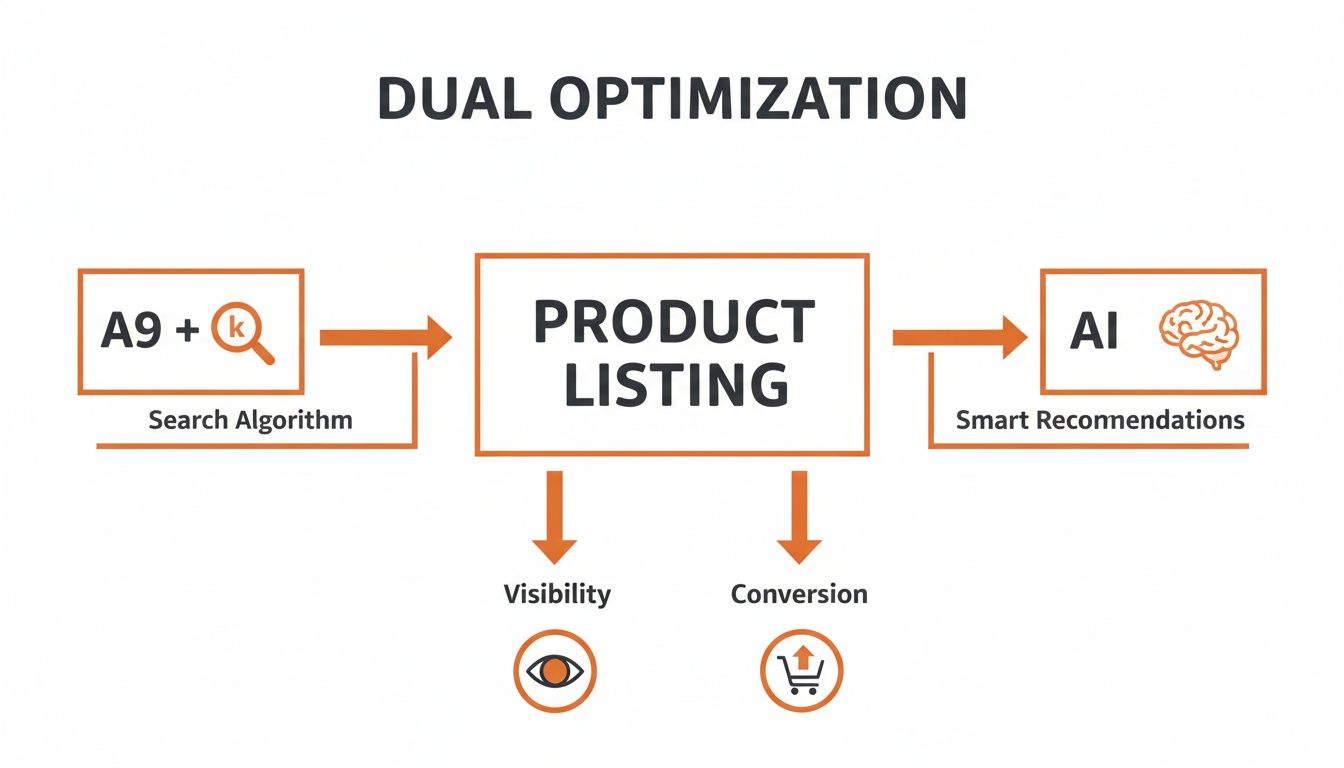
As you can see, a modern product listing has to satisfy both A9's keyword-based system and the AI's context-driven brain to have any chance at maximum visibility.
Creating a Prioritized Action Plan
Once you've found the gaps, you need a plan. But not all content gaps are created equal; some have a far bigger impact on your sales than others.
A data-driven approach means you focus on closing the gaps that address the most frequent and highest-intent shopper questions first. This ensures your content creation efforts are directly tied to commercial outcomes, delivering a measurable return.
For instance, fixing a missing detail about your product's material might be less urgent than adding a whole new section explaining how it solves a common problem for a specific type of user. You can learn more about how to structure your listing in our deep-dive on product keyword optimisation.
The exploding search ecosystem in India's IT landscape highlights just how urgent this is. In tech hubs like Noida and Mumbai, a massive 66% of product discovery now starts on Amazon—not Google. For leading categories like electronics and kitchen appliances, where over 200,000 exporters are fighting for global reach, effective optimisation is non-negotiable. You can discover more about Amazon's top-selling categories and the data behind these trends.
By systematically finding and fixing these AI visibility gaps, you create a powerful, defensible advantage. Your product becomes more discoverable to shoppers ready to buy, your content directly answers their needs, and you turn Amazon’s AI into a predictable engine for growth.
Your Questions on Amazon Search Answered
As Amazon's search landscape evolves, you've got questions. We have straightforward answers. Here’s a no-fluff breakdown of the most common challenges brand managers are facing right now.
How Long Until I See Results from AI Optimisation?
Optimizing for Amazon's new AI is not like flipping a switch. It's a different game than old-school keyword changes. While a targeted keyword update for A9 might show a rank improvement in a few weeks, think of AI optimization as building a reputation with a new, very smart shopping assistant.
You can typically see an initial lift in discoverability for conversational searches within 30-45 days. But the real benefit happens over several months. This is where the results compound as the AI digests your richer content and, more importantly, sees customers responding positively to it.
Should I Prioritize A9 or the New AI?
This is the big one, and the answer is simple: you have to do both. Picking one over the other is a mistake. The A9 algorithm still powers the millions of traditional, keyword-driven searches that fuel your daily sales. You can't ignore it.
But the new AI is your key to reaching a massive, growing group of shoppers with high intent—the ones asking long, conversational questions. These are often the customers who are closer to making a purchase.
The only path forward is a dual-optimization strategy. This means weaving your core, high-volume keywords (for A9) into descriptive, benefit-first sentences that give the AI the clear, contextual answers it needs.
Where Should I Add Content for the AI?
Everywhere. The AI is a voracious reader, and it consumes information from every single field on your product detail page. It's scanning your:
Title: For the big picture and primary benefits.
Bullet Points: To understand key features and what they actually do for the customer.
Product Description: For the deeper story, use cases, and problems your product solves.
A+ Content: To find rich, detailed answers in your text and image modules.
The winning strategy is to thread this conversational, answer-first language throughout your entire listing. A+ Content is a goldmine here, since its flexible layout lets you create specific modules to tackle common questions about features, comparisons, or how to use your product.
Do Reviews and Q&A Really Matter for AI Search?
They matter more than ever. In fact, they’re critical. The AI leans heavily on user-generated content like customer reviews and Q&A to get the "ground truth" on your product. It uses this real-world feedback to verify the claims you make in your own content.
Think about it: if you claim your blender is "whisper quiet," the AI immediately scans your reviews for customers who mention how quiet (or loud) it is. This is the social proof the AI needs to trust your claims. Encouraging detailed reviews and answering every single customer question isn't just good customer service—it's a core part of a successful AI search strategy.
Are you ready to stop guessing and start winning in the new era of Amazon search? Cosmy provides the actionable intelligence you need to diagnose AI visibility gaps, prioritize content fixes, and measure the impact on your organic discovery. Get your free, data-backed audit and turn Amazon's AI into your competitive advantage. Start your analysis at https://cosmy.ai.