Mastering Reviews on Amazon: A Practical Guide

Written by

Cosmy
AI-driven eCommerce Optimization
Forget the buzzwords. On Amazon, reviews are the most direct measure of customer trust. They are the online equivalent of a friend saying, "You need to buy this." This social proof decides if a customer clicks 'Add to Cart' or moves to a competitor's page.
Why Reviews on Amazon Are Your Strongest Sales Tool
Imagine your product page is a physical store. A customer walks in. In the real world, they might ask a friend for advice. Online, they scroll straight to the reviews on amazon.
These customer stories build trust in a way your product description can't. They offer a real, unfiltered look at your product. A healthy number of positive reviews tells shoppers: "This product is a safe purchase, and it delivers on its promises."
The Direct Link Between Reviews and Sales
The connection isn't complicated: more good reviews lead to more sales. It's the simplest formula on Amazon. More trust equals more sales.
This is especially true in competitive markets. For example, India has over 218,000 active sellers. Here, reviews are essential. Products with strong ratings can see their sales increase by up to 30% compared to those with average scores. You can see more data in Shiprocket's 2026 insights.
This effect is even stronger in certain categories.
Electronics: A few bad reviews can sink a product's ranking quickly as shoppers fear buying a faulty item.
Fashion and Home Goods: Customers rely on other people's experiences to understand things like clothing fit, true color, and material quality.
Building Credibility and Standing Out
In a crowded marketplace, reviews help you stand out. When two products have similar features and prices, the one with more positive feedback nearly always wins.
Your review history is your brand's reputation. It’s the proof that gives a shopper the confidence to complete their purchase.
Think of it this way: a product with ten reviews is a small gathering. A product with a thousand reviews is a packed event. Shoppers are drawn to the popular option because it signals reliability. A high number of reviews shows that a product has been bought, used, and approved by many others.
This trust doesn't just create one sale. It leads to repeat business. Every review also provides raw customer feedback, offering ideas for product improvements and marketing. Getting this right is the first step to succeeding on Amazon.
Amazon's A9 search algorithm is more than a simple keyword tool. Think of it as a smart librarian. When a customer asks for something, it doesn't just point to the right section—it recommends the specific item everyone is talking about.
On Amazon, customer reviews are that buzz. They are a powerful signal to the A9 algorithm that your product is not just relevant but also trusted. A steady stream of positive reviews tells A9 your product deserves a high search ranking. A series of bad reviews is a red flag, and the algorithm may push your product down in the search results.
The Key Review Metrics A9 Cares About
A9's analysis is more than just the star rating. It looks at several metrics to get a full picture of your product's performance and customer satisfaction. To improve your ranking, focus on these areas.
Review Quantity: A high number of reviews shows A9 that your product has a sales history. It's been tested by real customers, which gives it credibility that new products lack.
Review Velocity: This is about momentum. Are you getting new reviews regularly? A steady pace shows your product is currently popular, not just a bestseller from last year. This keeps your product relevant in the algorithm's view.
Average Star Rating: This is obvious but critical. A high average rating, especially one consistently above 4.0 stars, is essential for top search placement. It's a direct indicator of quality.
These elements work together to build trust, increase visibility, and drive sales. They are all connected parts of the same system.
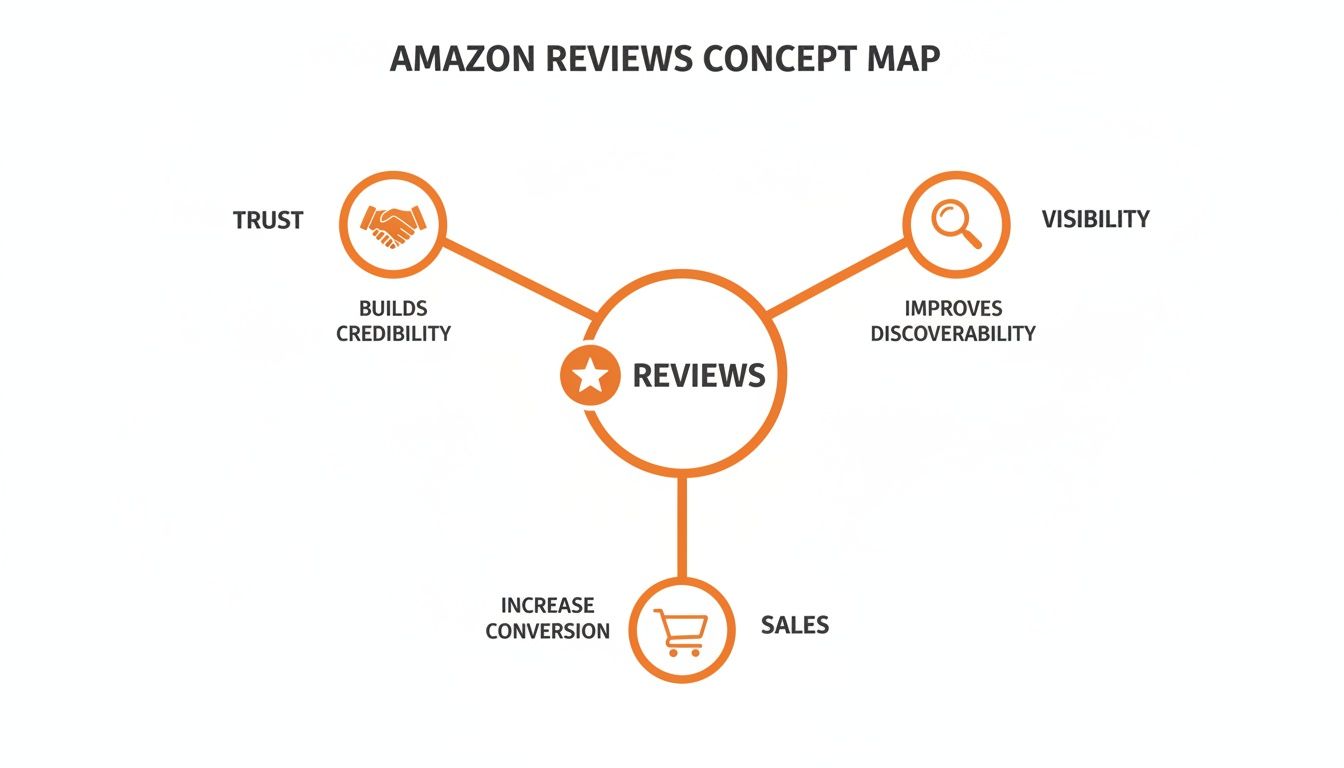
As you can see, reviews are not just a tool for increasing sales; they are a core part of the entire Amazon system.
How Review Content Becomes Your Best SEO Weapon
Here’s a point most sellers miss: the actual text of your reviews is a goldmine for your search ranking. A9 doesn't just count stars; it reads the words your customers use. This is how your listing gets filled with real, long-tail keywords you might not have considered.
For example, let's say you sell a yoga mat. If customers write reviews saying it’s "perfect for hot yoga" and "doesn't get slippery when you sweat," A9 learns to connect your product with those specific needs. Soon, you might start appearing in searches for "best non-slip mat for sweaty yoga," even if you never used those exact words in your listing.
This is how you build relevance for a wide range of customer searches. The more descriptive your reviews, the more keyword information you give the A9 algorithm. This is a fundamental part of any serious SEO for Amazon strategy, turning your customers' own words into a powerful ranking tool.
Understanding how A9 uses reviews is essential for success. To see how this fits into the bigger picture, you should also learn how to optimize Amazon product listings. Ultimately, managing your reviews isn’t just about protecting your reputation—it's about controlling your visibility on the world's largest online marketplace.
On Amazon, trust is the business model. Amazon became a retail giant not just by selling everything, but by creating a system where a customer in one city could trust the opinion of a customer in another.
That trust is what turns a one-time purchase into a loyal customer. When shoppers see real people sharing honest experiences, it gives them the confidence to buy. Without that social proof, your product is just another item among millions.
Why "Verified Purchase" Is Everything
Not all reviews are equal. You’ve seen the small, orange label: "Verified Purchase." That label is very important. It’s Amazon's confirmation that the reviewer actually bought your product on their platform at a normal price.
This simple system helps protect against fake or biased feedback. An unverified review could be from anyone—a competitor, a paid review farm, or someone who got the product for free. While not every unverified review is fake, shoppers are rightly skeptical of them.
A strong collection of 'Verified Purchase' reviews is your best defense against doubt. It shows customers your ratings are earned, not bought. This builds credibility that is hard to fake and essential for long-term success.
How to Spot the Fakes
To protect your brand, you need to know how to spot fake reviews on competitors' listings. Recognizing these signs gives you a clearer view of the market and shows why your own authenticity is so important.
Look for these common patterns:
Vague Praise: Reviews that are enthusiastic but offer no details. For example, "Great product!" or "Amazing!" without explaining why. This often indicates a scripted or low-effort review.
Sudden Influx of Reviews: A new product that gets dozens of 5-star reviews overnight is a major red flag. Real reviews tend to come in slowly; manipulated ones arrive in a flood.
Identical Wording: If you see multiple reviews using the same or very similar phrases, it's a strong sign they were written from a script.
Irrelevant Content: Reviews that complain about shipping or the delivery person have nothing to do with the product itself. This can be a sign of reviewers who are just trying to meet a quota.
Authenticity is critical, especially in large markets. For example, Amazon became India's most trusted brand largely due to its review system. In a market where 70-80% of shoppers read reviews before buying, that trust is invaluable. Data shows products with over 100 genuine reviews and a 4+ star rating win the Buy Box 85% more often. You can find more on this in the TRA Brand Trust Report.
To help brands and buyers, we've broken down the signals that distinguish a real review from a questionable one.
Review Authenticity Signals at a Glance
Signal | What It Indicates | Why It Matters |
|---|---|---|
"Verified Purchase" Badge | The reviewer bought the product on Amazon at a standard price. | This is the most credible type of review, coming from a genuine customer. |
Specific Details & Use Cases | The reviewer used the product and can describe its pros and cons. | This provides useful, real-world information that helps other shoppers. |
Photos or Videos | The reviewer owns the product and is willing to show it. | Visual proof adds a strong layer of authenticity and builds trust. |
Vague or Generic Language | The review lacks substance (e.g., "Love it!"). | This can be a sign of a fake or low-effort review with little value. |
Unnatural Timing or Volume | A sudden rush of reviews appears in a short time. | This is a strong indicator of review manipulation. |
Reviewer's History | The reviewer has a history of leaving thoughtful reviews for different products. | This suggests an experienced and genuine shopper, not a fake account. |
Understanding these signals is the first step. The next is building a review profile that is clearly credible.
Building a Credible Review Profile
A trustworthy review profile is the natural outcome of offering an excellent product and great customer service. Your main goal should be to earn genuine feedback by deserving it.
Honesty and transparency are your best tools. Create products that solve real problems. Describe them accurately in your listings. Provide customer support that makes people want to recommend you. While platforms like Cosmy can audit your listings to find opportunities, the foundation always starts with your brand and product.
When you do this well, genuine, positive reviews will follow. This creates a cycle of trust, visibility, and sales that becomes a true competitive advantage.
Compliant Strategies for Generating More Amazon Reviews
Getting a steady flow of reviews is important, but doing it the wrong way can get your account suspended. One mistake—even an unintentional one—can lead to your reviews being removed or your account being closed. The key is to encourage feedback correctly, turning happy customers into advocates without breaking Amazon's strict rules.
Amazon provides approved tools to do this. These methods are safe and effective when used consistently.

Use Amazon's "Request a Review" Button
The simplest and safest way to ask for a review is the official "Request a Review" button in Seller Central. You can find this on each order between 5 and 30 days after delivery.
When you click it, Amazon sends a standard email asking for both a product review and seller feedback. Because the message comes directly from Amazon using their approved template, it is 100% compliant. You cannot change the wording, which removes the risk of saying something wrong.
While this is a manual task, making it part of your routine is an easy way to get more reviews. Many sellers see a significant increase in reviews just by using this button regularly.
Leverage the Amazon Vine Program
Getting the first few reviews on a new product is often the hardest part. The Amazon Vine program was created to solve this problem. It's an invitation-only program where you give free products to a select group of trusted reviewers called "Vine Voices."
Amazon chooses these reviewers based on their history of writing helpful, detailed feedback. In exchange for the free product, they are expected to leave an honest review.
The main benefit of Vine is its ability to build early social proof. A product with zero reviews is a hard sell, but one with five to ten detailed Vine reviews has immediate credibility, helping to start sales and attract more organic reviews.
Vine reviews are clearly marked with a green "Vine Voice" badge, so shoppers know the context. While there's no guarantee the reviews will be positive, the early, in-depth feedback is invaluable for any new product.
Design Compliant Product Inserts
Product inserts—the small cards inside your packaging—are a great way to connect with customers, but they are also a common area where sellers make mistakes. You can ask for a review, but how you ask is critical.
The language must be neutral. You cannot offer an incentive, gift, or discount in exchange for a review. You also cannot direct unhappy customers to your support team while sending happy ones to leave a review.
Here’s a clear breakdown of what is and isn't allowed:
Compliant vs. Non-Compliant Language for Product Inserts
Tactic | Compliant Example (Do This) | Non-Compliant Example (Do NOT Do This) |
|---|---|---|
The Ask | "Thank you for your purchase! We'd love to hear your feedback. Please consider leaving a review on Amazon to let us know how we did." | "Get a free gift card for leaving a 5-star review!" |
Guidance | Provide a simple QR code that links directly to the product's Amazon review page. | "Having a problem? Contact us first! Love the product? Leave a review!" |
Tone | Neutral and appreciative, focusing on the value of honest feedback for the community. | Pressuring or incentivized, making the customer feel obligated to leave a positive review. |
Following these guidelines is not optional. The goal is to gently remind customers and make it easy for them to share their honest thoughts, not to manipulate the outcome. By using these approved methods, you can build a strong, trustworthy review profile that supports long-term growth.
Turning Negative Reviews into Growth Opportunities

Every brand wants 5-star reviews, but your 1- and 2-star reviews are where you can find real opportunities for improvement. Don't see them as failures. Think of them as free, honest market research.
This feedback is a goldmine. It shows you exactly where your product, packaging, or listing doesn't meet customer expectations. This is where you can stop passively collecting reviews on amazon and start actively using them to improve your business.
From Feedback to Actionable Insights
First, look for patterns. A single angry review might be an outlier. But if five different people complain about the same broken zipper, you've found a trend. That trend is a problem you can solve.
Your job is to sort through the feedback and understand what customers are really saying.
Common themes often include:
Product Flaws: Are customers consistently reporting that a part breaks or the material feels cheap? This is direct feedback for your product development team. For instance, if you sell a blender and multiple reviews say the lid cracks easily, you know exactly what to fix in the next production run.
Shipping & Packaging Issues: If items arrive damaged or the box is hard to open, that's an operational issue you can fix now. For example, if reviews mention that a glass jar arrived broken, you need to improve your protective packaging.
Listing Inaccuracies: The classic "it's smaller than I expected" review is a clear sign that your product photos, dimensions, or description are misleading. This is an easy fix that can prevent future returns.
Unexpected Use Cases: Sometimes, customers reveal a new marketing angle you missed. For instance, you sell a kitchen organizer, but five reviews praise it as "perfect for organizing my craft supplies." You've just discovered a new customer segment for free.
A negative review isn't just a complaint; it’s a roadmap. It highlights a gap between a customer's expectation and their reality. Closing that gap is how you can turn a critic into a future advocate.
Turning Data into Product and Listing Improvements
Once you identify these themes, it's time to act. This analysis should directly inform your entire Amazon strategy, creating a loop of continuous improvement. If you're looking for more ways to use this information, explore our guide on how to effectively gather and use feedback on Amazon.
Let’s use a real-world example. Imagine you sell a backpack, and several reviews mention it's "perfect for small apartments" because it folds completely flat. This is a huge selling point you might have overlooked.
Here’s how you turn that insight into action:
Update Your Listing Copy: Immediately add "space-saving, foldable design" to your bullet points and mention it’s "ideal for compact living or travel."
Enhance A+ Content: Create a new A+ module showing the backpack stored in a small closet or under a bed. Make the benefit visual.
Inform Your Ad Campaigns: Start targeting keywords like "foldable backpack for travel" or "small apartment storage solutions" to attract shoppers with that specific need.
This proactive approach turns reviews from a passive metric into an active tool for growth. By systematically listening to your customers—especially the unhappy ones—you can solve problems before they grow and uncover new opportunities.
Optimising Reviews for Amazon's AI-Powered Future
The next stage of Amazon search is here, and it's powered by generative AI. New tools like Amazon's Rufus are changing how shoppers find products. Instead of simple keyword searches, these AI assistants have conversations with shoppers, pulling information from all over a listing to provide direct answers.
This is a critical shift. Your customer reviews are no longer just for convincing other people to buy. They are now the main data source for the AI that decides which products to recommend. Preparing your reviews on amazon for this new reality is essential for survival.
Teaching the AI What Your Product Is Good For
Think of an AI assistant like a very smart personal shopper. When a customer asks, "Which of these cameras is better for travel vlogging?" the AI doesn't just look at your star rating. It reads the actual text of your reviews to find the real answer.
If your reviews are full of phrases like "the battery lasted all day on my trip" or "incredibly lightweight and easy to pack," you are teaching the AI that your camera is a great choice for travelers. The AI then uses these real-world experiences to make a confident recommendation to the next shopper.
Detailed, descriptive reviews are your most powerful tool for influencing AI recommendations. Each positive review acts as a vote of confidence that trains the AI on your product's specific strengths and uses, making it more likely to be featured in conversational search results.
This changes your review strategy. It's no longer just about increasing sales. It's about building a rich dataset that ensures your products remain visible in a market increasingly driven by AI.
Reviews as the Fuel for Your Ad Performance
This AI ecosystem also has a huge impact on your ad performance. In competitive markets like India’s IT sector, a strong review profile is what turns an expensive ad click into a sale.
For example, well-optimized listings with strong reviews can see conversion rates of 10-15%, far above the platform average. When top keywords can cost ₹50-100+ per click, you need that social proof to justify the ad spend.
Reviews are the foundation that makes your ad budget more effective. They provide the trust a shopper needs to click "buy" after an ad brings them to your page. To learn more, check out our guide on how reviews in the Indian market drive success.
Actionable Strategies for an AI-First World
Preparing for this future means focusing on the quality and content of your reviews, not just the quantity. The goal is to encourage customers to leave detailed feedback that describes your product's key benefits in their own words.
To get ahead, consider using tools for automatic sentiment analysis for reviews. These can turn raw customer feedback into clear, actionable insights. By understanding the language your customers use, you can identify the phrases that are most likely training Amazon’s AI.
This is where a platform like Cosmy is invaluable. Cosmy audits how AI assistants like Rufus see your products, analyzing review sentiment and other signals. It gives you a clear, data-backed report showing you exactly where to focus your efforts to become the top recommendation in your category.
Frequently Asked Questions About Amazon Reviews
Let's address some common questions and myths about reviews with straightforward, practical answers.
How Many Reviews Do I Need to Start Seeing an Impact?
There isn't a magic number, but momentum is key. The first review is a big step, but the first real change in conversion rates usually happens after you have 10-25 reviews.
The real impact often begins around 50 to 100+ reviews. At this point, you have enough social proof to build serious trust. You've also given Amazon's A9 algorithm enough data to see your product as a popular choice, which can improve your search ranking.
The most important metric isn't just your total review count. It's maintaining a steady stream of new, authentic reviews. This consistent "review velocity" signals ongoing relevance to both shoppers and Amazon's algorithm.
Can I Ask Customers to Change a Negative Review?
Absolutely not. This is a firm rule. Directly asking a customer to change or remove a negative review is a serious violation of Amazon's policies and can lead to your account being suspended. The same applies to offering refunds or gifts in exchange for changing feedback.
So, what can you do? Post a public, professional reply on the review. This shows other shoppers you are responsive. Apologize for their bad experience and offer to solve the problem offline. For example: "We're sorry to hear this happened. Please contact our customer support so we can make this right." This shows you care without breaking any rules.
Is the Amazon Vine Program Worth It?
For most brands launching new products, yes. Vine is one of the safest and most effective ways to get those crucial first reviews. Early feedback from trusted "Vine Voices" provides the social proof needed to overcome shopper hesitation.
Be prepared for honest feedback. Vine reviewers are known for their detailed, unbiased reviews, so a 5-star rating is not guaranteed. But even critical feedback is valuable, as it highlights issues you can fix. The cost of fees and free products is often a small price for building that initial credibility.
Can I Delete a Bad Review on My Product?
You can't delete a negative review just because you don't like it. However, you can ask Amazon to remove a review if it clearly violates their community guidelines.
Valid reasons for removal include:
The review contains obscene or harassing language.
It includes personal information like phone numbers.
The feedback is only about shipping, not the product itself.
It’s a one-word review with no context.
If you find a review that fits these criteria, use the "Report" button next to it. Clearly state which guideline it violates. Amazon's team will then review your request.
Ready to turn Amazon's AI into your competitive advantage? Cosmy delivers the insights you need to win in this new environment. Get your free, data-backed audit and see exactly how to optimise your listings for higher visibility and more sales. Start your free audit at https://cosmy.ai