Your Practical Guide to Merch by Amazon for Brand Growth
Written by

Cosmy
AI-driven eCommerce Optimization
What if you could launch a merchandise line for your brand without buying a single t-shirt or shipping a single box? That’s the simple, powerful idea behind Merch by Amazon, the print-on-demand service that lets you sell branded apparel and products with zero upfront cost.
Understanding the Merch by Amazon Model
Think of Merch by Amazon as your brand’s merchandise partner, operating entirely within Amazon's marketplace. You provide the designs, and Amazon handles all the physical work—manufacturing, shipping, and customer service.
It’s a true print-on-demand model, meaning a product is only created after a customer buys it. This setup removes the financial risk of holding unsold inventory.
When an order is placed, Amazon prints your design onto the product using technology like Direct to Garment Printing. Then, they package and ship it directly to the customer. They even manage all customer service and returns. You never have to touch the product.
How the Process Works
You don't need a warehouse or a shipping department. The process is streamlined. All you need are your designs and an understanding of what your audience wants to wear.
Your responsibilities are straightforward:
Uploading Artwork: Submitting your unique, high-resolution design files.
Choosing Products: Selecting which items to sell your design on—t-shirts, hoodies, PopSockets, and more.
Setting Your Price: Deciding the list price for each product.
Writing Descriptions: Crafting clear titles, bullet points, and descriptions that help customers find your products.
Earning Royalties on Your Sales
For every product sold, you earn a royalty. This is a straightforward calculation: your royalty is the list price you set, minus Amazon’s costs.
Those costs cover the blank product, printing, packaging, shipping, and customer support.
A higher list price means a bigger royalty per sale, but it could also deter buyers. Finding the right balance between price and sales volume is key to maximizing your total income. For example, a t-shirt priced at £17.99 might earn you a £3.50 royalty. Raising the price to £19.99 could increase the royalty to £5.00, but you need to assess if customers will still buy it at the higher price.
This simple, zero-risk model makes Merch by Amazon one of the best ways for brands and creators to test new design ideas, connect with fans, and open a new revenue stream without any upfront investment.
Weighing the Pros and Cons for Your Brand
Is Merch by Amazon the right move for your brand? It’s a trade-off. You exchange some control and profit for massive reach and zero financial risk. Understanding this is critical before you start.
On one side, you get an incredibly easy entry into selling physical merchandise. The logistical problems and financial risks that often stop new merchandise ventures are completely removed.
The biggest benefit is the zero upfront inventory cost. You never pay for stock that might not sell. This transforms the platform from a sales channel into a risk-free lab for testing hundreds of design ideas. You only pay for a product after a customer has already bought it.
Then there's the audience. Instead of spending months building an audience from scratch, you're placing your products directly in the world's largest online store. Millions of people are already there, actively searching for products.
The Trade-Offs to Consider
But that convenience comes at a price. Because the marketplace is so competitive, profit margins are almost always lower than if you sold directly from your own website. Amazon does all the heavy lifting—printing, packing, shipping, returns—and their fee takes a significant portion of the sale price. What you receive is a royalty.
You also give up the customer relationship. This is a significant point. You don't get customer emails, you can't create a unique unboxing experience with custom packaging, and you have no direct contact with the people buying your designs. Building a loyal fan base is much harder when Amazon is the intermediary.
Finally, you operate under Amazon's rules. Their platform has strict terms you must follow. Adherence to their content policies and intellectual property guidelines is mandatory. One mistake, intentional or not, can lead to your listings being removed or, in the worst case, your account being suspended. That means a revenue stream vanishing overnight.
The decision is whether to prioritize low-risk, high-reach opportunities over higher profit margins and direct customer control. For many, Merch by Amazon is an excellent starting point or an additional sales channel, but it may not replace a dedicated e-commerce store.
To make the decision clearer, it helps to see the benefits and limitations laid out side-by-side.
Merch by Amazon: Weighing the Opportunities and Limitations
This table breaks down the strategic exchange you're making when you join the Merch by Amazon platform. It’s a balanced look at the key advantages you gain versus the control and margin you give up.
Benefit (Pro) | Limitation (Con) |
|---|---|
No Inventory Costs: You never have to pay for products upfront, eliminating financial risk. | Lower Profit Margins: Royalties are smaller than what you would earn from direct-to-consumer sales. |
Access to Amazon's Customers: Your products are listed on one of the largest e-commerce sites. | No Customer Relationship: You cannot collect emails or directly interact with your buyers. |
Logistics Handled for You: Amazon takes care of all printing, shipping, returns, and customer service. | Limited Brand Control: You have no say over packaging, shipping times, or the end-customer experience. |
Easy to Scale and Test: You can upload many designs to see what sells without any initial investment. | Strict Policy Adherence: Your account is subject to Amazon's rules, and violations can be costly. |
Ultimately, there's no single right answer. For brands looking to test the waters, validate product ideas, or add a low-effort revenue stream, the pros are compelling. For brands focused on maximizing profit and building a strong community, the limitations might be a deal-breaker.
Creating Designs That Actually Sell on Amazon
A great t-shirt idea is worthless if the final design doesn't convince a browser to become a buyer. On Merch by Amazon, execution is everything. Your artwork must be technically correct and designed to sell within Amazon’s competitive environment.
First, let's cover the technical requirements. These are rules, not suggestions. If you ignore them, Amazon's printers will produce blurry, poorly colored merchandise that leads to bad reviews and no repeat business.
Resolution: Your final artwork must be a 300 DPI (dots per inch) file. This ensures every line is crisp and sharp, not pixelated.
Color Profile: Save all your designs in the sRGB color space. If you use a different profile, the vibrant red on your screen might print as a dull orange.
Transparency: Ensure your design’s background is transparent. A hidden white background will print as a large white box on any colored t-shirt.
Designing to Win the Click
Beyond technical specs, your design must grab attention among countless other small images. A design that looks great on a large monitor can become an unreadable smudge on a mobile phone's search results page. You have to think like a customer scrolling quickly.
A successful Merch by Amazon t-shirt design, for example, almost always uses bold lines, high-contrast colors, and a single, clear focal point. Intricate, subtle details are often lost. The core message or image has to be understood in less than a second. On the other hand, a design for a phone case might need a different approach, like a repeating pattern that looks good in a small, vertical format.
The most effective designs come from understanding both the product and the platform. You are not just creating art; you are creating a product image that has to win a click against hundreds of others.
Researching trends is important, but this doesn't mean you should copy. Your job is to analyze why certain styles are selling. Are customers drawn to vintage fonts, minimalist line art, or bold, humorous text? Identify the underlying trend, then create your own unique version. This is how you build a distinct look that helps customers recognize your brand and return for more.
For a deeper dive into the platform, check out our complete guide on how to succeed with print-on-demand on Amazon.
How to Master Amazon SEO for Your Listings
If you’re still stuffing your Amazon listings with keywords, you’re using an outdated strategy. The rise of AI in Amazon's search has changed the game. Your optimization strategy now needs to appeal to the AI systems that guide shoppers.
Think of your product listing—the title, brand, and bullet points—as the information you’re feeding directly to Amazon’s AI. The clearer and more helpful that information is, the better the AI can understand who your product is for and when to show it. It's no longer just about matching keywords; it's about providing answers.
Writing for People and Search Engines
The core of modern Amazon SEO is simple: write for your customer first. When you create clear, helpful, and natural-sounding product descriptions, you give Amazon's AI the exact data it needs to connect your merchandise with the right shoppers.
Instead of just listing features, use your bullet points to answer questions a real person would ask. For example: What occasion is this shirt for? Who would love this as a gift? What makes the design special? This conversational approach is more effective than a robotic list of attributes.
To really dig into this, you can explore our detailed guide on improving your SEO on Amazon.
Transforming Your Product Listings
Let's look at a concrete example of how to put this into practice. Many sellers still use old-school, keyword-stuffed titles that are hard to read and unappealing to customers.
Before (Keyword-Stuffed):
Funny Fishing T-Shirt for Men Dad Grandpa Bass Fishing Gift Humour Graphic Tee
This title is a jumble of search terms. It feels generic and spammy, and it doesn't create a real connection with the shopper.
Now, let’s rewrite it with a customer-first, AI-friendly approach. We’ll make it readable and descriptive while still naturally including important terms.
After (Optimized for People and AI):
Brand Name: Reel Life Apparel
Title: "I'd Rather Be Fishing" Funny Graphic Tee for Men
Bullet Point 1: Perfect Gift for Dad or Grandpa - This humorous bass fishing t-shirt is a great choice for a fisherman's birthday, Christmas, or Father's Day.
Bullet Point 2: Unique & Relatable Design - Features a classic, witty "I'd Rather Be Fishing" slogan that fellow anglers will instantly appreciate.
The "after" version is not just easier to read; it provides much richer context for Amazon’s AI. It directly answers questions like, "Is this a good gift?" and "What makes the design special?" This is the kind of helpful information that Amazon’s search system is designed to reward.
The takeaway is straightforward. When you focus on creating a better experience for your human customers, you are simultaneously optimizing your listings for modern AI-powered search. Provide clear answers, use natural language, and let your helpful content guide the search algorithm to your products.
Advanced Strategies to Scale Your Merch Business
Once you have some sales coming in, it’s time to shift your thinking. You're no longer just uploading designs; you're building a scalable business. This means treating your Merch account like a portfolio of assets, not just a random collection of t-shirts. It requires a data-driven approach to what you sell, when you sell it, and how you price it.
Scaling effectively starts with diversifying your products. Don't just sell the same black t-shirt all year. Anticipate demand by looking at your sales data and seasonal trends. For example, push cozy hoodies and sweatshirts hard in the last three months of the year for the holiday season, then switch to lightweight t-shirts and tank tops as summer approaches. This ensures you always have something relevant for buyers at the right time.
Strategic Pricing for Maximum Profitability
A one-price-fits-all strategy limits your earnings. You need to be smarter. A tiered pricing model that reflects each design's market potential is more effective. For instance, a highly specific design for a passionate niche—like a "Vintage Tractor Restoration" t-shirt—can be sold at a higher price. Those buyers are less sensitive to a few extra pounds.
On the other hand, a shirt based on a short-lived internet meme needs competitive pricing to capture as many sales as possible before the trend fades.
Top sellers often use a tiered approach to increase their overall profit margins. You can adapt these three common markup tiers for your Merch by Amazon business:
Premium Niche Designs: Can often support a 40-60% markup over the base cost.
Trending/Seasonal Designs: Aim for a 25-35% markup to balance sales volume and profit.
Broad Evergreen Designs: Perform best with a lower 15-25% markup to attract mass-market sales.
To see how these pricing strategies perform in the real world, you can dig deeper into the data on Amazon Merch on Demand.
A Roadmap for Navigating Merch Tiers
Your ability to scale is directly linked to the Merch by Amazon tier system, which controls how many designs you can upload. Moving from Tier 10 to Tier 100, then to 1,000 and beyond, is your primary path to growth. Amazon’s system is simple: it rewards sellers who demonstrate consistent quality and, most importantly, sales.
Your goal isn't just to sell products; it's to sell enough products to prove to Amazon that you deserve more "shelf space." Each sale is a vote of confidence that helps you unlock higher tiers and expand your capacity.
This is where optimizing your listings becomes essential. It drives the sales that fuel your tier progression.
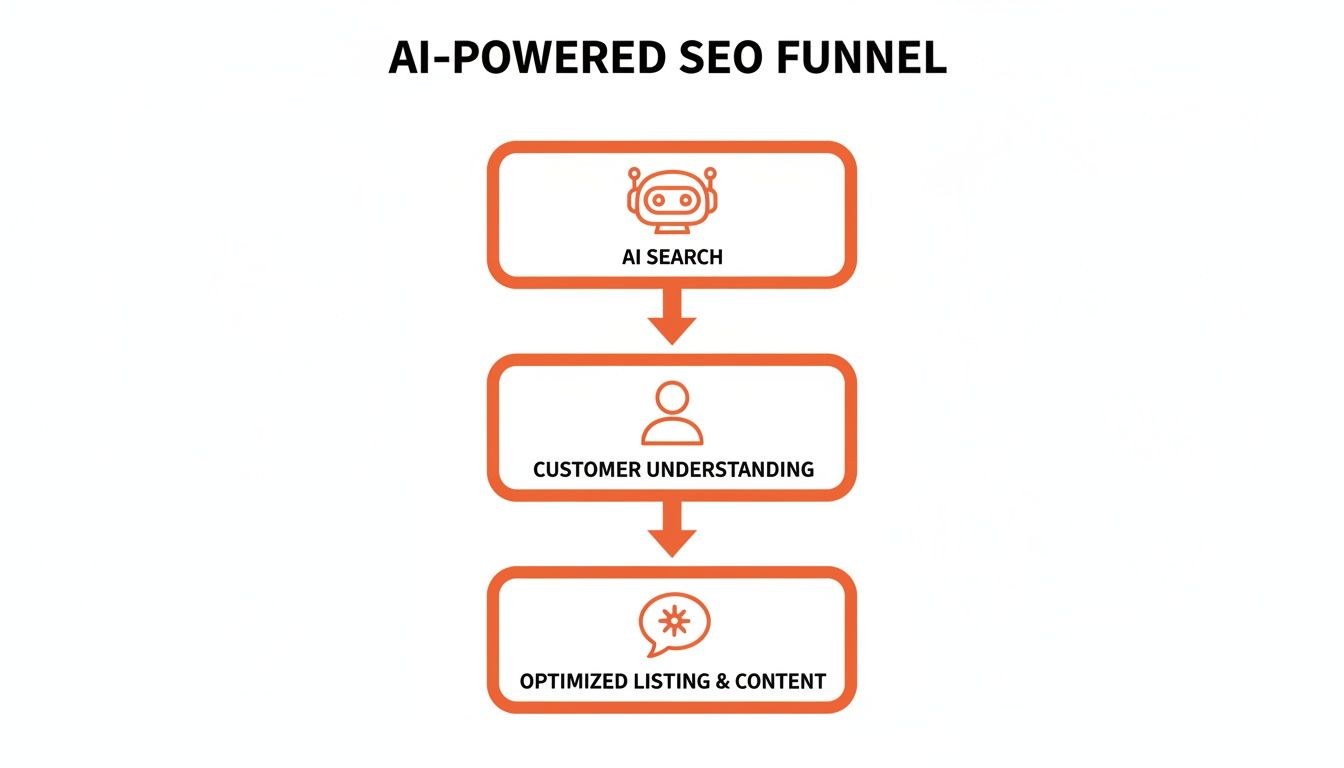
The key insight is that every well-optimized listing helps teach Amazon's AI how and when to show your products to customers. More sales provide more proof of demand.
So, forget about rushing to fill your slots with mediocre designs just to feel productive. Focus on generating sales on the products you already have live. This is the single most reliable way to get promoted to a higher tier and truly scale your business. Quality over quantity is the core strategy for success on Merch.
How to Stay Safe: Navigating Copyright and Protecting Your Account

Nothing will shut down your Merch by Amazon business faster than an account suspension. The quickest way to get suspended is by ignoring intellectual property (IP) rules. This isn't about becoming a lawyer; it's about being careful and diligent.
You just need to understand two main concepts:
Copyright: This protects a specific piece of art, like a drawing of a famous cartoon character or the exact likeness of a movie superhero. Using it without a license is a quick way to receive a takedown notice.
Trademark: This protects what identifies a brand, such as logos, brand names, or even iconic taglines like "Just Do It." A funny phrase you saw on a bumper sticker might seem harmless, but if it’s trademarked, it’s off-limits.
The single biggest mistake new sellers make is assuming that if a quote or phrase is popular, it's okay to use. Always assume it’s protected until you have confirmed it is not.
A Quick Checklist for Due Diligence
Before uploading a new design, run it through this basic check. It takes only a few minutes and can save you from major problems.
Use a free database like the US Trademark Electronic Search System (TESS) to search for any text or phrases in your design. This simple step is your first line of defense.
To further safeguard your brand, you should enroll in Amazon Brand Registry. This gives you tools to report infringements and control your brand’s presence on the platform.
Beyond IP, Amazon has its own content policies you must follow. For example, don't put a design with violent or adult themes on a youth-sized T-shirt. The system will detect it, and it will count as a strike against your account's health. We dive deeper into this in our full guide to Amazon's Brand Registry.
Building a lasting business on Merch by Amazon means playing by the rules. It requires some caution, but that's what keeps your account safe and your royalties flowing.
Let's clear the air. When you’re getting started with Merch by Amazon, a few questions always pop up. Here are the straight-up answers you need to get moving, without the fluff.
How Much Can You Realistically Earn?
Your earnings can vary widely. It all comes down to your design quality, the niches you target, and how consistently you work. A single t-shirt royalty could be anything from a couple of pounds to over ten, depending on the price you set.
Don't expect to get rich overnight. New sellers often make very little at first. The real money comes from treating this like a business, not a hobby. Established sellers with large, well-optimized portfolios can earn a significant monthly income, but they got there by consistently uploading quality designs, researching what sells, and optimizing their listings.
What Is the Merch by Amazon Tier System?
Think of the tier system as Amazon's way of managing its platform and encouraging quality. Every new account starts at Tier 10, which means you can have 10 designs live on the marketplace at one time.
To "tier up" to the next level (Tier 25, 100, 500, and so on), you need to prove your designs sell. The general rule is you have to sell a number of products equal to your current tier. So, to get from Tier 10 to Tier 25, you need to sell at least 10 items.
Your account also has to stay in good standing, with no policy violations. Amazon designed this system to reward sellers who create products that customers want to buy. It’s their way of filtering for quality over quantity.
Can I Use AI to Create My Designs?
Yes, you can use AI art generators, but you have to be smart about it. Amazon’s policy is clear: you must disclose if your artwork was made with AI tools, and you are 100% responsible for the final design.
This is the critical part. You must ensure that what the AI generates doesn't infringe on anyone's copyright or trademark. AI tools can sometimes create images that look very similar to protected works. You need to carefully check—and often modify—the output before you upload.
Using AI for brainstorming or creating basic elements is a great strategy. Just never assume an image is safe to sell just because an AI made it.
Ready to stop guessing what Amazon's AI wants to see? Cosmy audits your product listings against real-time signals from Amazon's search environment, giving you a clear, data-backed plan to improve visibility and increase sales. Get started with a free audit and see what you're missing at https://cosmy.ai.