A Practical Guide to Marketing for Ecommerce
Written by

Cosmy
AI-driven eCommerce Optimization
Effective marketing for ecommerce isn’t just a checklist—it’s a system built on three key jobs: getting new customers (acquisition), convincing them to buy (conversion), and giving them a reason to come back (retention). When these three parts work together, they create a powerful growth engine for your online store.
Your Blueprint for Ecommerce Marketing Success

Many brands treat marketing as a series of separate tasks—running ads, posting on social media, sending a few emails. This disconnected approach often leads to wasted money and missed chances. A smarter way is to see your marketing strategy as a single, connected system.
Think of it like a flywheel. Every bit of effort in one area adds momentum to the others. For example, a great customer experience (retention) leads to positive reviews, which helps attract new customers (acquisition). This creates a cycle of growth that is both sustainable and more affordable.
The Three Pillars of Ecommerce Growth
A solid ecommerce marketing plan focuses on mastering three fundamental areas that work together.
Acquisition: This is how you bring new, interested shoppers to your online store. It includes activities like paid advertising, search engine optimization (SEO), and selling on marketplaces.
Conversion: Once people arrive on your site, the goal is to turn that visit into a sale. This involves everything from improving your product pages to writing clear descriptions and making the checkout process easy.
Retention: This is where you focus on building relationships with existing customers to encourage repeat business. Key methods include email marketing, loyalty programs, and excellent customer service.
When you focus on how these three areas support each other, you build a resilient business that isn't just propped up by expensive ads. You create a brand that customers trust and choose to buy from.
Why an Integrated Approach Matters Now
This connected strategy is more important than ever. Marketplaces like Amazon now use advanced AI to recommend products. These systems don't just look for keywords; they analyze your brand's entire presence, from the quality of your product details to the tone of your customer reviews.
A holistic approach ensures you’re sending all the right signals. It shows that your brand is reliable, your products deliver on their promises, and your customers are happy. This makes it easier for both people and AI assistants to see the value you offer. To get a full picture of how this works, check out this guide on building A Modern Ecommerce Content Marketing Strategy.
This guide will give you a straightforward framework for each of these pillars. You’ll learn actionable steps to build a marketing machine that doesn’t just survive but thrives in the competitive world of online retail.
Mastering Customer Acquisition in a Crowded Market

Attracting new customers is essential for any online business. It's the first step in building momentum, but in today's crowded market, you can't afford to waste money on tactics that don't work. Effective acquisition is about finding the right people, at the right time, with a message that resonates.
This isn't about hoping people stumble upon your brand. It requires a deliberate plan that combines paid advertising, search engine optimization (SEO), and a strong presence on major marketplaces like Amazon. Each of these channels plays a different but equally important role in your overall marketing for ecommerce strategy.
Finding High-Intent Shoppers with SEO
Search engine optimization is the process of making your products appear when someone searches for them on Google or Amazon. This isn't about tricking the system. It’s about understanding what your customers are actually typing into the search bar. Many brands make the mistake of targeting broad, competitive keywords like "running shoes."
A smarter approach is to focus on long-tail keywords. These are longer, more specific phrases that shoppers use when they are close to making a purchase. For example, a search for "best waterproof trail running shoes for wide feet" indicates a buyer who knows exactly what they want and is ready to buy.
Optimizing for these specific phrases connects you directly with customers who have a clear and immediate need. This not only increases your chances of making a sale but also reduces your reliance on expensive ads for general, high-traffic terms.
This level of detail is becoming crucial as AI assistants like Amazon's Rufus change how people discover products. These AI systems are designed to understand and answer complex shopper questions by analyzing detailed, helpful content. A well-optimized product page that directly addresses specific needs is far more likely to be recommended.
Using Paid Ads to Accelerate Growth
While SEO is a long-term investment, paid advertising provides immediate visibility. Platforms like Google Ads and Amazon Ads allow you to place your products directly in front of potential customers who are actively searching for what you sell.
Think of it as renting a billboard on a very busy digital highway. The key is to make sure your ads are targeted and relevant to the search. Showing an ad for hiking boots to someone searching for high heels wastes your money and creates a poor experience for the shopper.
Here are a few practical tips for your paid campaigns:
Start with a small, defined budget to test what works before increasing your spending.
Use negative keywords to prevent your ads from showing up for irrelevant searches. For example, if you sell premium leather shoes, you might add "cheap" or "faux" as negative keywords. This simple step can save you a significant amount of money.
Direct ad clicks to a specific product page, not your homepage. Make the path to purchase as short and simple as possible.
For anyone selling on Amazon, a smart paid strategy is essential for gaining initial sales and visibility.
Winning on Major Marketplaces
For many brands, marketplaces are the primary way to acquire customers. Selling on platforms like Amazon gives you direct access to a huge audience of buyers who are ready to spend. The challenge is that you're competing with thousands of other sellers.
Success on these platforms requires a specific strategy that combines SEO and advertising, tailored to the marketplace's rules. The global opportunity is huge, especially in fast-growing markets.
For example, e-commerce in India is expanding rapidly, with a projected 14.1% compound annual growth rate from 2023 to 2027. With 78% of retail site traffic in the region coming from mobile phones, a mobile-first strategy is essential. This means prioritizing mobile-friendly images and content that can capture impulse buys from a large, phone-centric audience.
How to Turn Clicks Into Customers

Getting traffic to your site is a great start, but it’s only half the battle. The real work begins when a potential customer lands on your product page. This is where you need to turn their interest into a sale.
Think of your product page as your most important salesperson—one that works 24/7.
This process is called conversion rate optimization (CRO). It involves making small, deliberate improvements to your product listings to convince shoppers to click the "Add to Cart" button. Every element, from the main image to the bullet points, plays a role in this decision.
Good conversion optimization is also good AI optimization. Modern shopping assistants on platforms like Amazon don’t just scan for keywords. They analyze your content to determine if your product is a good solution for a customer's problem. A page that clearly explains benefits and answers common questions is far more likely to be recommended by these AI systems.
Writing Descriptions That Actually Sell
Your product description has one job: to answer every question a customer might have. Too many brands fill this space with generic marketing language or technical jargon. This is a missed opportunity to build trust and show what your product can do.
You need to understand your customer's perspective. What are their biggest frustrations? What problems are they trying to solve? Your description should speak directly to those issues and present your product as the solution.
For instance, don't just say your blender has a "high-torque motor." Explain what that means for the customer: "It pulverizes ice and frozen fruit in seconds, giving you perfectly smooth smoothies every time, with no grainy bits left behind." This focus on real-world benefits makes the value of your product instantly clear.
The Power of High-Quality Visuals
Online, your customers can’t touch or test your product. Your images and videos must do all the work. Low-quality or unhelpful photos are one of the fastest ways to lose a sale.
Your visuals need to show the product from every angle, but more importantly, they need to show it in use. You need a mix of image types:
Studio Shots: Crisp, high-resolution photos of the product against a clean, white background.
Lifestyle Images: Photos showing a real person using the product in a real-world setting. This helps customers visualize themselves using it.
Infographics: Simple graphics that highlight key features, dimensions, or benefits in an easy-to-scan format.
Comparison Shots: Images that place your product next to a common object (like a phone or a coffee mug) to give an immediate sense of its scale.
A strong set of visuals does more than show what your product looks like; it helps the customer imagine it in their own life. That connection is often the tipping point that turns a browser into a buyer.
Crafting Bullet Points That Highlight Benefits
The bullet points at the top of a product page are valuable. Shoppers scan these first for a quick summary of why they should buy your product. The biggest mistake brands make here is listing features instead of explaining the benefits those features provide.
This shift is small but has a huge impact. Let's look at how to move from feature-based copy to benefit-driven content.
Key Conversion Optimisation Checklist for Product Pages
This table shows the difference between a weak product page and one built to convert. The optimized examples focus on solving problems and communicating value, which is exactly what modern search systems look for.
Element | Unoptimised Example (What to Avoid) | Optimised Example (What to Do) | Impact on AI Search |
|---|---|---|---|
Title | "Water Bottle 32oz Stainless Steel" | "Leak-Proof Insulated Water Bottle | Keeps Drinks Cold 24 Hrs for Gym & Hiking" | Provides context and use cases for better search matching. |
Main Image | A single, low-resolution studio shot. | A high-resolution gallery with 360° views, lifestyle shots, and an infographic. | More visual data helps AI understand features and applications. |
Bullet Point 1 | "Made with stainless steel." | "Resists Rust & Stains: Stays looking new for years, even with daily dishwasher use." | Connects a material (feature) to a long-term value (benefit). |
Bullet Point 2 | "Has a 5,000 mAh battery." | "All-Day Battery Life: Go a full day of heavy use without worrying about finding a charger." | Translates a technical spec into a real-world solution. |
Description | A single block of text full of jargon. | Short, scannable paragraphs with bolded headings that address customer questions. | Structured, benefit-focused text is easier for AI to understand. |
By focusing on how your product improves the customer's life, you create a much more compelling reason to buy.
Building Loyalty and Lifetime Value Through Retention
It costs significantly more to get a new customer than to keep an existing one. So why do many brands focus their entire budget on acquisition? Real, sustainable growth comes from turning a one-time purchaser into a loyal, repeat customer.
This is retention, and it's the foundation of a lasting brand. It’s about creating a positive experience that begins the moment an order is confirmed and continues long after. By showing customers you care beyond the first transaction, you create a powerful loop where happy people not only buy again but also recommend you to others.
Moving Beyond the First Sale
The period right after a purchase is a golden opportunity to build a relationship. A generic "thank you" email is a missed chance. Instead, create a thoughtful post-purchase email series that adds value and keeps your brand top of mind.
Imagine someone just bought a high-end coffee machine from you. A well-planned email series could look like this:
Day 1: An email with a short video tutorial on setting up the machine and brewing the perfect first cup.
Day 4: A follow-up with simple tips for cleaning and maintenance to keep it running well.
Day 10: A message offering an exclusive discount on your premium coffee beans, timed for when they might need a refill.
This automated sequence transforms a one-time sale into a helpful, ongoing conversation. You're showing you're invested in their satisfaction, making them more likely to return.
Creating Stickiness with Subscriptions and Loyalty
Subscriptions are another excellent tool for building predictable, recurring revenue. When you offer essentials like coffee, vitamins, or skincare on a subscription, you make it effortless for the customer to buy again. The key is to offer real value in return for their commitment, such as a small discount or early access to new products.
Loyalty programs work on a similar principle. They reward customers for sticking with you by offering points, exclusive perks, or special status.
A great loyalty program makes customers feel like insiders. It’s a way of recognizing their value to your brand and giving them a clear reason to choose you over a competitor next time.
A Global Look at Customer Engagement
As you build these strategies, remember that customer behavior varies across the world. Tech-forward markets like Japan and South Korea, for instance, offer unique opportunities. Their e-commerce sectors are dominated by mobile and social commerce, where an active presence can boost sales by as much as 32%.
In these markets, over half of all online retail is expected to happen on a phone by 2025. This makes a flawless mobile experience crucial for keeping customers. Building true loyalty requires blending the right tools with a real understanding of local culture.
How to Adapt Your Strategy for AI Search
The way customers discover products is changing fast. For years, the strategy was simple: find the right keywords and add them to your listings. But with the rise of AI-powered shopping assistants, that approach is becoming outdated.
Think of old SEO like leaving a trail of breadcrumbs (keywords) for a search engine. Optimizing for today's AI search is different. It’s more like having a detailed conversation with an expert personal shopper.
This AI assistant doesn't just match words; it understands context, problems, and human needs. In this new era of marketing for ecommerce, your job is to give the AI all the information it needs to confidently recommend your product as the perfect solution.
Shifting from Keywords to Conversations
The biggest change is moving from isolated keywords to answering complete customer questions. Shoppers aren't just typing "running shoes" anymore. They’re asking conversational questions like, "What are the best waterproof running shoes for someone with flat feet?"
An AI assistant will scan thousands of product pages to find the most relevant answer. It’s not just looking for the word "waterproof." It's looking for pages that explain why they're waterproof, what materials are used, and how that benefits a runner.
To adapt, structure your content around providing clear, direct answers. Think of the top five questions a customer would ask about your product in a store, and make sure your product page answers them directly.
How do I use this?
What problem does this solve?
How is this different from other options?
What is it made of, and why does that matter?
Who is this product perfect for?
Your product listing is no longer just a static page. It's a source of information that prepares the AI shopping assistant to advocate for your product. When the AI has all the answers, it can recommend you with confidence.
Structuring Content for AI Understanding
AI systems need well-organized information. They work best with clear structure and context. A long, messy paragraph stuffed with keywords is confusing for both humans and AI.
Instead, organize your content with clear headings and benefit-driven bullet points. This breaks information into digestible chunks that an AI can easily process. For example, instead of a bullet point that says "Durable materials," rewrite it to say, "Built for Adventure: Made from tear-resistant ballistic nylon, so you can take it on the toughest trails without worry."
The second version gives the AI rich context. It understands the material (ballistic nylon), the benefit (tear-resistant), and the ideal use case (tough trails). This is the kind of structured data it needs to match your product to a specific shopper's query.
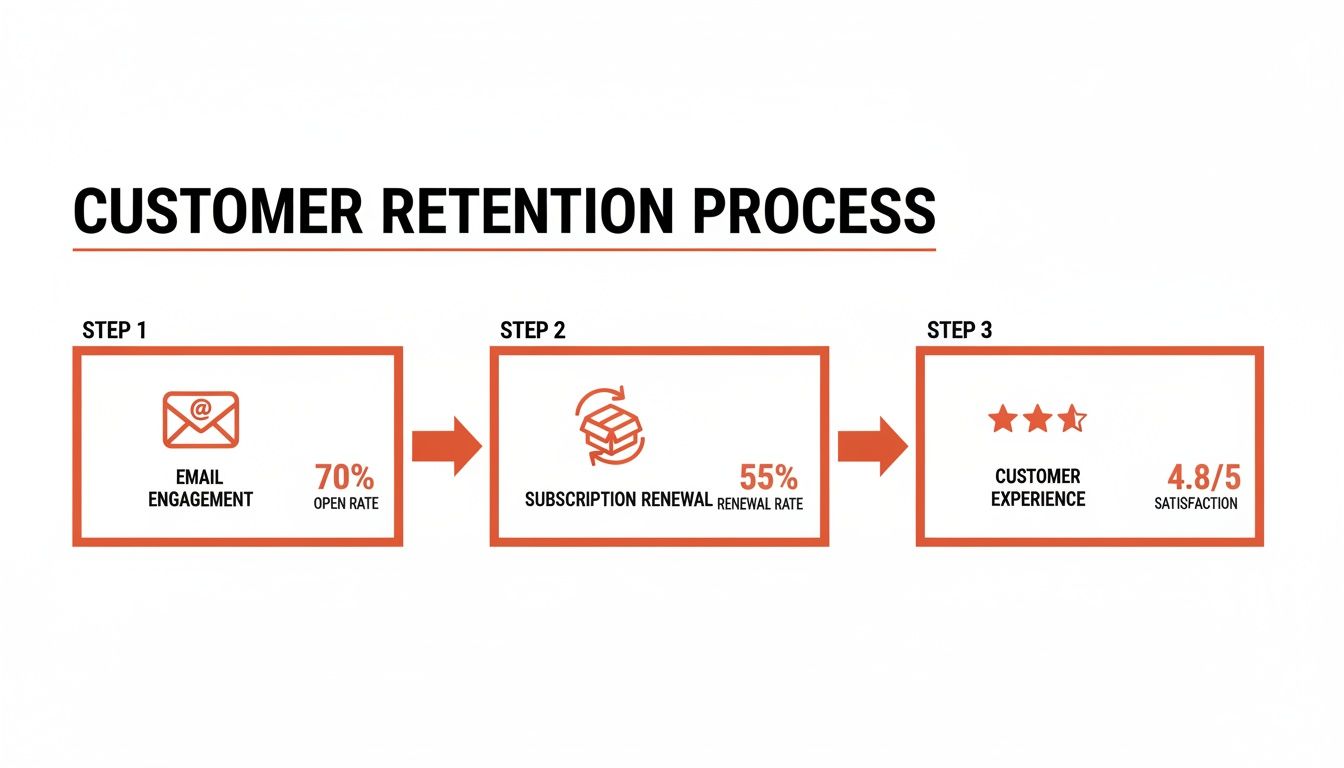
This shows how different marketing efforts, like email and subscriptions, contribute to a better customer experience. A great customer experience is a powerful positive signal that AI recommendation engines notice.
Auditing and Prioritising Your Content Fixes
Adapting to AI doesn't mean you have to rewrite every product page overnight. The key is to start with a systematic audit to find your biggest opportunities.
Begin by identifying your most important products—either your top sellers or those with the highest growth potential. Then, analyze their content from the perspective of an AI assistant. Are you answering the most common questions? Is the language focused on benefits? Is the information structured clearly?
Tools like Cosmy are built for this purpose. They can analyze your product listings on Amazon to find these visibility gaps and show you what needs to be fixed to align with how modern AI search works. This methodical approach ensures your efforts are focused where they'll have the biggest impact.
To stay ahead, it's useful to explore new AI SEO strategies that go beyond the basics. For a deeper look at how this all fits together, check out our guide on the broader role of AI in SEO for today's brands.
Your Ecommerce Marketing Questions Answered
Putting a complete marketing plan into action always brings up practical questions. This final section addresses common hurdles, from budgeting to picking the right tools, to help you move forward with confidence.
How Much Should I Spend on Ecommerce Marketing?
There’s no single right answer, but a good starting point for most growing brands is to allocate 7% to 12% of your total revenue for marketing. This is a flexible guideline, not a rigid rule.
For example, a new brand will likely need to invest more upfront—perhaps 15-20%—to build initial awareness. An established brand with strong organic traffic might find that 5-8% is sufficient to maintain growth.
The best approach is to treat your marketing budget as a dynamic investment. Start with a baseline, track your returns carefully, and be ready to shift funds to the channels that deliver the best results.
What Are the Essential Marketing Tools for an Ecommerce Business?
You don't need dozens of expensive tools to get started. It's smarter to focus on a few key platforms that cover the core areas: acquisition, conversion, and retention.
A simple, effective toolkit would include:
Analytics Platform: Google Analytics is the standard for tracking website traffic, user behavior, and sales. It’s essential for understanding what’s working.
Email Marketing Service: A platform like Mailchimp or Klaviyo is your direct line to customers. It lets you automate welcome emails, announce promotions, and build relationships that drive repeat purchases.
SEO and Content Tools: For brands on Amazon, a specialized tool like Cosmy is becoming crucial. It helps you understand how Amazon's AI search sees your product listings and shows you how to improve your content for better visibility.
How Do I Measure Marketing Success?
Measuring success means looking beyond simple metrics like website traffic. You need to focus on data that directly connects marketing efforts to your business goals.
Start by tracking these key performance indicators (KPIs):
Customer Acquisition Cost (CAC): How much does it cost, on average, to gain one new customer?
Conversion Rate: What percentage of website visitors make a purchase?
Customer Lifetime Value (LTV): How much revenue does the average customer generate over their entire relationship with your business?
Return on Ad Spend (ROAS): For every dollar you spend on advertising, how much revenue do you get back?
Tracking these metrics gives you a clear picture of your performance. They tell you not just if your marketing is working, but how well it's working, allowing you to make smarter decisions and build a profitable ecommerce business.
Ready to stop guessing and start optimising your Amazon content for AI search? Cosmy gives you the actionable insights you need to improve visibility and drive sales. Get your free, data-backed content audit today.