Kindle Direct Publishing Royalty Calculator: A Practical Guide to Your Earnings
Written by

Cosmy
AI-driven eCommerce Optimization
Figuring out your Kindle Direct Publishing royalties comes down to two options: the 35% plan or the 70% plan. Your choice isn't just about picking the higher number; it’s a decision based on your book's price, its file size, and where you're selling it. This choice directly shapes how much you earn from each sale.
Understanding Your KDP Royalty Options
Before using a calculator, you need to understand the choice every author on Amazon KDP makes. It’s not as simple as just picking the bigger percentage. Each plan has its own set of rules that affect your book's profitability.
Think of this decision as the foundation for your income. Your choice between the 35% and 70% royalty plans will guide your pricing strategy and, ultimately, your earnings. Let's review what each one requires so you can see where your book fits.
The 70% Royalty Plan
Most authors aim for this plan because it offers a much larger share of the sale. To qualify, your eBook must meet a few specific requirements.
Pricing Window: Your list price must be between $2.99 and $9.99 in the US, or ₹225 and ₹750 in India.
Territory Restrictions: This rate is available in major markets like the US, UK, Canada, Australia, and India.
Delivery Costs: This is the main catch. With the 70% plan, you pay a small fee on every sale to cover the cost of sending the digital file to a reader's device. The fee is based on your book's file size.
Public Domain: Your book cannot be in the public domain.
The 70% plan is designed for competitively priced, modern eBooks sold in major global markets. The small delivery cost is the trade-off for getting a significantly higher cut of the sale. For most authors who can price their books in this range, this plan usually makes the most sense.
When the 35% Royalty Plan Is the Better Choice
At first glance, a lower percentage seems like a bad deal, but the 35% royalty plan offers more flexibility. In some situations, it's your only option, or even the more profitable one. You will automatically be on this plan if your book does not meet all the criteria for the 70% plan.
Here are a few common scenarios where the 35% plan applies:
Pricing your book below ₹225 or above ₹750.
Selling your book in countries not on the 70% eligibility list.
Publishing books with very large file sizes, like image-heavy textbooks or graphic novels, where delivery costs on the 70% plan would erase your profits.
The main advantage is that you do not pay delivery costs on the 35% plan. For authors with large files, this can make the 35% option more profitable.
As Amazon introduces tools like Amazon's AI-powered Kindle Translate to expand your book's reach, understanding how your sales work in different regions becomes even more important. You can also explore the strategic benefits of enrollment in our guide to Amazon KDP Select.
How to Calculate Your KDP eBook Royalties
Now that you understand the two royalty plans, it’s time for the math. Calculating your potential earnings is straightforward once you know the formulas. The 70% plan has one extra step—the digital delivery cost—that often surprises new authors.
Let's walk through the exact calculations for both plans. We'll break down each part so you can confidently forecast your income per sale, whether you use a Kindle Direct Publishing royalty calculator or a simple spreadsheet.
This flowchart gives you a quick visual of how your pricing decision leads to one calculation or the other.
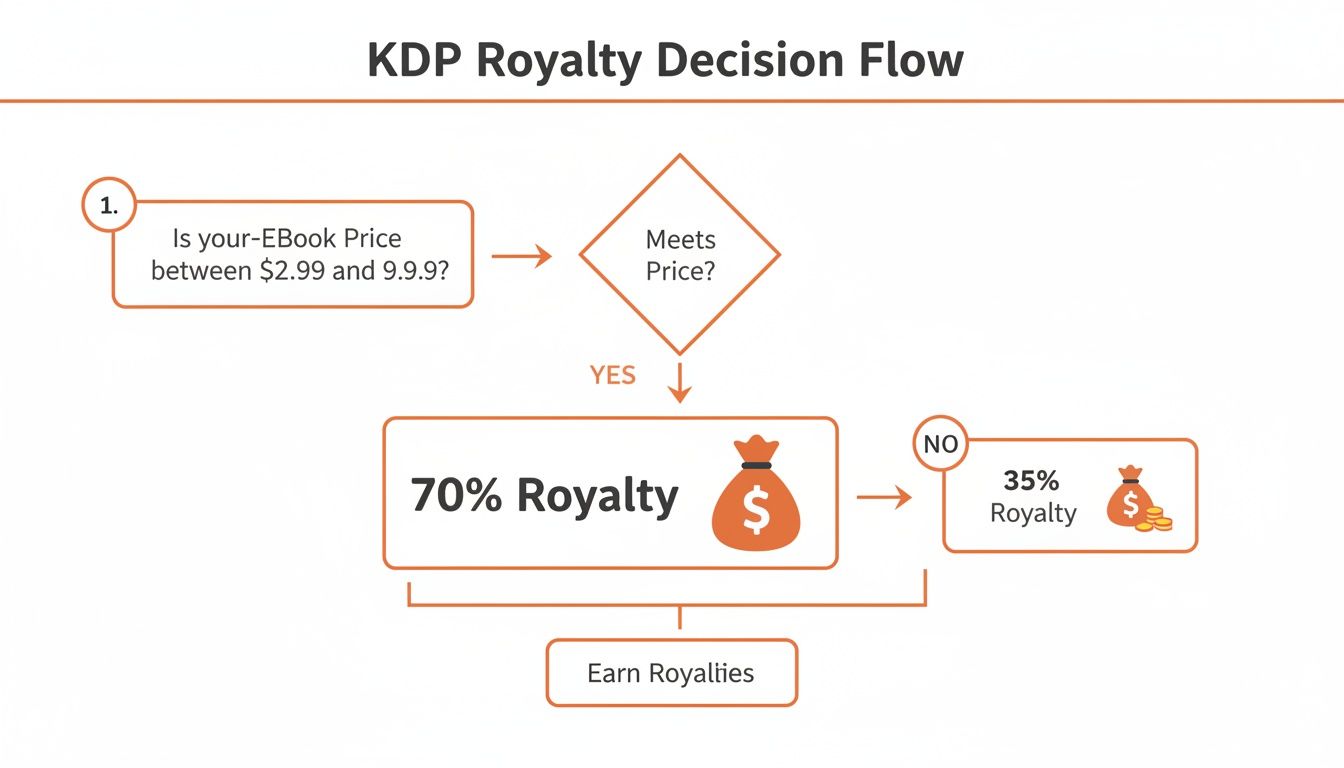
While 70% offers a larger share, it comes with specific pricing rules and deductions. The 35% plan is more flexible, but the payout is smaller.
The Simple 35% Royalty Formula
The calculation for the 35% royalty plan is simple because you don't have to worry about delivery fees. This makes it easy to predict earnings on books priced below ₹225 or above ₹750, or for sales in certain territories.
Here’s the formula:
(List Price - Applicable VAT) x 0.35 = Your Royalty
Let’s say you’ve priced a short story at ₹150 on Amazon.in. Since that’s below the ₹225 minimum for the 70% plan, it automatically uses the 35% option.
List Price: ₹150
Royalty Rate: 35%
Calculation: ₹150 x 0.35 = ₹52.50 per sale
That’s it. There are no hidden fees or extra deductions. What you see is what you get, which is why it’s a solid choice for certain pricing strategies, like short reads or introductory books.
The Nuanced 70% Royalty Formula
This is where you need to pay closer attention. The 70% rate is more appealing, but you must factor in the digital delivery cost. This fee is based on your eBook's final converted file size, not your original manuscript file. It's a critical variable for any accurate Kindle Direct Publishing royalty calculator.
The formula looks like this:
(List Price - Applicable VAT) x 0.70 - Delivery Cost = Your Royalty
Delivery costs vary by marketplace. For sales on Amazon.in, the current rate is ₹7 per megabyte (MB). Remember, this is based on the file size after Amazon converts it for Kindle, which can sometimes be slightly larger than your source file.
eBook Royalty Calculation Examples
To make this clear, let's put these formulas into practice. Here's a side-by-side comparison showing how a typical eBook's earnings would differ under each plan.
Metric | Example 1 (70% Plan) | Example 2 (35% Plan) |
|---|---|---|
List Price | ₹399 | ₹799 |
Royalty Plan | 70% (Price is between ₹225 - ₹750) | 35% (Price is above ₹750) |
File Size | 3 MB | 10 MB |
Delivery Cost | 3 MB x ₹7/MB = ₹21 | ₹0 (Not applicable on 35% plan) |
Royalty Calculation | (₹399 x 0.70) - ₹21 | ₹799 x 0.35 |
Final Royalty per Sale | ₹258.30 | ₹279.65 |
These examples show how much the details matter.
A Deeper Look at the Scenarios
Let's break down those numbers.
Scenario 1: A Standard Fiction Novel (70% Plan)
Imagine you've priced your new thriller competitively.
List Price: ₹399
Royalty Plan: 70%
Final File Size: 3 MB
First, calculate the delivery cost: 3 MB x ₹7/MB = ₹21.
Next, apply the main formula: (₹399 x 0.70) - ₹21 = ₹279.30 - ₹21.
Your final take-home amount is ₹258.30 per sale.
Scenario 2: A Non-Fiction Guide with Images (35% Plan)
Now, picture a large non-fiction guide packed with images. It's bigger, and you've priced it higher.
List Price: ₹799
Royalty Plan: 35%
Final File Size: 10 MB
Because the price is over ₹750, it automatically falls into the 35% plan. The delivery cost is irrelevant here. The 10 MB file size has no impact on your earnings.
The calculation is just: ₹799 x 0.35 = ₹279.65 per sale.
This is a crucial point many new authors miss. In this case, the higher-priced book on the 35% plan actually earns slightly more per sale than the lower-priced book on the 70% plan. It shows how important it is to run the numbers for your specific book and pricing strategy.
Once you master these simple calculations, you can make smarter pricing decisions and get a clearer picture of your income. When the sales start rolling in, you’ll want to get familiar with your sales data in our guide to navigating your Amazon KDP reports.
Calculating Royalties for Paperbacks and Hardcovers
Your income on KDP can go beyond digital downloads. The platform’s print-on-demand service for paperbacks and hardcovers opens up another revenue stream, but the math works completely differently from eBooks. Instead of delivery fees, your primary cost is the physical production of each book.
Understanding this model is key to setting a list price that not only covers costs but also leaves you with a profit. We’ll break down the formula, review the factors that determine your printing costs, and walk through a real-world example.
The Print-on-Demand Royalty Formula
For physical books, KDP offers a fixed royalty rate of 60%. From that amount, Amazon subtracts the printing cost for that specific book. What’s left is your final royalty per sale.
The formula is:
(List Price x 60%) - Printing Cost = Your Royalty
The formula is straightforward, but it all depends on one critical variable: the printing cost. This isn’t a flat fee. It’s calculated based on your book's specifications, and getting this number right is the most important step in using any kindle direct publishing royalty calculator for your print editions.
What Determines Your Printing Cost
The cost to print a single copy of your book is a direct result of the choices you make during setup. Every decision impacts this cost and, by extension, your profit margin.
Here are the main factors:
Page Count: This is the most significant factor. The more pages your book has, the higher the printing cost.
Ink Type: You can choose between black and white or color. Standard black and white ink is the most cost-effective. Premium color ink is significantly more expensive and is usually reserved for children's books, photography collections, or textbooks.
Trim Size: The physical dimensions of your book (e.g., 6x9 inches, 5x8 inches) also influence the cost. Larger trim sizes generally cost more to produce.
Marketplace: Printing costs vary slightly depending on which Amazon marketplace the book is sold in (e.g., Amazon.in, Amazon.com, Amazon.co.uk) because of local production costs.
Amazon is transparent about these costs, which are calculated as a small fixed fee plus a per-page cost. For instance, on Amazon.in, a standard black and white paperback has a specific fixed cost and a per-page charge that you can find in your KDP dashboard.
A Practical Paperback Royalty Calculation
Let's use a real example. Imagine you've written a 300-page fiction novel and want to sell it as a paperback on Amazon.in.
Here are the details:
Book Type: Paperback
Trim Size: 6 x 9 inches
Ink Type: Black & White
Page Count: 300 pages
List Price: You decide to set it at ₹599
First, we need to calculate the printing cost. KDP uses a formula: a fixed cost plus a per-page cost. For this example, let’s assume the marketplace fixed cost is ₹80 and the per-page cost is ₹1.20.
Per-Page Calculation: 300 pages x ₹1.20/page = ₹360
Total Printing Cost: ₹360 (page cost) + ₹80 (fixed cost) = ₹440
This ₹440 is what Amazon will deduct to cover the physical production of one copy.
Now, we plug the printing cost into the main royalty formula.
Formula: (List Price x 60%) - Printing Cost = Royalty
Calculation: (₹599 x 0.60) - ₹440
Breakdown: ₹359.40 - ₹440
The result is negative. This is a perfect example of a common pricing mistake. A list price of ₹599 is too low to cover the printing cost of a book this size, let alone generate a profit. You would lose money on every sale.
Let's fix this by adjusting the list price to a more realistic ₹899. The printing cost of ₹440 stays the same.
Calculation: (₹899 x 0.60) - ₹440
Breakdown: ₹539.40 - ₹440
Final Royalty: ₹99.40 per sale
That’s much better. By adjusting the price, you've gone from losing money to earning a respectable royalty. This step-by-step process shows why it is essential to calculate your printing costs before you finalize your list price. If you want to dive deeper into the platform as a whole, you can learn more in our complete guide to Amazon Kindle Direct Publishing.
Factors That Actually Impact Your Payout
The numbers you enter into a royalty calculator are a starting point, not the full story. Think of them as the gross figure. Several other factors will adjust that number before the money lands in your bank account.
Understanding these variables is the difference between a pleasant surprise and a financial shock at the end of the month.
The first is tax withholding. Amazon is a global platform based in the U.S., which means it must follow U.S. tax rules. If you are not a U.S. resident, this can mean a default withholding rate of up to 30% on your U.S. sales. That’s a large portion of your earnings.
Fortunately, many countries have tax treaties with the United States that can reduce this rate, often down to 15% or even 0%. To get this benefit, you must complete the KDP tax interview correctly.
Selling Across Different Marketplaces
Your book is available on multiple Amazon marketplaces worldwide, from Amazon.co.uk to Amazon.com.au. While this global reach is great for visibility, it adds complexity to your earnings.
Each sale is processed in the local currency. When Amazon consolidates your royalties, those different currencies are converted into your home currency. Because exchange rates fluctuate daily, the payout from a £4.99 sale in the UK might be slightly different from one month to the next when converted to Indian Rupees.
It’s a common mistake to apply your home country's pricing logic to all marketplaces. A price that seems reasonable in India might be uncompetitive in the U.S. or Germany after currency conversion and considering local market expectations.
Additionally, pricing rules and VAT (Value-Added Tax) differ by territory. In many European countries, the list price you set must include VAT. Amazon automatically deducts this tax before calculating your royalty, which can reduce your base earnings on those sales.
The Kindle Unlimited Global Fund
A separate income stream comes from Kindle Unlimited (KU). When you enroll your book in KDP Select, subscribers can read it for "free" as part of their membership. You don't get a royalty per book borrowed; you get paid for every page they read.
This income comes from the KDP Select Global Fund, a pool of money Amazon sets aside each month to pay authors. Your share is determined by your total number of pages read by KU subscribers that month.
Here’s how it works:
Amazon calculates the total number of pages read across all KU books.
They divide the total Global Fund amount by the total pages read to get a "per-page-read" payout rate.
This rate changes slightly each month but typically hovers around ₹0.20 to ₹0.30 per page in India.
So, if KU subscribers read 10,000 pages of your book in a month and the rate is ₹0.25 per page, you'd earn ₹2,500 from the KU fund for that period. This is completely separate from your direct sales royalties. For authors in genres with high readership, like romance and fantasy, KU page reads can often generate more income than sales.
Ultimately, your final payout is a mix of all these parts. It’s not just about your list price and royalty choice. It’s about managing taxes, navigating global markets, and leveraging programs like Kindle Unlimited.
Common Mistakes That Will Wreck Your Royalty Forecasts
Even careful authors can make a few common mistakes, turning a promising earnings forecast into a disappointing reality. A KDP royalty calculator is a useful tool, but it's only as good as the numbers you provide. Knowing where people usually go wrong can help you avoid these pitfalls.

Let's review the most frequent errors authors make. Avoiding these will make your financial planning much more accurate.
Using the Wrong File Size for Delivery Fees
This is the most common mistake for authors on the 70% royalty plan. The delivery fee is not based on the size of your manuscript file (your Word document or EPUB). It's calculated from the final, KDP-converted file size, which is often larger.
The Mistake: Using the size of your 2.5 MB Word document for your calculation.
The Right Way: Upload your book to KDP. Before you publish, go to the pricing section and find the "Digital Delivery Cost." That is the only number you should use.
Using your manuscript's size will cause you to underestimate costs and overestimate your royalty per sale. It seems like a small detail, but over thousands of sales, it can add up to a significant amount.
Forgetting About Tax Withholding
The gross royalty figure you calculate is not what lands in your bank account. Because Amazon is a US-based company, it is required to withhold taxes on royalties from US sales. For many international authors, this can be a default rate of up to 30%.
Forgetting to factor in tax withholding is like creating a budget but ignoring taxes. It presents an overly optimistic and incorrect picture of your actual take-home pay.
Make sure you complete the KDP tax interview. Depending on your country's tax treaty with the US, you could reduce this withholding rate significantly—down to 15%, 10%, or in some cases, 0%. Whatever your rate is, you must account for it in your forecasts.
Misunderstanding the 70% Pricing Rules
The 70% royalty plan is great, but it comes with strict pricing rules. To be eligible, your book’s list price must fall within a specific range (for example, between $2.99 and $9.99 in the US marketplace).
A classic error is thinking this rate applies no matter what you charge. If you price your book at $2.98 or $10.00, Amazon will automatically switch that sale to the 35% plan, instantly cutting your earnings in half for that transaction.
The power of using a KDP royalty calculator correctly is evident in India, where many authors have seen success. Recent data shows that thousands of authors worldwide earn significant income, with many benefiting from the growth of digital reading. Discover more insights about self-publishing trends in India on JaneFriedman.com.
Overlooking Expanded Distribution Calculations
Finally, a common oversight for authors with paperbacks is forgetting that Expanded Distribution royalties follow a different formula. Direct sales on Amazon give you a 60% royalty (minus printing costs). But sales through Expanded Distribution channels, which make your book available to other retailers and libraries, pay a lower royalty of 40%.
That's a big difference. If you don't track and calculate these sales streams separately, your overall paperback income forecast will be inaccurate. Always split your projections to account for the lower rate on any sales you expect from these wider channels.
KDP Royalty Questions? We've Got Answers.
When you're working with the numbers, a few common questions always come up. Here are some straight answers to the royalty questions authors ask most often.
This is the practical information that affects your bottom line, from when you get paid to how a price drop impacts your earnings.
How Often Does Amazon Actually Pay?
Amazon pays royalties monthly, with a delay. Payouts arrive approximately 60 days after the end of the month in which the sales occurred.
For example, everything you earn in January gets paid out at the end of March. This two-month lag is consistent across all marketplaces.
Also, keep in mind you have to meet a minimum payment threshold. This amount varies based on your payment method (direct deposit, check, etc.) and currency. Direct deposit usually has the lowest threshold, making it the best choice for most authors to get paid faster.
Do Promotions and Discounts Tank My Royalties?
Yes, they do. Any KDP royalty calculator will likely start with your full list price, but your actual royalty is always calculated on the price a customer paid.
If you’re running a Kindle Countdown Deal or any other promotion, your royalty is based on that discounted price, not the original one. This is important to remember when forecasting your income from a launch or a sale.
Your royalty is calculated from the final sale price. If your book is normally ₹399 but you run a Countdown Deal at ₹150, your 70% royalty (minus delivery fees) is based on that ₹150 for every copy sold during the promotion. You have to account for this manually.
What’s the Deal with "List Price" vs. "Royalty Price"?
These two terms can be confusing, but the difference comes down to one thing: Value-Added Tax (VAT).
Your list price is the number you enter into the KDP dashboard. However, in many countries, particularly in Europe, that price legally has to include VAT. Amazon automatically subtracts this tax before applying your royalty percentage.
The number left over is often called the royalty price—it’s the true base for your earnings calculation.
Let's break it down:
List Price: The price a customer sees on the store page (e.g., €3.99).
Applicable VAT: The tax Amazon deducts for the government (e.g., 19% in Germany).
Royalty Price: This is your List Price minus the VAT. Your 35% or 70% royalty is calculated from this number.
This is why you might look at your European sales and feel the royalty is a bit lower than expected. It's not a mistake; it's the VAT at work. A good Kindle Direct Publishing royalty calculator might account for this, but it's always smart to double-check it yourself.