Dropshipping to Amazon: A Practical Guide for Sellers
Written by

Cosmy
AI-driven eCommerce Optimization
If you're considering dropshipping on Amazon, it's easy to get lost in the online hype about a "hands-off" business model. Let's be direct: while dropshipping on Amazon is a legitimate business strategy, it is not the passive income dream often portrayed. It's an active business model that requires careful management.
When done right, it's a low-investment way to test new products and enter markets, capable of delivering 10-30% profit margins without the significant upfront cost of inventory required for Fulfilment by Amazon (FBA).
Is Amazon Dropshipping a Good Business Model?

The real question isn’t if it's possible, but if you can manage the day-to-day operations. Success on Amazon means following their rules precisely, and their dropshipping policy is strict. This isn't about finding a loophole; it’s about building an efficient operation that meets Amazon’s high customer service standards.
The appeal of the model is its simplicity. You list products on Amazon before you purchase them. When a customer places an order, you buy that item from your supplier, who then ships it directly to the customer. This minimizes your financial risk.
A Low-Cost Way To Test the Market
This is where dropshipping is most valuable. Think of it as a live market research tool. You can list a dozen different products from several suppliers to see what actually sells, without spending thousands on inventory that might not move. This is a major advantage over the traditional FBA model, where you have to invest heavily in a product before you know if there’s real demand.
For example, imagine you want to sell home office gadgets. You could list five different ergonomic mouse pads from three suppliers. After a month, you notice one specific gel wrist pad consistently sells well, while the others get no interest. You now have real sales data. You can stop selling the unpopular items and focus on the winner, perhaps even transitioning it to FBA later for faster shipping and better profit margins.
Dropshipping is your real-world testing ground. It lets you validate product ideas with actual sales, minimizing your financial risk before you make a larger investment. You find your winning products by letting the market vote with their wallets.
The Real Profit Margins and Challenges
While the low entry cost is a significant benefit, you need a realistic view of the numbers. After paying your supplier and Amazon's referral fees (typically around 15%), a well-managed dropshipping business can achieve net profit margins between 10% and 30%.
However, reaching that margin means navigating serious challenges:
Supplier Reliability is Everything. Your business is only as good as your supplier. If they ship late, send a poor-quality product, or use cheap packaging, your Amazon seller metrics and customer feedback will suffer. You take the hit, not them.
Inventory Syncing is Crucial. Nothing harms an Amazon account faster than canceling orders because a product is out of stock. If your supplier runs out of an item but your listing is still live, you're forced to cancel sales. This is a major violation for Amazon and can lead to account suspension.
Strict Policy Compliance. Amazon's dropshipping policy is clear: you must be the "seller of record" on all invoices and packing slips. This means no supplier logos or marketing materials. The customer must believe the package came directly from you.
The opportunity is real. The Indian dropshipping market alone is projected to grow from USD 10.8 billion to USD 67.5 billion by 2033, with fashion being a major category. You can read more about these trends at The4.co. This growth is part of a global shift toward more flexible e-commerce models. Deciding if it's the right fit for you means honestly weighing that opportunity against the operational discipline required to succeed.
How to Navigate Amazon's Dropshipping Policies
Getting Amazon dropshipping right is not about finding clever workarounds. It's about understanding and strictly following their rules. Even small mistakes can put your entire seller account at risk. The main principle is simple: the customer must always believe the product came directly from you.
This means you are the seller of record. Every piece of documentation and packaging associated with an order—the packing slip, the invoice, the box itself—must carry your brand name. There can be no mention of a third-party supplier. This is not negotiable.
For example, if a customer orders a desk lamp from your Amazon store, "Bright Ideas UK," the package that arrives must look like it came from Bright Ideas UK. The invoice inside must list your company as the seller. If it arrives in a box with "Lighting Warehouse" logos or has their invoice inside, you have violated Amazon’s policy.
The Forbidden Practice of Retail Arbitrage
A common mistake new sellers make is confusing legitimate dropshipping with retail arbitrage. Shipping a product from another retailer directly to your Amazon customer is strictly forbidden.
You absolutely cannot do this:
Buy a product from another online retailer (like Walmart or another marketplace) and have them ship it directly to your customer.
Allow orders to be shipped with packing slips, invoices, or packaging that shows a seller name or contact information other than your own.
Consider the customer experience. Someone buys from you on Amazon, only to receive a package from a different company. It's confusing and breaks trust, which is exactly what Amazon's policy is designed to prevent. Violating this rule is one of the quickest ways to get your account suspended.
Key Takeaway: You are responsible for the entire customer journey. From Amazon's point of view, your supplier doesn't exist. Every point of contact, from the shipping label to the returns process, must represent you as the sole seller.
Staying Compliant as The Seller of Record
To build a sustainable dropshipping business on Amazon, you must set up your operations for compliance from the start. This requires clear agreements with your suppliers. They must understand that following your branding and packaging rules is a condition of doing business with you.
Here’s your checklist for every potential supplier:
Neutral or Branded Packaging: They must agree to ship products in plain, unbranded boxes or, ideally, in packaging with your logo and company name.
Your Invoices Only: The supplier must include an invoice or packing slip that identifies you as the seller. You will need to provide them with a template for this.
No Supplier Marketing: The box cannot contain any of the supplier's flyers, business cards, or other promotional materials.
Before signing any contracts, discuss these points directly. Ask them: "Can you ship products in plain packaging with my company's packing slip inside?" If they hesitate or say no, they are not the right partner for your Amazon business. A good supplier will already understand these requirements and often has systems in place to handle them. You can learn more about evolving Amazon policies by following the latest news for Amazon sellers.
Finally, remember that you are responsible for accepting and processing customer returns, not your supplier. While you will coordinate with them behind the scenes, the customer's only point of contact is you. By controlling the branding and documentation, you not only stay compliant but also build a real, trustworthy brand on the world's largest marketplace.
After navigating Amazon's policies, your entire business depends on one critical factor: your supplier.
In dropshipping, your supplier is more than just a vendor. They are the invisible partner controlling your product quality, shipping speed, and your customer's overall experience. A great one helps you build a brand. A bad one can get your account shut down. It's that simple.
Where to Find Quality Suppliers
Don't waste time with random Google searches that lead to unreliable middlemen. Start your search on established platforms and directories that vet their listings. These curated sources are your best bet for finding wholesalers and manufacturers who are open to dropshipping arrangements.
Online trade shows and industry forums are also excellent places to make direct connections. Once you have your compliance plan in place, the next step is securing that perfect partner. For a deeper dive, you can learn more about how to find dropshipping suppliers.
This model is growing globally. For instance, in the Indian e-commerce market, dropshipping to Amazon has been transformative. More than 200,000 Indian exporters now sell over 750 million products on Amazon worldwide. Cumulative exports are projected to exceed $20 billion by early 2026, proving the massive potential when you pair authentic products with reliable fulfillment.
The Vetting Process: A Checklist for Due Diligence
Finding a list of potential suppliers is easy. The hard work is in the vetting process. You need to question their processes, check their history, and ensure they can comply with Amazon's strict dropshipping rules.
Before considering a partnership, you need a thorough vetting process. This isn't a casual chat; it's an investigation to protect your business. Use this checklist as your guide.
Supplier Vetting Checklist
Criteria | What to Look For | Red Flags |
|---|---|---|
Amazon Experience | They immediately understand Amazon's policies on branding and invoicing. They have a history of dropshipping for other Amazon sellers. | "What's Amazon's dropshipping policy?" Vague answers or confusion about the rules. |
Packaging & Branding | A clear "yes" to shipping in neutral (unbranded) or custom-branded packaging. No third-party logos or marketing materials. | Any hesitation or refusal to use plain packaging. Statements like "We always use our own boxes." |
Order Processing | Firm commitments on processing and shipping times (e.g., "within 24 hours"). They can provide performance metrics. | "Usually a few days." Evasive answers or no concrete timeline. |
Inventory Management | An automated system for providing real-time inventory updates (e.g., daily CSV file, API access). | "Just email us to check stock." Manual processes that can't keep up with sales. |
Returns Process | A clear, documented process for handling returns, issuing credits, or sending replacements without hassle. | "We don't really handle returns." Pushing all return responsibility back on you. |
A solid vetting process like this filters out amateurs and leaves you with serious, professional partners who understand what it takes to succeed on Amazon.
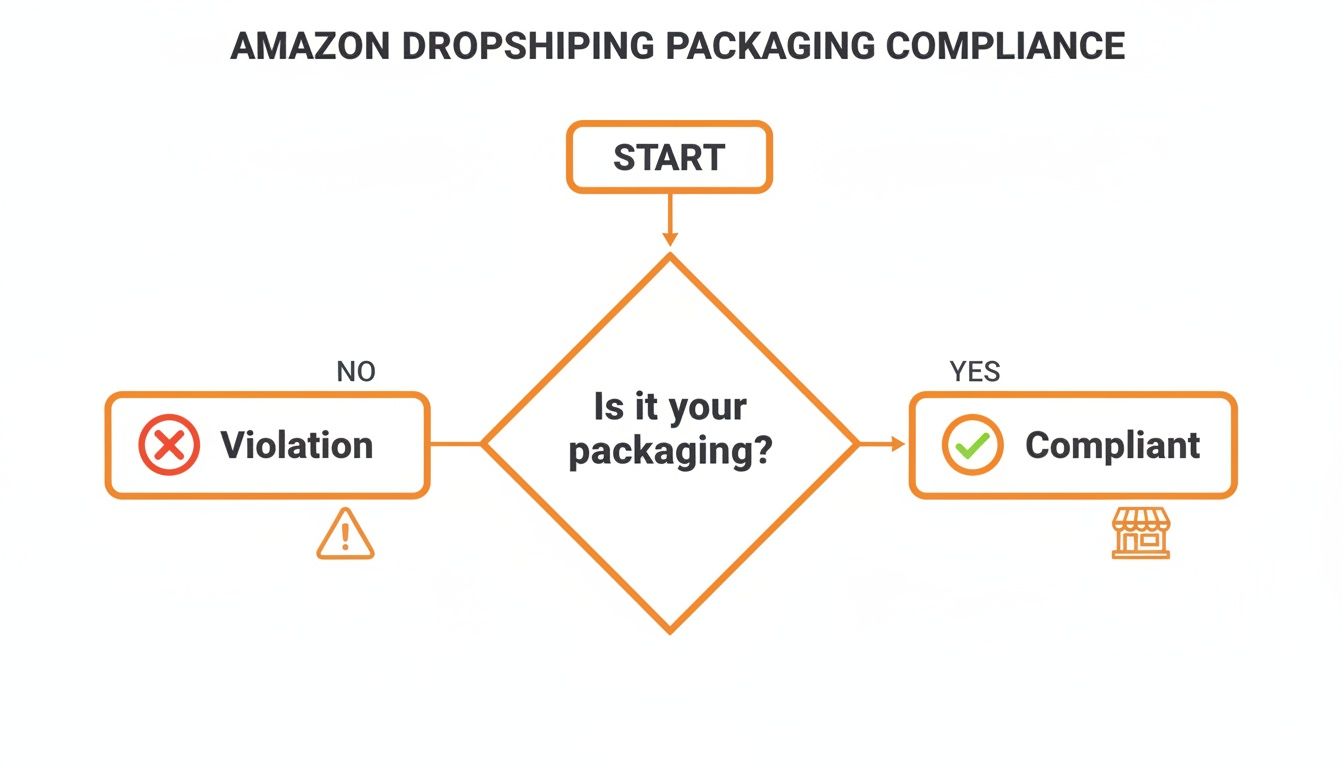
This flowchart makes it clear: if the box doesn’t identify you as the seller, it’s a policy violation. This is the single biggest reason dropshipping accounts get suspended.
Lock It Down With a Supplier Agreement
Once you’ve chosen your supplier, don't move forward on a verbal agreement. You need a formal dropshipping supplier agreement. This document isn't just a formality; it's the legal foundation of your partnership, defining every responsibility and leaving no room for "misunderstandings" that could cost you your business.
If you're sourcing from major platforms, our guide comparing https://blog.cosmy.ai/alibaba-vs-aliexpress may also be helpful in your decision-making.
Your agreement must specify these key points in detail:
Packaging and Branding: State that all shipments must use your company's packing slip and be sent in neutral packaging. No third-party logos, flyers, or invoices are permitted.
Fulfilment SLAs: Define the service level agreement for fulfilment. Specify the maximum time allowed from order receipt to shipment (e.g., 24-48 business hours).
Returns Protocol: Outline the exact procedure for customer returns. The supplier must agree to accept returned products and detail how you will be credited or sent a replacement.
Inventory Syncing: Require the supplier to provide regular, automated inventory updates. This is critical to prevent you from selling out-of-stock items and damaging your seller metrics.
A strong supplier agreement is your insurance policy. It turns verbal promises into contractual obligations, holding your partner accountable and protecting your Amazon account from their potential mistakes.
Optimizing Your Amazon Listings for Today's Marketplace
Your Amazon listing now has two audiences: the human shopper ready to buy, and the AI that decides if they even see your product. With conversational shopping assistants becoming more common, the old strategy of just stuffing keywords into your title is no longer effective.
Success in today's marketplace means creating content that directly answers customer questions. Think of your product page as a conversation. Every element—the title, the bullet points, the A+ Content—is a chance to give shoppers and Amazon's AI the clear, direct answers they need to choose your product.
Moving Beyond Keywords to Conversational Content
For years, Amazon SEO was about keyword density. Now, it's about context. Amazon’s AI is trying to understand products on a deeper level so it can answer complex, natural language questions like, "Which of these non-stick pans is best for a glass-top stove and is also dishwasher safe?"
Your job is to make it easy for the AI to find those answers within your listing.
Product Title: Instead of "Non-Stick Pan 10-Inch," a better title would be "10-Inch Non-Stick Frying Pan, Dishwasher Safe & Induction Compatible for All Stovetops." The second title answers multiple potential questions immediately.
Bullet Points: Dedicate each bullet point to a specific benefit. For a portable charger, one might be, "Powers Your Phone Up to 3 Full Times – Our 10,000mAh battery lets you stay connected all weekend without being tied to a wall outlet."
Product Description: This is where you tell a story and address more detailed questions. Anticipate customer concerns. Is it easy to clean? What is the warranty? What materials is it made from?
When you structure your content this way, you're creating a rich data source for Amazon's AI. This dramatically improves your chances of being featured in AI-generated recommendations, which is where the market is heading.
Auditing Your Listings with Data-Driven Tools
How do you know if your listing is effectively communicating with Amazon's AI? Guessing isn't a strategy. This is where you use data-driven tools that can audit your content against the signals that actually matter to Amazon's search algorithm.
A platform like Cosmy was built for this purpose. It analyzes how Amazon's AI sees your product and shows you precisely where your content is lacking. Instead of guessing what works, an AI-powered audit provides a clear, prioritized plan for optimization. It reveals the gaps between what your customers are asking and what your listing is telling them.
This analysis gives you actionable intelligence, allowing you to make data-backed changes that directly impact visibility and conversion rates.
A Real-World Optimization Scenario
Let's walk through a practical example. Imagine you're dropshipping a yoga mat. Your listing looks decent, but sales are flat. You run it through an AI-driven audit and uncover a few critical gaps.
The Finding: The audit reveals that many shoppers are asking questions like, "best yoga mat for sweaty hands" and "non-slip yoga mat for hot yoga." Your current listing mentions it's "high-grip," but doesn't specifically address sweat or hot yoga.
The Action: You rewrite your bullet points and description. A new bullet point now reads: "Ultimate Non-Slip Grip for Hot Yoga: Our moisture-wicking surface provides superior traction even during the sweatiest sessions, keeping you stable and safe."
The Result: Your listing now directly answers a critical set of customer questions. Amazon's AI picks up on these strong contextual signals, and your product starts appearing more often for searches related to "hot yoga" and "non-slip mats." Organic traffic increases, and sales follow.
Think of your product listing as a knowledge base for Amazon's AI. The more comprehensively you answer potential customer questions, the more confidence the AI has in recommending your product over a competitor's.
Of course, content is only one piece of the puzzle. A crucial element of successful Amazon dropshipping is an effective pricing strategy that balances competition, profitability, and Amazon's unique market dynamics. You can gain further insights into Mastering Amazon Pricing Strategies to complement your content optimization efforts.
Ultimately, optimizing for an AI-driven marketplace is about being the most helpful and informative seller. If you're looking for more details on keyword strategy, you can also explore our guide on finding the best product key-word. By arming your listings with clear answers, you not only win over customers but also gain a powerful ally in Amazon's algorithm.
Mastering Order Management and Customer Service
Smooth operations are the engine of a successful Amazon dropshipping business. If you get this part right, your store runs efficiently. If you get it wrong, you face negative feedback, A-to-z claims, and a potential account suspension.
Your entire focus must be on building a reliable system for handling orders and providing excellent customer service. This isn't the most glamorous part of the business, but it's where you win or lose.
The moment a customer clicks "Buy Now," the clock starts ticking. Your first job is to transmit that order to your supplier instantly. When you're just starting, it might be tempting to forward orders manually via email. Avoid this. It's slow, error-prone, and can lead to costly mistakes.
The only scalable approach is automation. Any reputable supplier will offer integration through an Application Programming Interface (API) or an Electronic Data Interchange (EDI) system. This connection means an order placed in your Seller Central account is automatically sent to your supplier’s fulfillment queue without delay or human error.
The Order Fulfilment Workflow
Once the order is in your supplier's hands, their job is to pick, pack, and ship it, ideally within 24-48 hours. This speed is essential to meet Amazon's demanding shipping expectations.
As soon as the package is dispatched, your supplier must provide you with a tracking number. This is a critical requirement. You must then immediately take that tracking information and enter it into the corresponding order in your Amazon Seller Central account. This action officially marks the order as shipped and notifies the customer that their item is on its way.
Failing to upload tracking information on time is a major red flag for Amazon. It negatively impacts one of your most critical account health metrics: your Valid Tracking Rate (VTR). If your VTR drops, you risk losing the Buy Box, having your listings suppressed, or even losing your selling privileges entirely.
Creating a Reliable Returns Strategy
Returns are a standard cost of doing business in e-commerce. On Amazon, you are required to authorize return requests within their policy window, no questions asked. How you manage this process will define your store’s reputation.
You need to have a clear returns process established with your supplier before you make your first sale. When a customer wants to return an item, you have two main options for the return address:
Your own address: You receive the product back, inspect it yourself, and then arrange for a credit or replacement with your supplier. This gives you full control but adds an extra logistical step.
Your supplier’s warehouse: You provide the customer with your supplier's address to send the item back directly. This is more streamlined, but requires you to trust your supplier to process the return correctly and credit your account promptly.
Regardless of where the item is sent, you are always the one responsible for issuing the refund to the customer through Seller Central once the return is received. You then work with your supplier to get your money back. Fast, proactive refunds are vital for protecting your seller rating.
The customer’s only point of contact is you. Never direct them to your supplier for any issue—not for tracking, not for returns, not for product questions. From their perspective, your supplier does not exist. All communication must come from you.
These operational details are what separate successful sellers from the rest, especially in competitive markets. For example, dropshipping success rates often fall between a challenging 10-20%, a figure heavily influenced by supplier reliability and fulfillment speed. Success isn't just about a popular product; it's about flawless execution.
As detailed in these dropshipping statistics, operational costs are a significant factor, but a solid workflow can dramatically improve your chances. By building a seamless and customer-focused operational flow, you can run a thriving dropshipping business on Amazon while keeping your account health in good standing.
The Hard Questions About Amazon Dropshipping
Dropshipping on Amazon sounds simple: find a product, list it, and let a supplier ship it. But success is in the details—and in following the rules. Let's address the questions that really matter.
Can I Just Dropship From Walmart or AliExpress to My Amazon Customer?
The answer is a definite no. Do not do this.
This practice is called retail arbitrage, and it's the fastest way to get your account suspended. Amazon's policy is clear: you are strictly forbidden from shipping a product from another retailer (like Walmart, eBay, or AliExpress) directly to an Amazon customer.
Think about it from the customer's point of view. They buy from you on Amazon and a Walmart box arrives, possibly with a receipt for a lower price. It's confusing, unprofessional, and destroys trust. Amazon built its brand on customer experience and will remove any seller who compromises it.
The bottom line: everything the customer receives—the box, the packing slip, the invoice—must identify you as the seller. If another company's logo appears anywhere, you are risking your account.
What Are the Real Risks I'm Not Thinking About?
Dropshipping eliminates the financial risk of buying inventory upfront. However, you trade it for significant operational risks that can shut down your business just as quickly.
Your entire Amazon account's health depends on your supplier. This leads to two major, account-threatening risks:
Supplier Mistakes: If your supplier ships an order two days late, it hurts your Late Shipment Rate. If they use poor packaging and the product arrives damaged, it results in a negative review and an A-to-z claim against you. If they send the wrong item, your metrics suffer. Their mistakes become your account defects.
Inventory Issues: This is a silent killer. Your supplier runs out of stock, but your Amazon listing is still active and taking orders. Now you must cancel them. A high pre-fulfillment cancellation rate is one of the biggest red flags for Amazon. It signals an unreliable seller and can get your account suspended overnight.
This is why serious dropshippers know that solid supplier contracts and automated, real-time inventory syncing are not optional. They are essential for survival.
How Do I Actually Handle Returns?
On Amazon, returns are a normal part of business. Your dropshipping model doesn't exempt you. You must accept returns according to Amazon's customer-friendly policies.
The first step is to negotiate a returns process with your supplier before you sell a single item. When a customer requests a return, you provide them with a shipping address—this is almost always your supplier's warehouse.
Your role in this process is critical:
You are the only person the customer ever communicates with. Never tell a customer to "contact the supplier."
You issue the refund through Seller Central as soon as the return is confirmed. Do this promptly.
After the customer is taken care of, you then work with your supplier to get a credit or a replacement.
Mishandling returns will lead to bad feedback and damage customer trust. A smooth return process is what separates professional sellers from amateurs.
Is This Even Still Profitable?
Yes, but it's not a get-rich-quick scheme. Profitability today comes from building an efficient, scalable system, not from finding one magic product.
After you factor in the cost of goods, Amazon's referral fees (typically around 15%), and any supplier fees, your net profit margins will usually land somewhere between 10% and 30%.
The real money isn't in finding a single "homerun" product. It's in building a system that can consistently find, list, and manage a portfolio of products while keeping your account health metrics pristine. That is the key to success now.
Ready to stop guessing and start winning in Amazon's AI-driven marketplace? Cosmy delivers the actionable intelligence you need to optimise your listings, boost visibility, and drive sales. Get your free, data-backed audit and see how Amazon’s AI really views your products by visiting https://cosmy.ai.