A Guide to Dropshipping for Amazon
Written by

Cosmy
AI-driven eCommerce Optimization
Can you dropship on Amazon? The direct answer is yes, dropshipping for Amazon is allowed. However, there is a critical rule that many new sellers overlook: you must be the seller of record.
This rule is not a suggestion; it is the foundation of a compliant dropshipping business on Amazon. It means that every packing slip, invoice, and package that reaches your customer must identify you, and only you, as the seller. Follow this rule, and you can build a sustainable business. Ignore it, and you risk account suspension.
The Reality of Amazon Dropshipping Today

Many people think dropshipping is a hands-off model where they simply list a product and a supplier handles the rest. This idea is not only outdated but also dangerous on Amazon. The platform's policies are strict because its primary focus is protecting the customer experience.
The only correct way to dropship on Amazon is to operate as the official business. You control everything the customer sees and experiences. This means you are responsible for creating product listings, setting prices, managing marketing, and handling all customer service, from initial questions to returns.
Your supplier's role is purely logistical. They store inventory and ship orders, but they must do so under your brand identity. This is the key difference between a compliant business and one at risk of being shut down.
Compliant vs. Non-Compliant Amazon Dropshipping
The distinction between the right and wrong way to dropship on Amazon comes down to who controls the branding and customer experience.
Here is a straightforward comparison of the Amazon-approved method versus the approach that leads to account suspension.
Operational Step | The Compliant Method (You Are the Seller) | The Risky Method (Retail Arbitrage) |
|---|---|---|
Supplier Relationship | You have a formal agreement with a manufacturer or wholesaler. | You have no direct relationship; you buy from another retailer as a customer. |
Branding & Packaging | Packaging, invoices, and slips identify YOU as the seller. | The package arrives with another retailer's branding (e.g., a Walmart box). |
Inventory Source | Your supplier ships products they stock on your behalf. | Another online retailer (e.g., eBay, Walmart) ships to your customer. |
Customer Experience | The customer buys from you and receives a package that appears to be from you. | The customer buys from you but receives a package with different branding and pricing. |
Policy Compliance | Follows Amazon's dropshipping policy. | Directly violates Amazon's dropshipping policy. |
Account Risk | Low. This is a sustainable business model. | Extremely High. This can lead to account suspension or a permanent ban. |
The prohibited practice, often called retail arbitrage dropshipping, is when a seller lists an item on Amazon, receives an order, and then buys that item from another retailer like Walmart to ship directly to the customer. Imagine a customer buying from "Your Store" on Amazon but receiving a Walmart box with a gift receipt. This creates confusion and a poor experience.
Amazon's policy is direct: fulfilling orders by purchasing products from another online retailer and having them ship to the customer is not allowed. This is a clear violation that puts your account at immediate risk.
By operating as the "seller of record" from the start, you ensure every package reinforces your brand and builds customer trust. This approach focuses on building a durable business that Amazon's platform is designed to support, rather than pursuing risky shortcuts.
Staying Compliant with Amazon's Rules
Amazon's dropshipping policy is a set of strict rules that determine whether your business survives. To comply, you must translate Amazon's requirements into concrete actions. Failure to do so can result in a sudden account suspension.
The entire policy centers on one principle: you must always be the seller of record. This means that from the customer's viewpoint, the transaction starts and ends with you. There should be no mention of a third-party supplier anywhere in the process.
What Being the Seller of Record Actually Looks Like
Being the seller of record means you own the entire customer experience. Every document and piece of packaging must reflect your business name.
This applies to several key items:
Invoices: Must show your business as the seller, with your contact information.
Packing Slips: Must be customized with your logo and company details. Your supplier’s name should not appear.
External Packaging: A plain, unbranded box is acceptable. Any branded tape or shipping labels must be yours.
You are also fully responsible for processing all customer returns. You cannot direct a customer to your supplier for a refund or return. This responsibility is yours alone and is essential for maintaining good account health.
Consider this: if a customer opens a package and sees another company’s name on the invoice, they will be confused. Amazon views this as your failure to provide a clear and trustworthy purchasing experience.
Vetting Suppliers for Compliance
Your supplier is your biggest compliance risk. Before partnering with any supplier, you must confirm they can operate according to Amazon's rules. This conversation needs to happen before you list any products.
Here is a practical script you can use when speaking with a potential supplier:
"We sell on Amazon and must adhere to their dropshipping policy. This requires us to be the seller of record on all orders. Can you confirm that you can ship all of our orders using our customized packing slips and invoices? We also need to ensure that none of your company's branding appears on the boxes or shipping labels."
If they are unable to provide a clear "yes" or seem unfamiliar with these requirements, it is a significant red flag. A reliable partner for dropshipping for Amazon will already understand these rules and have procedures in place to follow them.
The Fastest Way to Get Suspended
The one mistake that is an almost guaranteed path to account deactivation is purchasing from another online retailer to fulfill an Amazon order.
For example, if you receive an order for a coffee maker on Amazon, you cannot then go to Walmart's website, buy the coffee maker, and enter your customer's address for shipping. A few days later, your customer would receive a Walmart-branded box.
This is strictly forbidden because it creates a confusing and unprofessional experience for the customer. The goal is to build a legitimate business, not to find short-term loopholes that jeopardize your entire operation. Adhering to the rules is what protects your business long-term.
How to Find and Vet Reliable Suppliers
Your supplier is the operational backbone of your business. They manage product quality, shipping times, packaging, and returns. A poor choice in a supplier can quickly lead to negative reviews, order defects, and a suspended account.
Finding the right partner requires more than a simple web search. You need to find businesses that understand Amazon's strict requirements. Your success depends on their ability to act as an invisible extension of your brand. This means finding a supplier who not only has the products you need but also has the capability to handle branded packing slips, sync inventory accurately, and ship on time, every time.
Where to Look for Potential Partners
Starting your search in the right places can save you significant time and trouble. A general internet search can be filled with middlemen and unreliable operators. Instead, focus your efforts where legitimate wholesalers and manufacturers are active.
Industry Trade Shows: This is a traditional but effective method. Attending trade shows in your niche allows you to meet manufacturers and distributors in person. You can build relationships and get direct answers to your questions.
Online Supplier Directories: Platforms like SaleHoo or Worldwide Brands pre-vet their listings, which can be a good starting point. However, you must still conduct your own thorough vetting.
Direct Manufacturer Outreach: If you know which products you want to sell, contact the manufacturer directly. Even if they don't offer dropshipping, they can often refer you to their authorized distributors who do.
E-commerce has created global opportunities. For example, Amazon's Global Selling program, launched in 2015, has helped over 200,000 Indian exporters ship more than 750 million products worldwide. By early 2025, this drove Indian sellers past $20 billion in cumulative e-commerce exports. This example shows the potential for sellers who can find reliable international partners.
The Vetting Checklist: Questions You Must Ask
Once you have a shortlist of potential suppliers, you need to interview them as if you were hiring a key employee. Their performance directly reflects on your business. Do not sign an agreement until you have clear answers to these questions.
If a potential supplier hesitates when asked about Amazon’s policies, consider it a sign to look elsewhere. The right partners will already be familiar with these rules and have systems to follow them.
Operational and Compliance Questions
Can you ship orders using our customized packing slips and invoices? This is essential. If they cannot put your brand on the paperwork, they are not a suitable partner for Amazon dropshipping.
Does any of your company branding appear on the shipping boxes or labels? The only correct answer is "no." The customer should only see your brand.
How do you provide inventory updates? At a minimum, you need a daily inventory file (like a CSV). An API connection for real-time updates is even better. Selling out-of-stock items will negatively impact your seller metrics.
What are your typical order processing and shipping times? Get specific timelines, not vague estimates. You need this information to set accurate delivery expectations on your Amazon listings.
What is your process for handling returns? You must understand their return policy completely, as you are responsible for managing the customer's return experience.
Solidifying the Partnership with a Dropshipping Agreement
A verbal agreement is not sufficient. A formal dropshipping agreement is a professional necessity that protects both you and your supplier. This document should clearly outline all the terms discussed during the vetting process. For more context on different types of suppliers, our comparison of Alibaba vs AliExpress can be a helpful resource.
This written contract formalizes responsibilities and sets clear expectations.
Key elements to include in your agreement:
Responsibilities: Clearly define who is responsible for each step, from order processing to managing returns.
Pricing: Finalize your wholesale costs per unit and any available volume discounts.
Service Level Agreements (SLAs): Get commitments in writing, such as "all orders will be processed and shipped within 24 hours of receipt."
Compliance: Reiterate the requirement to use your branded packing slips and neutral packaging.
Building a reliable supplier network is fundamental. When starting, it is important to learn how to efficiently find the best dropshippers for jewelry or any other niche. Taking the time to properly vet suppliers is a critical investment in the long-term health of your business.
Making Your Listings Visible to Shoppers and Amazon’s AI
Once you have a reliable supplier, your focus must shift to visibility. A great product is useless if customers cannot find it. This involves creating listings that appeal to both human shoppers and Amazon’s A10 search algorithm.
The goal is to build a product page that not only encourages visitors to buy but also signals relevance and authority to Amazon. This is more than just adding keywords to a title. It requires a strategic approach to writing benefit-focused copy, using high-quality images, and structuring content to answer customer questions.
Nailing the Title: Your First and Best Shot at Ranking
The product title is your most important SEO element. It is the first thing a shopper sees and carries the most weight with Amazon's algorithm. A common mistake is to create a long, unreadable string of keywords. This can look unprofessional to customers and be less effective than a well-structured title.
A good title formula often includes:
Brand Name: Start with your brand to build recognition.
Core Product Identity: Clearly state what the product is (e.g., "Silicone Spatula Set").
Key Feature or Benefit: Mention the main reason someone should buy it (e.g., "Heat-Resistant up to 600°F").
Crucial Spec: Add an important detail like material, size, or quantity (e.g., "4-Piece, BPA-Free").
Primary Use Case: Describe who or what it is for (e.g., "for Non-Stick Cookware").
For example, a weak title might be: "Spatula Kitchen Utensil Cooking Baking Tool Silicone Red."
A much stronger, optimized version would be: "BrandName Silicone Spatula Set (4-Piece) – Heat-Resistant to 600°F, BPA-Free Utensils for Non-Stick Cookware." This title is easy to read, informative, and incorporates relevant terms naturally.
Writing Bullet Points That Actually Sell the Solution
After the title and images, the bullet points are your best opportunity to persuade a shopper. Many sellers waste this space by simply listing features. Instead, you should translate those features into clear benefits that solve a customer's problem.
Think from the customer's perspective. They aren't just buying a "drill bit"; they are buying the "perfectly-sized hole" it creates. Structure each bullet point to lead with the benefit, then explain the feature that delivers it.
Pro Tip: Start your bullet points with the benefit. Use a capitalized phrase to grab attention, then explain how the feature provides that benefit.
Here is an example for a portable power bank:
NEVER RUN OUT OF BATTERY AGAIN: With a large 20,000mAh capacity, this power bank can charge your smartphone up to four full times, keeping you connected during long trips or power outages.
CHARGE YOUR DEVICES FASTER: Equipped with Quick Charge 3.0 technology, it powers up compatible devices to 80% in just 35 minutes, saving you time when you are on the go.
This approach speaks directly to the customer's needs and makes your product the clear solution.
Answering Questions Before They're Even Asked
Amazon’s search is becoming more conversational. People are using natural language questions when searching for products, including voice search with Alexa. Your product description and A+ Content are the ideal places to address these questions directly. To ensure your products are found, proper SEO is crucial; using professional SEO services for ecommerce can provide a significant advantage.
Instead of writing a generic block of text, structure your description around the questions a potential buyer might have. For instance, if you're selling a yoga mat, a customer might wonder:
Will this mat become slippery when I sweat?
How thick is it? Will it cushion my knees?
Is it easy to clean?
What is it made of? Is it non-toxic?
By building your content around answering these questions, you align your listing with how modern customers shop. Our guide to mastering SEO on Amazon provides more detail on these strategies. This not only improves your chances of ranking for valuable long-tail keywords but also builds trust with shoppers by providing the information they need to make a confident purchase.
Managing Your Day-to-Day Operations
With your listings live and optimized, the focus shifts to execution. The daily operations of a successful Amazon dropshipping business follow a clear process, from the moment a customer makes a purchase to when you upload their tracking number.
A smooth workflow is what separates sustainable businesses from those that fail quickly. Some repetitive tasks can be automated to save time and reduce errors that can harm your seller metrics. However, customer service remains your direct responsibility. On Amazon, you are the business. How you handle questions, returns, and problems directly affects your account health.
This flowchart shows the core loop of optimizing your listings, a process that should be part of your daily management to remain visible and competitive.
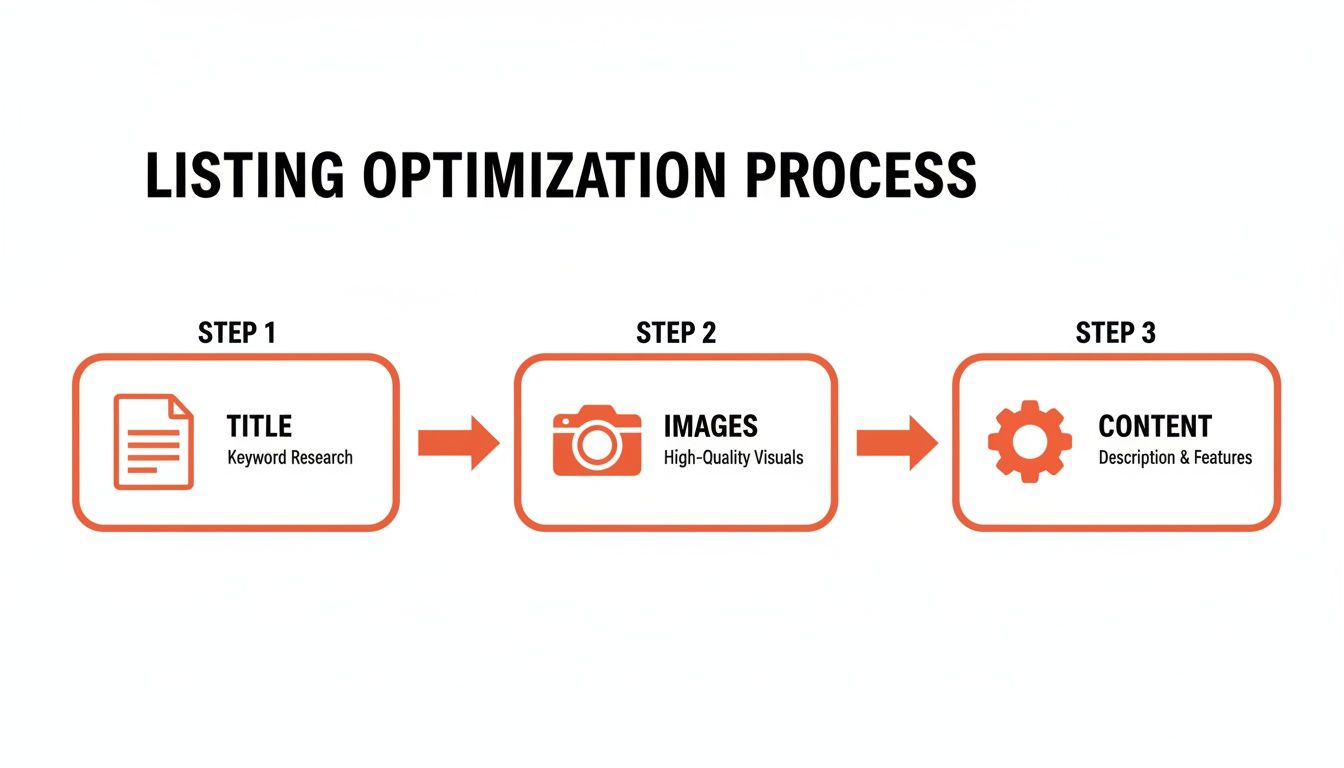
Think of your listing's health as having three pillars: the title, the images, and the content. Each requires ongoing attention to stay competitive.
The Order Fulfilment Workflow
When an order notification arrives in your Seller Central account, a precise sequence of actions must begin immediately. Any delay can affect your promised delivery window, a metric Amazon monitors closely.
First, verify the order. Go into Seller Central and review the order details for any special requests or potential issues, such as an unusually large quantity.
Next, place the order with your supplier. Send the order to your supplier immediately. Many established suppliers have an online portal for this, while others may use email or file uploads. This step is ideal for automation with third-party software.
Then, confirm and pay. Finalize the order with your supplier. Once they confirm the stock and send an invoice, pay it promptly. The faster you pay, the faster the order will ship.
Finally, receive and upload the tracking information. Your supplier will provide a tracking number as soon as the product ships. You must upload this number to the corresponding order in Amazon Seller Central without delay. Failing to do so will negatively impact your Valid Tracking Rate (VTR).
Your Valid Tracking Rate must remain above 95% to keep your account in good standing. Automating the order forwarding and tracking synchronization between your supplier and Amazon is one of the most beneficial operational improvements you can make.
Mastering Customer Service and Returns
Customer service in Amazon dropshipping is a critical function. You are responsible for every question, complaint, and return request.
Respond Promptly: Aim to answer all customer messages within 24 hours, including on weekends. Amazon tracks your response time, and fast replies build trust and can prevent small issues from escalating.
Handle Returns Gracefully: When a customer requests a return, you must authorize it according to Amazon's policy. Coordinate with your supplier on their process, but remember that the customer deals only with you. Provide clear instructions and a return shipping label.
A smooth operational flow is particularly important in growing markets. For instance, the dropshipping market in India is projected to grow from $10.8 billion in 2024 to $67.5 billion by 2033. With 218,000 active sellers on Amazon India, operational excellence is the only way to succeed and achieve the typical 15-20% profit margins.
Key Metrics to Monitor Daily
To maintain a healthy account, you need to check your Account Health dashboard daily. Monitor these key performance indicators (KPIs) regularly.
Order Defect Rate (ODR): This includes negative feedback, A-to-z Guarantee claims, and credit card chargebacks. It must stay below 1%.
Late Shipment Rate (LSR): This tracks orders confirmed for shipment after the expected date. Keep this below 4%.
Valid Tracking Rate (VTR): This measures how often you use valid tracking numbers and must be above 95%.
These metrics reflect how well you are running your business and satisfying customers. Allowing them to drop can lead to losing the Buy Box or, worse, account suspension. As your business grows, working with dedicated Amazon fulfilment companies can help keep these metrics on track.
Your Top Amazon Dropshipping Questions, Answered
Even with a solid plan, starting with Amazon dropshipping can be challenging. The rules are specific, the risks are unique, and small mistakes can have significant consequences.
Here are answers to the most common questions from new sellers. Understanding these fundamentals from the beginning is essential for building a sustainable business.
Is Dropshipping Really Allowed on Amazon?
Yes, but you must follow Amazon's rules. Their policy is clear and strictly enforced.
The primary rule is that you must be the seller of record on all paperwork and packaging. Your name must appear on the invoice, the packing slip, and any external branding. You are also responsible for handling all customer returns.
What is not allowed is retail arbitrage disguised as dropshipping. You cannot buy a product from another retailer like Walmart or eBay and have them ship it to your Amazon customer. This violates policy and is a quick way to get your account suspended.
What Are the Biggest Risks I Should Worry About?
The two biggest challenges in this business are typically unreliable suppliers and narrow profit margins.
A bad supplier can jeopardize your seller account. If they ship late, run out of stock unexpectedly, or use their own branding on the packaging, your seller metrics will suffer. Amazon holds you responsible, even if it was your supplier's error.
Profitability is the other major risk. After Amazon's referral fee (usually around 15%), supplier costs, and potential return expenses, margins can be thin. If you haven't chosen your products and negotiated costs carefully, you may find yourself doing a lot of work for little profit.
Success is about managing these two risks. First, establish a thorough supplier vetting process. Second, know Amazon's seller policies completely so that every action you take is compliant. Getting these two things right will solve most of the potential problems.
How Do I Actually Find Good Suppliers?
Finding reliable partners requires looking beyond a simple Google search. You need to search where legitimate wholesalers and manufacturers are active.
Vetted Directories: Start with platforms like SaleHoo or Worldwide Brands. They perform initial screening for you.
Trade Shows: Meeting potential partners in person can be very effective. Attend industry trade events to ask detailed questions about their dropshipping capabilities.
Go Direct: If you like a particular product, contact the manufacturer directly and ask for a list of their authorized distributors who offer dropshipping.
When you contact a potential partner, your first question should be direct: "Can you ship blind and meet Amazon's seller of record policy?" This means using your custom packing slips and plain, unbranded boxes. If they seem unsure, it is best to move on. Always get a formal dropshipping agreement in writing.
What Kind of Profit Margins Can I Realistically Expect?
Profit margins can range from 10% to 30%, but this is not guaranteed.
Your product niche is a major factor. In highly competitive categories, price competition can reduce your margins.
Your supplier's pricing is the other critical element. Securing good wholesale costs is essential. Finally, you must account for all of Amazon's fees, including the referral fee and your monthly Professional seller plan fee. Your final profit is what remains after you have balanced all these factors.
Success on Amazon isn't just about finding products; it's about seeing them through the eyes of Amazon's AI. Cosmy gives you that vision, auditing your content to find and fix the hidden visibility gaps that are costing you sales. Stop guessing and start optimising with data-driven insights. Get your free content audit at Cosmy.ai.