Unlocking Sales with Coupons on Amazon: A Practical Guide
Written by

Cosmy
AI-driven eCommerce Optimization
On Amazon, coupons appear as a small orange tag on product listings, offering customers a discount. More than just a price cut, they act as a signal to Amazon's system that can increase clicks and sales, which are essential for improving your product's search ranking.
Why Amazon Coupons Are a Powerful Sales Tool
A coupon is not just a discount; it's a strategic tool for gaining visibility in the crowded Amazon marketplace. That simple orange tag can be the reason a shopper clicks on your product instead of a competitor's. Getting that initial click is a critical first step.
When shoppers see a coupon, it creates a sense of immediate value, encouraging them to learn more. This directly improves your Click-Through Rate (CTR), a key metric for Amazon's A9 algorithm. A higher CTR indicates that your listing is relevant and appealing to customers, which can lead to a better position in search results over time.
Driving Sales Velocity and Ranking Momentum
Once a shopper clicks, the coupon helps complete the sale. By making the purchase more appealing, it increases the likelihood of a conversion. This boost in sales is called sales velocity—another significant factor for Amazon's ranking. Products that sell more quickly are considered popular, and Amazon rewards them with greater visibility.
For example, imagine you have launched a new product with no sales history, and it's buried deep in the search results. An aggressive coupon campaign can generate those crucial first sales. This kickstarts your sales velocity and shows the algorithm that your product is in demand, potentially moving it from obscurity to the first page.
A well-timed coupon is not just about short-term profit. It's about building long-term ranking authority. More visibility leads to more sales, which in turn leads to even more visibility.
Gaining a Competitive Edge
To understand the effectiveness of coupons, consider their role across the entire ecommerce industry. Shoppers are trained to look for deals. By offering a coupon, you meet this expectation and make your product more attractive than competitors who don't. This is especially important in categories where products and prices are very similar. The coupon becomes your key differentiator.
For example, in the competitive Indian eCommerce market, coupons are vital. During major sales events like the Great Indian Festival, shoppers actively search for promotions. Brands use these discounts to stand out. Offering a coupon is a clear, visual signal that helps your listing cut through the noise and win the click.
Creating Your First Amazon Coupon Campaign
Setting up your first coupon campaign on Amazon is straightforward. You don't need technical expertise; the interface in Seller Central is designed to be user-friendly. Here is a step-by-step guide to get you started.
First, go to your coupon dashboard. Log in to Seller Central, hover over the ‘Advertising’ tab, and click ‘Coupons’. This is where you will manage all your coupon activities.
From there, you will begin by selecting the products for your campaign. You can add them individually using their ASIN or SKU, or you can upload a list of products.
My advice? Start with a single, popular product that has good reviews. This allows you to measure the impact of the coupon clearly before applying it to your entire product line.
Choosing Your Discount Type
This is your first major strategic decision. Amazon offers two main types of discounts, and your choice should align with your campaign goals.
Percentage Off: A "15% off" coupon is effective for creating excitement. It often feels like a significant saving to shoppers, making it a powerful tool for new product launches or major sales events like Prime Day. A percentage discount can create a higher perceived value, even if the actual saving is the same as a fixed-amount offer.
Money Off: A direct discount like "₹100 off" is simple and effective, particularly for higher-priced items. On a ₹5,000 product, a "₹500 off" coupon is a tangible saving that can be the final push a customer needs to make a purchase.
Think about your objective. Are you trying to generate buzz for a new product, or are you aiming to make a premium item more affordable? Your goal will help you choose the right discount type.
The core idea is simple: a coupon serves as a visual hook that captures a shopper's attention, brings them to your listing, and increases the chance of a click. That click is the first step toward a sale and a positive signal to Amazon's ranking system.
This is how a coupon builds sales momentum.
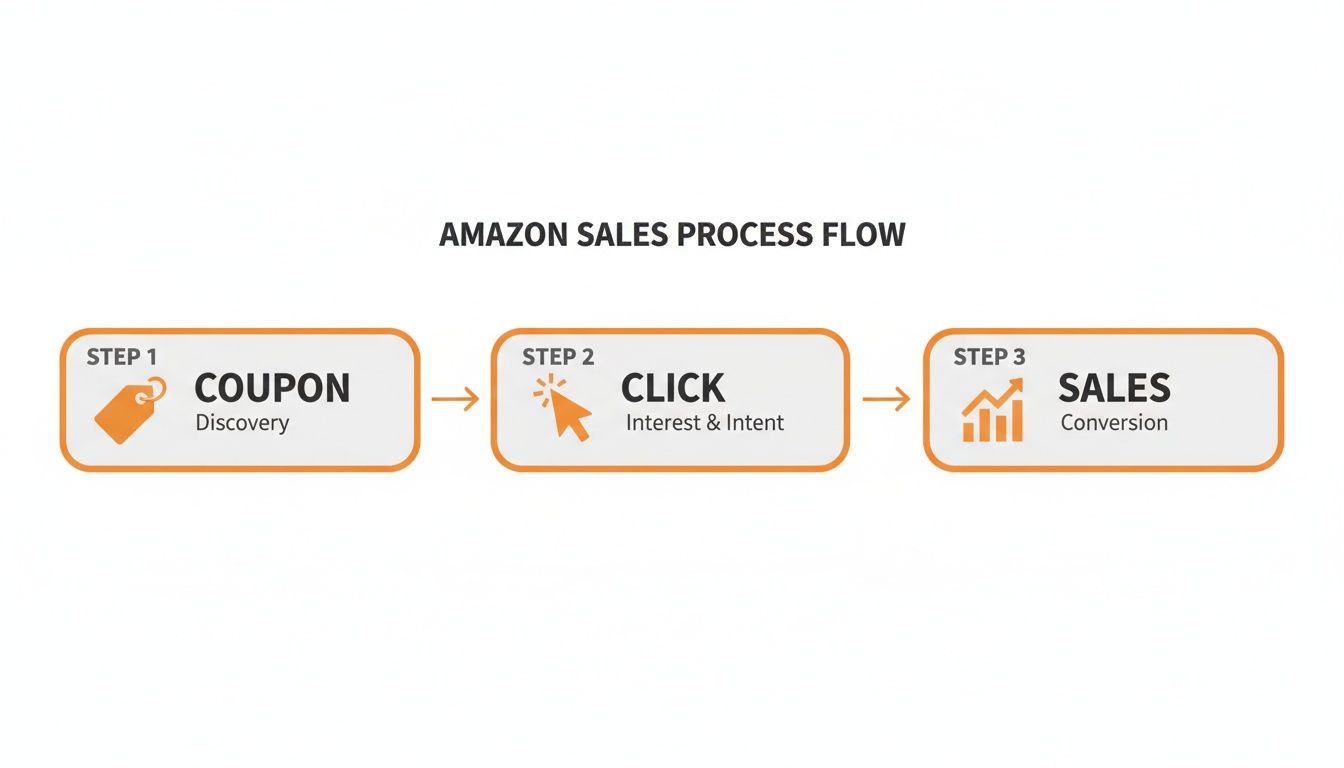
As the diagram illustrates, the coupon simplifies the customer's journey from discovery to purchase, acting as a powerful visual incentive.
Setting a Budget and Understanding Fees
Your budget is a crucial part of your campaign, as it prevents overspending. You set a total budget, and once that amount is reached, Amazon will automatically deactivate the coupon.
It is important to understand that your budget must cover two costs:
The discount amount itself.
Amazon’s redemption fee for each coupon used.
For every customer who redeems your coupon, Amazon charges a fee. For example, if you offer a ₹100 discount and the redemption fee is ₹50, your total cost per sale is ₹150. You must account for this in your budget.
The calculation is simple: (Discount per item + Redemption Fee per item) x Number of units you plan to sell with the discount
Let's do the math. If you offer ₹100 off, the redemption fee is ₹50, and you are willing to sell 50 units with this promotion, your budget should be (₹100 + ₹50) x 50 = ₹7,500.
Setting this budget ensures your campaign will end after 50 redemptions, protecting your profit margins. A clear financial plan is key to a successful first campaign.
Advanced Coupon Targeting and Budgeting
Once you understand the basics of creating coupons, you can start using them more strategically. Instead of offering a general discount to all shoppers, you can target specific customer groups to achieve your goals.
This targeted approach not only improves conversion rates but also ensures your budget is spent on shoppers who are most likely to buy. Amazon provides tools to move beyond a one-size-fits-all strategy, turning your coupons into a precise method for driving sales and building customer loyalty.
Pinpointing Your Ideal Customer
Amazon allows you to choose who sees your coupon. This lets you align your promotional spending with specific business objectives, such as rewarding loyal customers or attracting new ones.
Let’s review the key targeting segments available.
Amazon Coupon Targeting Options at a Glance
Selecting the right audience for your coupon can significantly impact your campaign's success. Here is a summary of the targeting options in Seller Central and when to use each one.
Targeting Option | Description | Best Used For |
|---|---|---|
All Customers | The standard option. Your coupon is visible to everyone browsing Amazon. | Maximizing visibility for new products or major sales events like Prime Day. Good for general brand awareness. |
Amazon Prime Members | An exclusive offer shown only to Amazon's most active customers. | Reaching high-intent buyers. Prime members are accustomed to deals and tend to convert at higher rates. |
Customers who have viewed certain ASINs | A retargeting strategy. Show a coupon to shoppers who viewed your product but did not buy. | Encouraging undecided shoppers to complete their purchase. Ideal for converting warm leads who need an extra incentive. |
Customers who have purchased certain ASINs | Re-engage past customers with a special offer. | Promoting repeat purchases for consumable products or cross-selling related items. Effective for building loyalty. |
Each option has a specific purpose. Combining these strategies based on your campaign goals can lead to the best results.
For example, if you sell premium coffee beans, you could run a coupon targeted only at Prime members the week before a major holiday. This helps you capture the attention of high-value shoppers before the main sales rush begins.
By targeting specific customer segments, your coupon becomes a strategic communication tool. You are no longer just reducing a price; you are creating a tailored incentive for a specific audience at a specific point in their buying journey.
Strategic Budgeting for Maximum Control
A smart targeting strategy must be paired with an equally smart budget. Simply setting a total budget and letting it run is not the most efficient approach. Using Amazon’s advanced budgeting tools can help you maximize your return.
The daily spending limit is a particularly useful tool. Instead of allowing a sudden increase in traffic to exhaust your entire budget in a few hours, a daily cap spreads your spending evenly throughout the campaign. This ensures your coupon remains visible all day, reaching shoppers in different time zones.
Another important tactic is scheduling your coupons. You can set specific start and end dates—and even times—for your promotion. If your sales data shows a peak on weekend evenings, you can schedule your coupon to run only from Friday afternoon to Sunday night. This concentrates your budget on high-traffic periods and avoids wasting money when your store is less active.
When you combine scheduling with targeted advertising, the effect can be significant. You can learn more about coordinating these efforts in our guide to Amazon PPC ads.
This level of control is especially important during major sales events. For example, Amazon India's Great Republic Day Sale often features significant, layered discounts. The 2026 event advertised up to 80% off on electronics, combining coupons with bank offers like a 10% instant discount from SBI. For brands participating in that sale, scheduling coupons to activate at the very beginning is essential to capitalize on the initial wave of traffic. More details on how these promotions work can be found at aboutamazon.in.
By using precise targeting with controlled, scheduled budgeting, you ensure your coupons on Amazon are seen by the right people at the right time. This strategic approach is what distinguishes successful sellers who consistently achieve profitable growth.
How to Measure Your Coupon Performance
A coupon campaign is only effective if it produces results. Launching an offer without tracking its performance is like guessing. By analyzing the data, you can turn it into useful business insights.

Amazon provides all the necessary performance metrics in the Amazon Advertising Console, under the same 'Coupons' tab where you created the campaign. The dashboard offers a clear, real-time view of how your promotions are performing.
Decoding Key Coupon Metrics
When you open your dashboard, you will see several key performance indicators (KPIs). Understanding what these numbers mean for your business is essential for making informed decisions. Let's look at the most important ones.
Here is a quick overview of the essential metrics in your coupon dashboard and what they indicate about your campaign's performance.
Key Metrics for Measuring Coupon Success
Metric | What It Measures | What to Look For |
|---|---|---|
Impressions | The total number of times your coupon was shown to shoppers on Amazon. | This represents your initial visibility. Low impressions may indicate poor organic ranking or overly narrow ad targeting. |
Clips | The number of customers who clicked the "Clip Coupon" button. | This shows initial interest. If impressions are high but clips are low, your offer may not be attractive enough. |
Redemptions | The number of times the coupon was used at checkout to buy your product. | This is your main conversion metric and the ultimate measure of success. |
Redemption Rate | Calculated as (Redemptions / Clips) x 100, this is the percentage of clipped coupons that led to a sale. | High clips but a low redemption rate could point to an issue on your product detail page (e.g., price, content, reviews). |
These metrics tell a story. For example, a campaign might have thousands of clips but few redemptions. This suggests that while your offer is compelling enough to get attention, something on your product detail page—such as the price, images, or description—is preventing shoppers from completing the purchase.
Your coupon's performance data is not just a report; it's a diagnostic tool. It identifies weak points in your sales process, showing you exactly where you need to make improvements, from the offer itself to your product listing content.
A Simple Framework for A/B Testing
The best way to determine what works is to test it. A/B testing, or split testing, involves running two slightly different versions of a campaign to see which performs better. This data-driven method eliminates guesswork and helps you find the right balance between attracting customers and maintaining your profit margins.
For example, you could test a 10% discount against a 15% discount on the same product.
Here’s how to set it up:
Create two separate coupon campaigns for the same ASIN.
Set one campaign with a 10% off discount and the other with 15% off.
Run them for a specific period, such as one week, with identical budgets and targeting to ensure a fair comparison.
After the test, analyze the data. Compare the Total Redemptions and Redemption Rate for both campaigns. You might discover that the 15% discount led to slightly more sales, but the 10% offer was more profitable overall after accounting for the larger discount. This is the type of insight that helps build a truly profitable strategy for using coupons on Amazon.
Calculating the True Return on Investment
Ultimately, the goal is to calculate the Return on Investment (ROI) of your coupon campaigns. You need to know if the additional sales generated by the discount are contributing to your bottom line after all costs are considered.
To get an accurate picture, you need to account for:
Total Discount Given: The total value of all redeemed coupons.
Total Redemption Fees: The fees charged by Amazon for each redemption.
Incremental Profit: The profit from sales you would not have made without the coupon.
Calculating precise incremental profit can be difficult, but a good estimate can be made by comparing your sales velocity during the campaign to the period before it. If your campaign costs ₹5,000 in discounts and fees but generates ₹15,000 in additional profit, it's a clear success.
Understanding these factors is crucial, especially when timing campaigns with major sales events. For instance, an analysis of coupon strategies during Amazon India's 2026 sales calendar shows a discount range of 30-80% during events like the Great Summer Sale and the Great Indian Festival. During these times, smart brands combine their offers with bank cashbacks to maximize their impact. You can find more insights about these seasonal sales dynamics and how top brands strategize at PaisaWapas.com. This information helps you benchmark your own offers against the market.
By consistently measuring, testing, and calculating ROI, you can confidently prove the value of your campaigns and make smarter, data-backed decisions every time.
Combining Coupons With AI Content Insights
Launching a coupon campaign is one thing; ensuring it is profitable is another. Driving traffic to your product page is only half the job. Once shoppers click the orange badge and arrive at your listing, your content must convince them to buy.
Your promotions and your content need to work together seamlessly. Instead of guessing what customers care about, you can use AI-powered insights to create a listing that answers their questions proactively. This ensures your coupon spending delivers a real return.

Think of it this way: your coupon is the invitation, and your product page is the event. If the content is confusing, vague, or fails to address key concerns, even interested shoppers will leave. Every lost sale represents wasted ad spend and a negative signal to Amazon’s system.
Uncovering What Shoppers Really Want To Know
The key is to understand your customers' mindset before they even see your page. Modern tools like Cosmy can analyze interactions with Amazon's generative shopping AI to show you exactly what information people are looking for when researching products like yours.
For example, if you sell high-performance wireless headphones, an AI analysis might reveal that many shoppers are asking questions like, "How long is the battery life for phone calls?" or "Are they sweat-resistant enough for the gym?" These are not just keywords; they are direct indications of what might be preventing a purchase.
By identifying the exact questions shoppers are asking, you can create targeted content that addresses the specific concerns influencing their buying decisions. This removes the guesswork from content optimization.
Once you have this information, your next steps are clear. You can update your listing to answer these questions directly.
Bullet Points: Add a bullet point that says, "Up to 8 hours of continuous call time and a full 24-hour charge with the case."
A+ Content: Include an image of someone using the headphones during a workout with a caption like, "IPX7 waterproof rating makes them perfect for any run, rain or shine."
Product Title: If "battery life" is a major concern, you could even add "Long-Lasting Battery" to your title.
Your product page is now optimized to convert the traffic your coupon is generating because it addresses the real-world concerns of your target audience.
Creating A Powerful Feedback Loop
This is not a one-time fix. It’s a continuous cycle of improvement. You use AI insights to refine your content, then run a targeted coupon campaign to drive traffic to the updated page. The higher conversion rate from the improved content immediately increases the ROI of your promotion.
Here’s a practical example. A brand selling portable power banks uses AI analysis and finds that shoppers are frequently asking Amazon's AI if their device can charge a laptop. Their current listing only mentions phones and tablets.
With this insight, they update their A+ Content with a graphic showing the power bank connected to a MacBook, clearly listing the compatible models. They then launch a 15% off coupon targeted at "Customers who have viewed certain ASINs" to bring back shoppers who were undecided.
The result? The conversion rate for this re-engaged traffic increases significantly. Their most important question is now answered as soon as they land on the page. To make the most of this strategy, a guide to using AI for content creation can help you write compelling copy that incorporates these insights into your brand's story.
Aligning Promotions With Content Strengths
This synergy also works in reverse. AI tools can help identify your listing's strongest selling points, which you can then emphasize in your promotional messages. If your product page effectively explains the benefits of a unique material, your coupon can be part of a larger ad campaign focused on that specific value proposition.
By integrating AI content insights with your coupon strategy, you stop treating marketing as a series of separate activities. It becomes a unified system. Each component reinforces the others, creating a cycle where data-driven content makes your coupons on Amazon more effective, leading to more sales, better sales velocity, and a stronger organic rank over time.
Common Questions About Amazon Coupons
Even with a solid strategy, you may have questions or encounter issues. This section addresses the most common problems sellers face, providing straightforward answers to help you resolve them quickly.
Think of this as your go-to guide for quick troubleshooting.
Why Is My Coupon Not Showing Up?
This is a frequent concern: you set up a coupon, but it isn't visible on your product page. In most cases, the solution is simple.
First, check the basics. Make sure your campaign's start date is correct. A coupon scheduled for tomorrow will not appear today. Also, confirm that your product is in stock and, most importantly, that you are winning the Buy Box. Amazon will not display a coupon for an offer that is not the main one customers see.
If these are all correct, the next thing to check is product eligibility. Amazon has strict rules:
The product cannot be on their restricted list.
It needs a sales history and, in most categories, a star rating of at least 3.5 stars.
Your seller feedback rating must also meet Amazon's minimum requirement.
If you've checked all these points and the coupon is still missing, wait a few hours. There can be a delay between when Amazon approves a campaign and when it becomes visible across the platform.
Can I Run a Coupon and a Deal at the Same Time?
Technically, yes, you can run a coupon alongside a deal (like a Lightning Deal or 7-Day Deal). However, you must be very careful.
The discounts will combine. A customer will receive the deal price plus the coupon discount. This can be a powerful sales driver during events like Prime Day, but it can also severely impact your profit margins if not planned correctly.
For example, let's say your product costs ₹2,000. You run a Lightning Deal that reduces the price to ₹1,600. If you also have a 20% off coupon active, that 20% will be calculated on the new, lower price. Always calculate the final, double-discounted sale price before launching both promotions.
A word of caution: Combining promotions is an advanced strategy. If you are new to Amazon deals, it is best to run them separately until you understand the costs and sales impact of each one individually.
What Is a Good Redemption Rate?
There is no single "good" redemption rate. It varies widely depending on your product, price point, and the competitiveness of your category.
Instead of aiming for a universal benchmark, focus on your own trends. The goal is to see your redemption rate improve over time as you test and learn. A low rate is not a failure—it's a signal to investigate further.
Is the discount too small? Is your main image not compelling enough? Do you have enough positive reviews to build trust?
Use the redemption rate as a diagnostic tool. A successful campaign is not just about giving away margin; it's about understanding what motivates your customers to buy. Pay close attention to this metric, and you will learn how to make every promotional rupee for your coupons on Amazon work more effectively for you.
Ready to stop guessing what your customers want and start giving them the answers they need? Cosmy uses AI to analyse shopper questions on Amazon, giving you the insights to create product pages that convert. Run a free content audit today and see exactly where your opportunities are. Learn more at cosmy.ai.