A Guide to Comparing Prices with Amazon: How to Protect Your Brand and Sales
Written by

Cosmy
AI-driven eCommerce Optimization
If you only check your prices on Amazon once a week, you're falling behind. Treating price comparison as a reactive task is a direct path to lost sales and shrinking profit margins. Small price differences have an immediate effect on your chances of winning the Buy Box, your product's visibility in search, and your overall revenue.
A systematic approach isn't just a good idea; it's how you turn price data into a real competitive advantage.
Why Comparing Prices with Amazon Is a Strategic Requirement
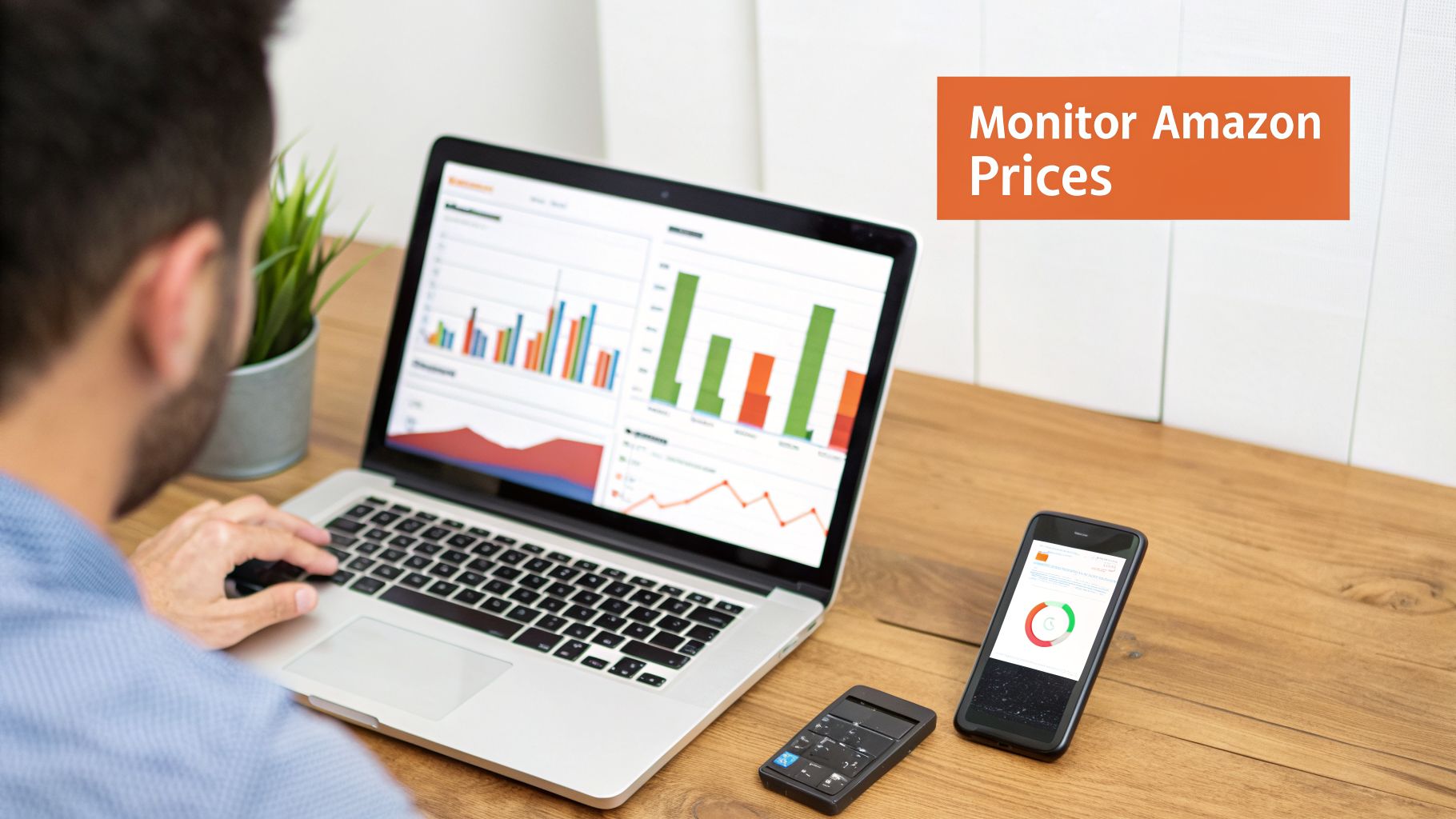
For any brand selling online, Amazon is more than just another marketplace. It's the benchmark that sets customer expectations for price everywhere else. You can't afford to ignore how your prices stack up. With Amazon's automated systems changing prices multiple times a day, shopper behavior and your product's visibility are always shifting.
A small price difference is often the only thing between you and the Amazon Buy Box—the checkout option that accounts for over 82% of sales. When your price isn't competitive, Amazon’s system can make your listing nearly invisible, even to shoppers searching for your brand by name.
The Real-World Impact of Price Differences
Failing to monitor and react to Amazon’s prices has tangible consequences. The damage isn't limited to Amazon; it affects all your sales channels, from your brand's reputation to your relationships with retailers.
Shrinking Profit Margins: Constantly lowering your price to match competitors without a clear strategy is a race to the bottom. Your profits will be the first to go.
Losing Customer Trust: A customer who buys a product directly from your website, only to find it cheaper on Amazon moments later, will lose confidence in your brand's value.
Damaging Retailer Relationships: Your wholesale and retail partners are watching. If they consistently see your products being sold for less on Amazon, you can expect difficult conversations about your pricing policies.
Comparing Your Website vs. the Amazon Marketplace
A key part of your strategy should be comparing the prices on your own direct-to-consumer (DTC) website against what's happening on Amazon. This isn't just about matching numbers; it's about understanding the total value you offer on each channel. The e-commerce world is vast, and different platforms have unique dynamics, as shown in this comparison of Aliexpress vs Amazon.
Here’s a practical look at the differences.
Comparison Point | Your Direct-to-Consumer Site | Amazon Marketplace |
|---|---|---|
Price Control | You have full control over pricing, sales, and promotions. | Your price is influenced by Amazon's algorithm and competing sellers. |
Customer Data | You own the customer relationship and all data for marketing. | Amazon owns the customer; you get very little direct data. |
Brand Experience | You have complete control to tell your brand story and design the user experience. | You're limited to a standardized template with minimal branding options. |
Associated Costs | Website hosting, marketing, and your own fulfillment logistics. | Referral fees, FBA (Fulfillment by Amazon) fees, storage costs, and advertising spend. |
The bottom line is that tracking prices should be a proactive process. By methodically monitoring how your products are priced on Amazon, you can shift from a defensive position to an offensive one. You start using data to make calculated decisions that protect your brand and drive sustainable growth.
Setting Clear Goals for Your Pricing Strategy
Before you start to compare prices with Amazon, you need to define exactly what success looks like for your business. Vague goals like “staying competitive” are not helpful and often lead to reactive decisions that hurt your profit margins. A solid pricing strategy starts with specific, measurable goals that are directly tied to your business objectives.
Without a clear destination, you're just collecting numbers. A specific goal acts as your guide, helping you make smart decisions when the market changes and ensuring your efforts lead to positive business outcomes.
From Vague Goals to Specific Metrics
The first step is to turn your broad business ambitions into clear Key Performance Indicators (KPIs). These are the metrics that tell you if your strategy is actually working. The right KPIs will depend on your market position, product category, and overall goals.
For example, a premium brand aiming to protect its value will track how its price compares to its suggested retail price. A high-volume seller in a crowded market will focus on winning the Buy Box.
A common mistake is focusing only on matching the lowest price. An effective strategy balances metrics that protect both market share and profitability. It’s about ensuring long-term brand health, not just making short-term sales.
The idea is to build a scorecard that gives you a quick, at-a-glance understanding of your performance.
Defining Your Primary and Secondary Goals
Organize your goals into two tiers: primary and secondary. Primary goals are your most critical, non-negotiable targets. Secondary goals provide context and help you understand why you are or are not hitting your primary goals.
Here’s what this looks like in practice:
Primary Goal: Protect Brand Value. You’ve invested heavily in quality and customer experience. You don't want your brand to be perceived as a discount item.
KPI Example: Keep the average price on Amazon no more than 5% lower than your Manufacturer's Suggested Retail Price (MSRP).
KPI Example: Reduce the number of unauthorized third-party sellers undercutting your price by 75% within 90 days.
Primary Goal: Maximize Sales. You’re launching a new product or competing in a saturated market. Gaining momentum is crucial.
KPI Example: Achieve a 90% Buy Box win rate on your top 10 products.
KPI Example: Ensure your price is within 3% of the top two competitors for a specific keyword search.
These measurable targets turn price monitoring from a passive chore into an active, strategic tool. They give you clear benchmarks for judging performance and make it easier to justify the resources you invest.
The table below breaks down essential KPIs you can adapt for your own strategy, providing a starting point for measuring what truly matters.
Essential KPIs for Amazon Price Monitoring
Here is a breakdown of key metrics to track, helping you measure the direct impact of your pricing strategies on business performance.
KPI Category | Metric | What It Measures | Target Example |
|---|---|---|---|
Market Position | Price Variance vs. Competitors | How your price compares to key rivals, expressed as a percentage. | Stay within +/- 5% of Competitor A on core products. |
Sales Performance | Buy Box Win Rate | The percentage of time your product is featured in the main Buy Box. | Achieve a 95% win rate on flagship products. |
Brand Integrity | MAP Policy Adherence | How often your products are sold below your Minimum Advertised Price. | Fewer than 2% of listings are below MAP at any given time. |
Profitability | Price Erosion Rate | The rate at which your average selling price decreases over time. | Limit price erosion to 3% each quarter. |
By establishing this framework before you dive into the data, you ensure every piece of information you gather serves a specific purpose. It’s the difference between being overwhelmed by data and using it to drive your business forward.
How to Build Your Price Comparison Toolkit
Once your goals are clear, it’s time to assemble your tools. To effectively compare your prices with Amazon, you need a repeatable, data-driven method for gathering the right information, not just a quick look at a competitor's page.
Reacting to the first price you see is a recipe for poor decisions. That single number ignores dozens of other factors that influence both Amazon's algorithm and a customer's choice to buy. A true apples-to-apples comparison goes much deeper.
The Data Points That Actually Matter
Building a reliable price comparison system means collecting information on several key factors. These signals paint a complete picture of the competitive landscape.
Landed Price: This is the real price the customer pays—the item price plus shipping. A low item price with a high shipping fee is a common tactic. If you're not tracking the total cost, you're missing the full picture.
Seller Reputation: Not all sellers are equal in Amazon's system. Monitor the ratings and review counts of your competitors, especially those winning the Buy Box. Amazon's algorithm favors sellers with a proven history of positive customer feedback.
Stock Levels: A competitor slashing their price is less of a threat if they only have five items left. Tracking inventory helps you understand if a price drop is a long-term strategy or just a temporary sale to clear out old stock.
Active Promotions: Keep an eye on coupons, "Lightning Deals," and other temporary offers. These can drastically change the effective price and often signal a competitor’s plan to boost sales or get rid of inventory.
Manual Tracking vs. Automated Tools
You have two main ways to gather this data: do it yourself or use software. While manual tracking might seem cheaper at first, it often costs more in the long run, especially as your business grows.
Manual Tracking usually means someone on your team spends hours each week checking Amazon product pages and entering numbers into a spreadsheet. It's tedious, difficult to scale, and the data is often outdated, as prices on Amazon can change multiple times a day.
Automated Tools are software programs built specifically for this purpose. They automatically collect data from Amazon at set intervals, giving you a constant stream of information across thousands of products and competitors without manual effort.
For almost any brand, manual tracking is a false economy. The hours your team spends on data entry are better spent analyzing the insights that automated tools provide. It’s about shifting focus from manual work to strategic thinking.
An automated approach allows you to build a rich dataset over time. To see how this works, you can learn more about using an Amazon price history tracker and discover how historical data can inform your future decisions.
Understanding Amazon's AI Signals
The best tools today go beyond simple price tracking. Modern platforms can help you interpret the complex signals that Amazon’s own AI, like its shopping assistant Rufus, uses to evaluate and recommend products. This gives you an edge by allowing you to make decisions based on what the algorithm sees, not just what a person sees.
This entire process follows a clear logic: you start with a specific goal, track a key performance indicator (KPI) to measure it, and drive a tangible business outcome.
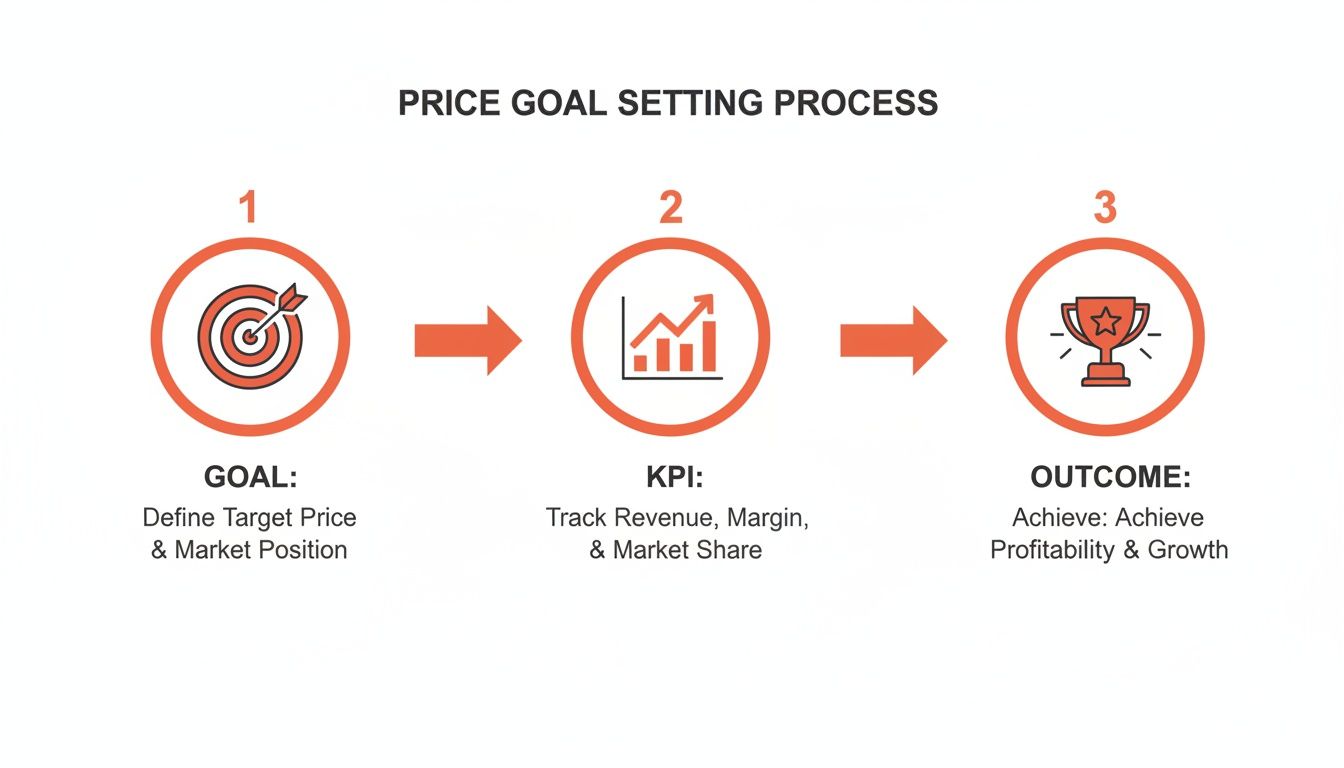
As the visual shows, a winning pricing strategy is a straight line connecting a clear goal, a measurable KPI, and a concrete business outcome.
This kind of intelligence is critical. In a dynamic market like India, for example, where savvy shoppers in tech hubs like Bangalore drive fierce e-commerce competition, prices can change dramatically. Data shows a Lifelong Cushion Massager's price on Amazon.in can fall from a high of ₹4,999 to just ₹1,149—a 77% drop. This isn’t just for high-end items; a simple fire extinguisher has been seen dropping from ₹510 to ₹92. With over 72% of Indian online shoppers using price comparison tools, failing to monitor these changes is a surefire way to lose sales.
Ultimately, your toolkit should empower you to act with confidence. It’s about transforming the chaotic job of comparing prices into a structured, data-driven process that protects your profitability and supports your strategic goals.
Developing A Competitive Response Playbook

Having the right pricing data is only the first step. Knowing when a competitor drops their price is useless without a plan for what to do next. This is where a competitive response playbook comes in—a simple set of ‘if-then’ rules that takes the guesswork out of your reactions.
This isn’t about blindly matching every price drop in a race to the bottom. It’s about creating a pre-approved menu of strategic actions that protect your profit margins, defend your brand’s value, and keep you on track with your business goals. This structure empowers your team to act quickly and consistently when the market changes.
Building Your If-Then Scenarios
The core of your playbook is defining specific market triggers and your corresponding actions. The goal isn't to cover every possibility but to create clear, repeatable instructions for the most common pricing threats you face on Amazon.
For each trigger, outline a primary and secondary response. This gives your team the flexibility to adapt while ensuring every move is deliberate.
Example Scenario: A Key Competitor Cuts Their Price by 10% or More This is an aggressive move designed to steal your sales and win the Buy Box. A knee-jerk reaction to match the price is tempting, but it’s often the wrong move for your bottom line.
If: A primary competitor drops their price by more than 10% on a core product.
Then (Option A): Immediately launch a limited-time coupon for 5-7% off. This narrows the price gap enough to stay competitive without permanently devaluing your product.
Then (Option B): Hold your price and focus on improving your product page. Review and enhance your A+ Content with better images or text that highlights features your competitor lacks, justifying your price.
Strategies Beyond Simple Price Matching
Winning on Amazon often has little to do with having the lowest price. Both shoppers and Amazon’s algorithm consider the entire offer, not just the price tag. Your playbook must include value-added strategies that defend your price without starting a race to zero profit.
These non-pricing moves are your most powerful defense because they build a competitive advantage that is difficult for others to copy.
A well-crafted response playbook forces you to constantly improve your value proposition. Every competitive threat becomes an opportunity to strengthen your content, enhance your offer, or create product bundles that make your brand more resilient.
Think about how you can increase the perceived value of your offer. For example, using Amazon's Virtual Bundles feature to pair a core product with a high-margin accessory creates a unique item that can't be directly price-matched. This can increase your average order value while making a direct price comparison impossible for shoppers.
To make these decisions effectively, you need to track competitor movements with precision. For a detailed guide, see our article on using Keepa for Amazon to see how it can enhance your competitive intelligence.
A Framework for Strategic Responses
To make your playbook truly actionable, organize it into a simple table. This format connects the "what" (the competitive scenario) with the "how" (your response) and, most importantly, the "why" (the strategic goal).
When your team is under pressure, this structure provides the clarity they need to act decisively and in line with the KPIs you’ve already set.
Competitive Pricing Scenarios and Strategic Responses
Competitive Scenario | Your Strategic Response Option | Objective of Response | Key Considerations |
|---|---|---|---|
New Seller Enters Market | Hold price; monitor their stock levels and seller feedback daily. | Gather information before acting; assess if they are a legitimate long-term threat. | Are they using FBA or fulfilling orders themselves? Do they have a professional-looking store? |
Lost Buy Box on a Key Product | Immediately check if price is the issue. If so, implement a small, temporary price reduction. | Regain control of the Buy Box to restore sales and visibility. | Could an underlying issue like seller metrics or low stock be the real problem? |
Chronic Undercutting by a Reseller | Do not engage in a price war. Focus on brand registry and report potential MAP violations. | Protect brand value and relationships with retail partners. | Document all instances of price violations with screenshots and timestamps. This is essential. |
Competitor Runs a Lightning Deal | Do not match the temporary deep discount. Consider running a coupon to capture deal-seeking traffic. | Maintain price integrity while capturing a share of heightened category interest. | Is their deal actually pulling significant traffic away from your listing? Monitor your page views. |
By developing this playbook, you transform the chaotic, reactive task of monitoring Amazon into a controlled, strategic function. Your team will know exactly what to do and why, allowing them to act with confidence and protect your bottom line.
Common Pricing Mistakes and How to Avoid Them
Effective price monitoring on Amazon is about more than just having good data. It’s about sidestepping common mistakes that can quietly drain your profits and damage your brand's reputation.
Even experienced teams can fall into traps that seem logical at first but cause serious long-term harm. Knowing what these pitfalls look like is the first step to avoiding them.
One of the most tempting and dangerous traps is the "race to the bottom." You see a competitor slash their price, and your gut reaction is to match them. This response only shreds your profit margins and teaches customers that your brand isn't worth its full price.
Miscalculating the True Cost
A classic mistake is focusing on the listed item price while ignoring the total cost to the customer. It's a common tactic for sellers to lure shoppers with a low item price, only to add a high shipping fee at checkout. If your analysis doesn't account for this "landed price," your entire comparison is flawed.
You might think you’re price-matched, but a competitor offering "free shipping" could be undercutting your final offer by a significant amount. Always compare the total checkout price—that’s the number a customer actually sees and the one that drives their decision.
An effective pricing strategy isn't about being the cheapest; it's about being the most competitive on the total value offered. This includes the product, shipping cost, delivery speed, and the seller's reputation.
Ignoring Important Compliance Rules
The pursuit of competitive pricing can sometimes lead brands into trouble, particularly when it comes to Amazon’s own rules and your agreements with retail partners. Two areas demand constant attention: MAP policy and Amazon's Fair Pricing Policy.
Minimum Advertised Price (MAP) Violations: If you sell through retail partners, you likely have MAP agreements that dictate the lowest price your products can be advertised. Aggressive repricing on Amazon can easily put you in breach of these terms, creating conflict with your most important partners and risking them dropping your product line.
Amazon's Fair Pricing Policy: Amazon actively polices what it considers unfair pricing. This includes setting a price that is significantly higher than recent prices for the product on or off Amazon. Overly aggressive or erratic price changes can trigger this policy, leading to your offer being hidden or, in worst-case scenarios, your account being suspended.
Relying on Incomplete or Outdated Data
Another major pitfall is making strategic decisions based on old information. On a marketplace as dynamic as Amazon, yesterday's price is ancient history. A competitor's price can change multiple times in a single day, making manual tracking in a spreadsheet completely ineffective.
Basing your strategy on a single data point—like a sudden price drop—without the full context is just as risky. Why did the price change? Is the competitor trying to sell their last 10 units, or is this a strategic move backed by thousands of units in their warehouse?
Without automated monitoring that tracks price, stock levels, and seller changes in near real-time, you're making decisions in the dark. This lack of complete data inevitably leads to poor, reactive choices that hurt your profitability. A competitor with low stock isn't a threat; it's just market noise.
Measuring The ROI Of Your Pricing Strategy
Connecting your pricing strategy to clear business results is the final and most critical step. This is where you prove the return on investment (ROI) from the time and tools you’ve put into your Amazon price comparison efforts. It all comes back to the KPIs you defined at the beginning.
Effective measurement isn’t just about pulling numbers; it's about telling a clear story to your team and leadership. You have to show a direct cause-and-effect relationship between your pricing actions and bottom-line results.
From Actions to Tangible Business Results
The most persuasive reports leave no room for doubt. Instead of saying "our pricing strategy worked," you need to present specific, measurable wins that tie your efforts directly to revenue.
Think in terms of success stories that are easy to understand.
"By using an automated rule to keep our price within 3% of our top competitor, we increased our Buy Box share from 60% to 85% in 45 days. This led directly to a 20% increase in sales for our flagship product."
A statement like this combines the action, the metric improvement, and the financial outcome into a single, powerful narrative. It’s the difference between just reporting data and proving your value.
Creating Clear Reports for Leadership
Your final job is to communicate this value across the organization. The best way to measure the ROI of your pricing strategy is by building custom dashboards to track KPIs that connect your performance indicators directly to business goals.
Your reports should be straightforward, visual, and focused on what leadership cares about—sales, market share, and profitability. For a practical tool to help with this, you might find our guide on using an Amazon revenue calculator useful.
Use simple charts to show trends over time:
Buy Box Win Rate: A line graph showing the percentage increase since you launched your new strategy.
Sales Volume vs. Price Changes: A chart with two axes that shows exactly how price adjustments impacted unit sales.
Average Selling Price (ASP): A chart proving your strategy protected or even increased your ASP, showing you didn’t just start a race to the bottom.
When you consistently track these outcomes and report on them clearly, you get the whole organization to support a data-driven approach. You turn price monitoring from a tedious task into a recognized driver of growth, proving that a smart strategy to compare prices with Amazon is one of the most profitable investments you can make.
Your Top Amazon Pricing Questions, Answered
When you start to formally compare your prices with Amazon, many questions come up. Here are straightforward answers to the most common ones.
How Often Should I Check Prices on Amazon?
Checking prices weekly or even daily is not enough. Amazon's prices—and those of your competitors—can change multiple times in a single day.
For any meaningful strategy, you need near real-time monitoring. This is only possible with automated tools. Anything less means you're reacting to old information and losing potential sales.
Is Being the Cheapest Always the Goal?
Absolutely not. This common misconception leads directly to lower profits and devalues your brand. Blindly chasing the lowest price is a race to the bottom that you can't win.
The real goal is to find the optimal price—the sweet spot that balances market competitiveness with your own profitability. Sometimes, the right move is to hold your price steady and let your superior product page, faster shipping, or stronger brand reputation justify the cost.
Research consistently shows Amazon’s prices average around 14% lower than other major online retailers. A direct price war is unwinnable. Your strategy must be about defending value, not just cutting costs.
Can I Get in Trouble for Changing My Prices Too Often?
Yes. Amazon takes its Fair Pricing Policy seriously. This policy is designed to stop price gouging and any other behavior that creates a bad customer experience.
Wild, unpredictable price swings can trigger this policy, which could cause your offer to be hidden or even lead to your account being suspended. Your pricing strategy must be both competitive and compliant.
Additionally, if you work with retail partners, constantly undercutting them on Amazon can violate your Minimum Advertised Price (MAP) agreements and damage those crucial business relationships. A smart strategy respects these boundaries.
What’s More Important Than Price?
Several factors are just as important, if not more so, than the number on the screen. When you compare prices with Amazon, you have to look at the entire offer.
The Landed Price: This is the total cost to the customer, including shipping. A low item price with high shipping is a classic tactic used to appear cheaper.
Seller Reputation: Amazon's system heavily favors sellers with high ratings and a history of positive feedback. A strong reputation is a competitive advantage.
Stock Availability: Don't panic over a competitor who has only a few items left. That’s a temporary market event, not a serious long-term threat.
Delivery Speed: In the age of Prime, a faster estimated delivery date can easily win the sale, even at a slightly higher price.
Ultimately, winning on Amazon isn't about looking at one number. It's about understanding the complete value that your customer sees.
Ready to stop guessing and start winning on Amazon? Cosmy delivers the AI-driven insights you need to optimise your content, improve visibility, and drive sales. Get your free, actionable audit today and see what Amazon’s algorithm really thinks of your products. Visit https://cosmy.ai to get started.