Mastering the Amazon Buy Box: A Practical Guide for Sellers
Written by

Cosmy
AI-driven eCommerce Optimization
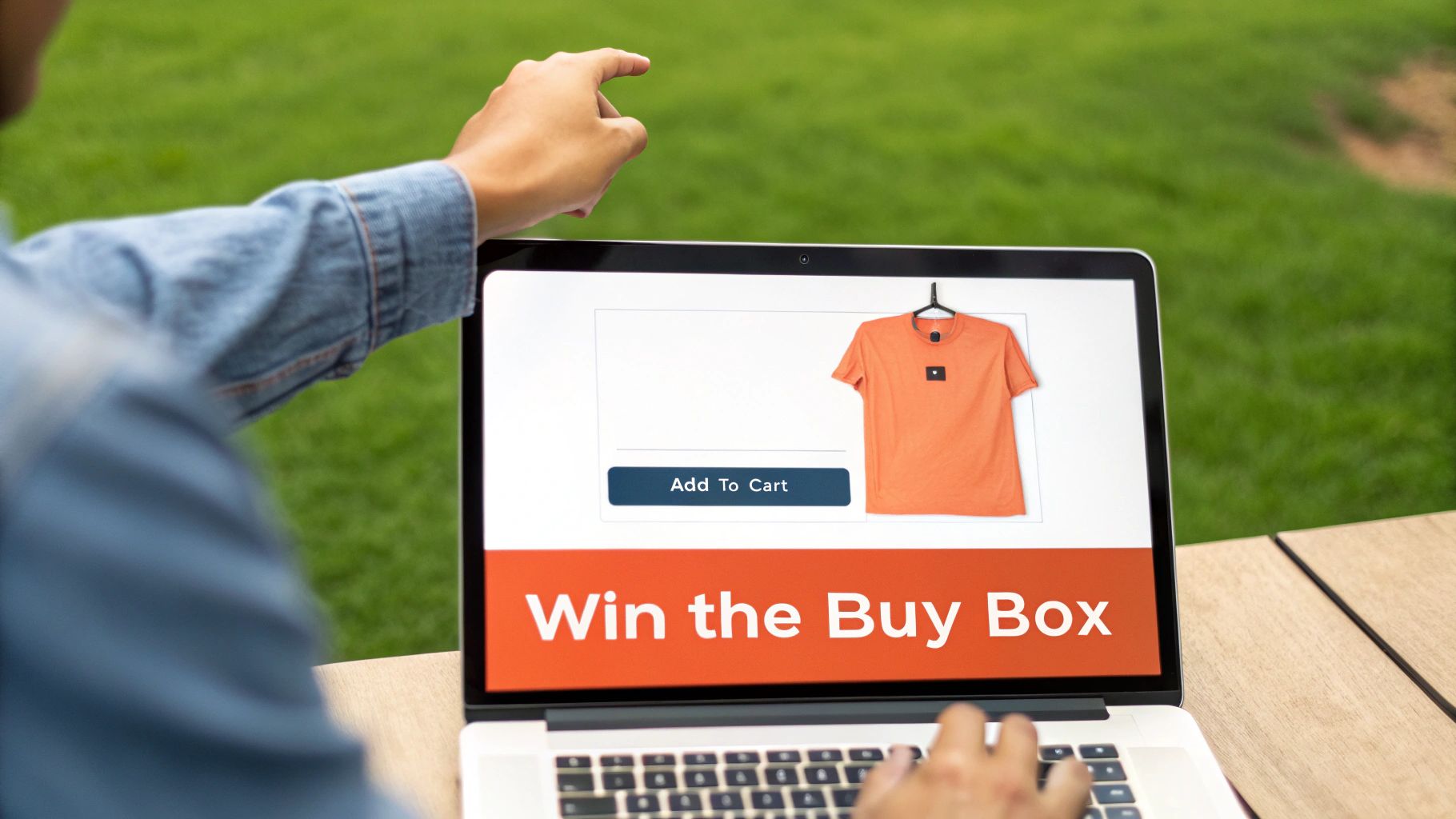
If you sell on Amazon, there's one piece of digital real estate that matters more than anything else: the Buy Box. It's that simple white box on the right side of a product page with the "Add to Cart" and "Buy Now" buttons. It might not look like much, but it's the gateway to the vast majority of sales on the platform.
Because multiple sellers can list the exact same product, Amazon's algorithm awards that prime spot to only one seller at a time. Winning it means you become the default choice for every customer who lands on that page.
What Is the Amazon Buy Box and Why It Matters
Here's a simple analogy: think of Amazon as the world's biggest shopping centre. Every unique product—say, a specific model of Sony headphones—has its own dedicated shop. Inside that shop, several authorised retailers might be selling the exact same headphones. But only one gets their display right at the entrance, where every single customer has to walk past.
That prime display is the Buy Box.
When a shopper finds the headphones they want, their eyes immediately go to those big, prominent "Add to Cart" and "Buy Now" buttons. A single click, and the sale automatically goes to whichever seller currently "owns" the Buy Box. The other sellers aren't gone, but they're pushed aside into a tiny, often-ignored link that says "Other sellers on Amazon."
The Unseen Battle for the Sale
This creates a constant, fierce competition happening behind the scenes. Amazon's algorithm is always at work, evaluating every eligible seller for that specific product. It's looking for who offers the best overall customer experience—factoring in price, shipping speed, and seller reputation. The winner of this continuous, automated evaluation gets featured in the Buy Box.
The importance of winning this battle cannot be overstated. Year after year, the data is clear: over 80% of all Amazon sales happen through the Buy Box. On mobile devices, where it’s a pain to browse for other sellers, that number is even higher.
Owning the Buy Box is not just an advantage; it's the primary driver of consistent sales. For any given product, if you aren't in the Buy Box, you are practically invisible to the majority of potential customers.
This means just listing a product on Amazon isn't enough. The Buy Box is a critical pillar of any successful strategy and a core part of effective marketplace SEO. To really succeed, you have to actively compete for—and win—this placement.
Every unique product has its own Buy Box, a concept tied directly to its unique identifier, which you can learn more about by understanding the role of the ASIN for Amazon products. The strategies we'll cover in this guide are all designed to help you do just that.
Getting Eligible to Compete for the Buy Box
Before you can even think about winning the Buy Box, Amazon has to see you as a credible, reliable seller. Think of it as getting a ticket to the main event; if you don't meet certain standards, you won't even be allowed in the arena. These aren't just random hoops to jump through—they're how Amazon protects its customers and ensures every Buy Box purchase is a great experience.
First things first, you need a Professional Seller account. The free Individual plan simply doesn't qualify for the Buy Box, making the upgrade a non-negotiable first step if you're serious about growing on the platform. This account unlocks the features and data you'll need to compete effectively.
A couple of other basics: the products you're selling must be new. Used or refurbished items have their own offer space and aren't eligible to be the star of the show. You also have to actually have the items in stock and ready to go. An empty shelf can't win a sale.
Your Account Health Report Card
Beyond the basics, Amazon's algorithm is constantly grading your performance on several key metrics. These numbers are a direct reflection of how trustworthy you are. To compete for the Buy Box, you have to keep these stats in pristine condition.
Order Defect Rate (ODR): This is arguably the most critical metric. It’s a combination of negative feedback, A-to-z Guarantee claims, and credit card chargebacks. To stay in the game, your ODR must be below 1%.
Cancellation Rate: This is the percentage of orders you cancel before shipping. A high rate tells Amazon you have inventory management problems. You need to keep this under 2.5%.
Late Dispatch Rate: This tracks how many of your orders ship after the promised date. Shipping on time is non-negotiable, and this rate has to stay below 4%.
Think of these metrics as your seller reputation. Just as you'd trust a friend who is always on time and reliable, Amazon gives the Buy Box to sellers who consistently prove their dependability through strong performance data.
Staying in the Game
Meeting these targets isn't a one-time thing; it requires constant attention. Amazon looks at your performance over both the short term (60 days) and the long term (90 days). One bad week can knock you out of the running, which shows just how important consistent operational excellence really is.
If you're handling your own shipping, providing valid tracking numbers for at least 95% of orders is also a must. This gives both Amazon and the customer peace of mind that the order is securely on its way.
Ultimately, these eligibility rules are all about protecting the customer. By making sure only top-tier sellers win the Buy Box, Amazon maintains trust in its marketplace. If you manage your own logistics, it's a smart move to learn how an Amazon fulfillment center operates to truly understand the high standards you're up against. By regularly checking your Seller Central dashboard and focusing on these core metrics, you can make sure your ticket to the competition is always valid.
Understanding the Key Buy Box Winning Factors
Once you’re eligible to compete, the real work begins. You need to understand what Amazon’s algorithm actually wants to see from a seller. Winning the Buy Box isn't a game of chance; it’s about consistently proving to Amazon that you offer the best possible experience for their customers. The algorithm weighs several factors, but they are not all equal.
Think of it like a recipe. A pinch of salt matters, but the main ingredients—like flour and water for bread—are what give the dish its structure. For the Buy Box, your fulfilment method, price, and seller performance are those core ingredients.
This flowchart lays out the foundational requirements just to get in the game.
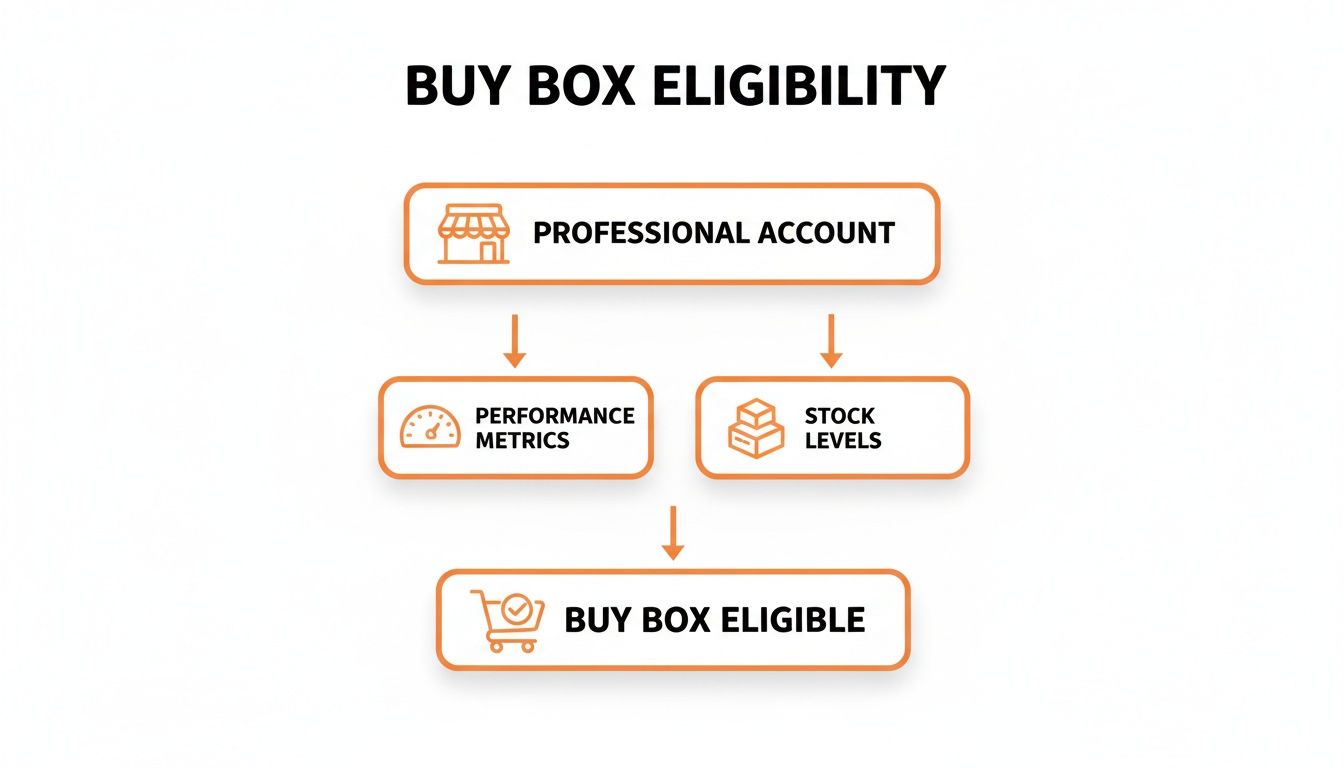
As you can see, a Professional Account is the starting point, leading to the two pillars of solid performance metrics and healthy stock levels. These are non-negotiable for eligibility.
Fulfilment: The Most Important Factor
The single most influential factor in the Buy Box algorithm is how you get the product into the customer's hands. Amazon places a massive premium on speed and reliability, which is why sellers using Fulfillment by Amazon (FBA) have such a powerful, built-in advantage.
When you use FBA, Amazon handles your storage, packing, shipping, and customer service. Critically, your products automatically become Prime-eligible, guaranteeing fast, free shipping for millions of Prime members. Because Amazon controls the entire process, its algorithm views FBA offers as the gold standard for a dependable customer experience.
This advantage is so significant that a seller using FBA can often win the Buy Box even if their price is higher than a competitor fulfilling orders themselves (Fulfilled by Merchant, or FBM). The algorithm knows an FBA order will be delivered quickly and reliably, and it heavily favours that certainty.
The table below breaks down the primary factors Amazon's algorithm considers when awarding the Buy Box, helping you prioritise your optimisation efforts.
Buy Box Algorithm Factors and Their Impact
Factor | What It Means | Why It Matters | Actionable Tip |
|---|---|---|---|
Fulfilment Method | How you get products to the customer (FBA vs FBM). | This is the most heavily weighted factor. Amazon's trust in FBA gives Prime-eligible offers a massive advantage. | Enrol your top-selling products in FBA to immediately boost your Buy Box chances. |
Landed Price | The total cost to the customer, including item price and shipping. | Price is crucial, but it's about competitive value, not just being the cheapest. | Use a repricing tool to stay competitive without starting a race to the bottom. Stay within 2% of the current Buy Box price. |
Seller Performance | Metrics like Order Defect Rate (ODR), feedback score, and customer response time. | These act as a tiebreaker and a signal of your reliability. Strong metrics can help you win against similarly priced offers. | Respond to all customer messages within 12 hours (well under the 24-hour requirement) to keep your account health pristine. |
Shipping Speed | The time it takes for an item to reach the customer. | For FBM sellers, this is a make-or-break factor. For FBA, this is handled by Amazon and is a key part of its advantage. | If shipping FBM, offer multiple shipping options, including expedited services. Aim to beat your stated delivery times. |
Each of these elements plays a part, but mastering them in the right order—starting with fulfilment—is the key to a winning strategy.
Landed Price: The Smart Approach to Competitiveness
After fulfilment, the next most important factor is the landed price. This isn't just your item price; it's the total cost the customer pays, including shipping. Amazon's entire brand is built on offering customers great deals, so a competitive landed price is essential.
However, many sellers fall into the trap of thinking they must have the absolute lowest price to win. This simply isn't true.
Simply being the cheapest seller is a race to the bottom that can destroy your profit margins. Amazon's algorithm rewards the best overall value, not just the lowest price tag.
Let's look at a common scenario with two sellers:
Seller A (FBM): Price is $20 + $4.99 shipping (Landed Price: $24.99). Ships in 3-5 days.
Seller B (FBA): Price is $24.99 (Landed Price: $24.99). Ships with free, two-day Prime delivery.
Even with the exact same landed price, Seller B has a much higher chance of winning the Buy Box because of the superior FBA shipping promise. This perfectly illustrates how a strong fulfilment method allows you to price higher than FBM competitors and still come out on top. You can dive deeper into how pricing influences sales by exploring our guide on how to check the price history of an item on Amazon.
Seller Performance Metrics: The Tiebreaker
So, what happens when you and a competitor both use FBA and have similar pricing? This is where Amazon's algorithm looks at your seller performance metrics to break the tie. These metrics are a direct reflection of your customer service quality and reliability over time.
Consistently strong performance tells Amazon you're a trustworthy partner. The key indicators that carry the most weight include:
Order Defect Rate (ODR): As mentioned, this must be under 1%. It’s a critical measure of your overall account health.
Shipping Performance: For FBM sellers, on-time delivery and valid tracking are non-negotiable. Late shipments will quickly knock you out of contention.
Customer Response Time: Responding to buyer messages within 24 hours is a requirement, but top sellers aim for much faster.
Feedback Score: A high seller rating built on positive customer reviews demonstrates a history of happy customers.
The importance of delivery speed, in particular, cannot be overstated. In hyper-competitive markets like Amazon India, for instance, delivery speed now accounts for 25% to 30% of the algorithm's calculation—a sharp rise from its previous 15% weighting. This reflects a massive consumer demand for same-day or next-day delivery.
Sellers using Amazon's regional Fulfilment Centres in these areas are seeing their Buy Box win rates jump by an average of 18%, even without being the cheapest. A seller promising next-day delivery from a local warehouse can easily beat a competitor with a slightly lower price but a 5-7 day shipping window.
These factors all work together. A seller with a perfect ODR and a 99% feedback score can often secure the Buy Box against a similarly priced FBA competitor who has a slightly weaker performance history. It's Amazon's way of rewarding sellers who consistently go the extra mile.
Actionable Strategies to Win and Hold the Buy Box
Knowing the rules of the Buy Box is one thing. Actually using that knowledge to win it is a completely different ball game. It’s time to move from theory to action with a focused, prioritised game plan.
These are the real-world tactics you can put into play right now to improve your win rate and keep that coveted spot locked down.
Master Your Pricing Strategy
Let's get one thing straight: being the absolute cheapest isn't the magic bullet. But you absolutely must be competitive. The trick is to be smart and strategic with your pricing, not just cheap.
Trying to manually track competitor prices is a recipe for insanity, especially at scale. This is where automated repricing tools become non-negotiable. These tools constantly adjust your prices based on what the competition is doing, keeping you in that sweet spot to win the buy box amazon.
But just turning on a repricer and hoping for the best is a huge mistake. You need to set clear rules.
Floor Price: This is your line in the sand—the lowest you’ll go while still turning a profit. Never, ever set this too low.
Ceiling Price: This is your ideal high price, which can snag you extra profit when your competitors suddenly go out of stock.
Think of a repricer as an employee you need to manage. By giving it clear rules—a floor and a ceiling—you empower it to make smart decisions for you 24/7 without risking your profitability.
For instance, you could set a rule to price your item $0.01 below the current Buy Box winner, but only if that price stays above your floor. This keeps you aggressive without getting dragged into a destructive race to the bottom.
Make Fulfilment Your Top Priority
As we've covered, your fulfilment method is the single most powerful lever you can pull. Your choice between FBA and Seller-Fulfilled Prime (SFP) needs to be a deliberate business decision, not an afterthought.
Fulfillment by Amazon (FBA) is the most direct path for most sellers. When you let Amazon handle your logistics, you instantly get the Prime badge and the enormous trust that comes with it. Amazon’s algorithm heavily favours FBA offers because it knows the customer will get a fast, reliable experience.
Seller-Fulfilled Prime (SFP) is a powerful option, but only for established sellers with rock-solid logistics. It lets you display the Prime badge while shipping from your own warehouse. The catch? The performance standards are incredibly strict. You have to hit Amazon's two-day delivery promise, every single time. SFP really shines for businesses with oversized items, multi-channel operations, or those who want tighter control over their inventory.
For most brands, enrolling your best-selling products in FBA is the fastest way to see a major jump in Buy Box ownership. The higher fees are often a small price to pay for the massive boost in visibility and sales.
Defend Your Inventory Levels
You can't sell what you don't have. Running out of stock is one of the quickest ways to lose the Buy Box, and it can be a real fight to win it back even after you’ve restocked. A stockout sends a clear signal to Amazon: you're an unreliable source for that product.
This is where proactive inventory management becomes critical. It means looking beyond your current stock levels and forecasting demand based on sales history, seasonality, and any promotions you have planned.
Get into these simple habits to prevent stockouts:
Set Reorder Points: Figure out the minimum stock level for each product that should trigger a new purchase order.
Monitor Your IPI Score: Keep a close eye on your Inventory Performance Index (IPI) in Seller Central. A healthy score ensures you have enough storage space at Amazon’s fulfilment centres.
Factor in Lead Times: Always account for how long it takes for your supplier to make and ship your products to you or an Amazon warehouse.
Protect Your Seller Metrics Relentlessly
Finally, think of your seller metrics as your reputation on Amazon. When you’re neck and neck with another seller on price and fulfilment, these metrics are the powerful tiebreaker. Protecting them demands a serious commitment to outstanding customer service.
The goal here is to be proactive, not reactive. Don't wait for problems to pop up. Check your account health daily and tackle any issues the moment they appear.
Your primary focus should be on:
Rapid Customer Service: Answer every single buyer message in under 12 hours—way faster than Amazon's 24-hour requirement. This small effort makes a huge difference in customer satisfaction.
Effective Feedback Management: Use tools to request feedback from happy customers to build a strong seller rating. If negative feedback comes in, address it professionally and do everything you can to resolve the customer's issue.
By mastering these four areas—pricing, fulfilment, inventory, and seller metrics—you’re not just chasing the Buy Box. You’re building a resilient, trustworthy reputation that Amazon's algorithm will consistently reward over the long term.
Winning the Buy Box isn't a "set it and forget it" kind of deal. It’s a constant tug-of-war. To keep your position and protect that sales momentum, you need to keep a close eye on your performance and know exactly how to react when things go sideways.
Luckily, Amazon gives you the tools to do this right inside Seller Central. The single most important number to watch is your Featured Offer Percentage. This metric cuts through the noise and tells you exactly how often your offer was the default choice in the Buy Box when customers landed on the page.
Finding Your Buy Box Report Card
You can find this data in your Seller Central account under the "Pricing" tab, then click into the "Pricing Health" dashboard. Amazon breaks this percentage down for individual products, usually showing you how you've done over the last 2 and 30 days.
Think of it as your performance report card for the buy box amazon. A consistently high number, like 90% or more, is a great sign that your strategies are firing on all cylinders. A sudden drop, however, is the first red flag that something needs your immediate attention.
A declining Featured Offer Percentage is your earliest warning sign. It could mean a competitor just got aggressive with their pricing, your seller metrics took a hit, or you're about to run out of stock.
Top sellers obsess over this number. They often aim for 100% ownership on their hero products. Even those in the 55-99% range are constantly tweaking their tactics to get a stronger grip on that coveted spot. Regular monitoring lets you catch problems before they crater your sales.
A Quick Troubleshooting Playbook
When your Buy Box share drops, don't panic. Just work through a quick, logical diagnostic to figure out what’s wrong. Most of the time, the problem falls into one of a few common buckets.
1. You Lost the Buy Box to a Competitor
This is the most common reason for a dip. The first thing you should do is check the product page and see who owns it now. Size up their offer against yours:
Price: Are they undercutting you? A small, strategic price adjustment with your repricer might be all it takes.
Fulfilment: Are they FBA while you're shipping FBM? That’s a tough fight to win on price alone.
Shipping Speed: If you're both FBM, is their delivery promise faster than yours?
2. The Buy Box Just… Disappeared
Sometimes, nobody wins. Instead of an "Add to Cart" button, customers see "See All Buying Options." This is called Buy Box suppression, and it usually happens when Amazon's algorithm decides that none of the available offers meet its standard for a good customer experience. The usual suspects are:
A recent, sharp price hike on the listing.
No sellers are offering Prime-eligible shipping speeds.
Poor seller metrics across the board for all offers on the listing.
In a marketplace as fierce as Amazon's, this kind of constant vigilance is non-negotiable. Data from Amazon India shows that with 85% of purchases flowing through the Buy Box, losing it can make a seller practically invisible. In one striking case, a seller with a lower price still lost out, capturing only 22% of the Buy Box compared to a competitor's 78%, simply because their warehouse was further from the customer.
To stay ahead, you need to dig into the numbers and build a solid Amazon analytics strategy. By regularly checking your Featured Offer Percentage and methodically troubleshooting any drops, you can react fast, reclaim your position, and keep your products in the spotlight where they belong.
Adapting Your Strategy for an AI-Powered Future
The battle for the Buy Box is no longer the same game it was a year ago. The classic algorithm—the one we all learned to master based on price, fulfilment, and seller metrics—is now being layered with a powerful new intelligence. Amazon’s conversational AI assistant, Rufus, is fundamentally changing how customers discover and choose what to buy.
Think about it. Instead of just sorting a list of products by price, a shopper can now ask complex questions like, "What's the most durable camera bag for hiking under $100?" Rufus doesn't just search for keywords; it analyzes listings, dives into customer reviews, and assesses seller history to deliver a specific, trusted recommendation.
This means all the classic Buy Box factors are now being filtered through a new, conversational AI lens.
Appealing to the AI Shopper
Here’s the thing: the core principles of winning the Buy Box haven't gone away. Strong metrics, competitive pricing, and lightning-fast shipping are more critical than ever. But now, they have to please two masters: the old algorithm and the new AI.
An AI like Rufus is constantly looking for signals of trust and relevance. It naturally prioritizes products from sellers with a proven history of exceptional customer service. It also favours listings that clearly and proactively answer the questions a shopper has in their mind.
Your product description, bullet points, and A+ Content are no longer just marketing copy for human eyes. They've become crucial data points that the AI uses to figure out if your product is the best possible answer to a customer's specific query. To get ahead of this curve, exploring what AI marketing software for better campaigns can do is a smart move.
Using AI to Beat AI
This shift means the standard dashboards and reports just don't cut it anymore. You need to go deeper and understand exactly how Amazon's AI sees your products. This is where a tool like Cosmy becomes your secret weapon, letting you peek "under the hood" of Amazon's new brain.
Cosmy's AI-powered audits analyse the same signals Rufus uses, showing you precisely how your products are being evaluated and recommended. It moves beyond the basic metrics to get at the questions that really matter now:
Does Amazon’s AI see your product as a genuine solution to common customer problems?
Are there gaps in your content that are making you invisible to Rufus?
How do your logistics and pricing signals look when an AI, not just a spreadsheet, is the one judging them?
By auditing your listings through the same AI lens Amazon uses, you can find and fix visibility gaps you never knew you had. You're no longer just optimising for keywords; you're optimising for conversational queries.
This approach gives you a clear, actionable roadmap. It’s not about guessing anymore. It's about refining your content, logistics, and pricing to appeal directly to this new generation of AI-driven shopping, ensuring your products don't just get seen today, but recommended tomorrow.
Any Questions About the Buy Box?
Working out the rules of the Amazon Buy Box can feel like trying to solve a puzzle. Here are some straightforward answers to the most common questions sellers run into while fighting for that top spot.
Can Multiple Sellers Share the Buy Box?
Yes, absolutely. In fact, for most products with any real competition, it's rare for one seller to own the Buy Box 100% of the time. Amazon's algorithm actually rotates the Buy Box between different eligible sellers, giving each a slice of the sales pie.
But this rotation isn’t random. The algorithm calculates what percentage of the time each seller deserves based on how their offer stacks up on the key factors—fulfilment, price, and seller performance. One seller using FBA with a 99% feedback score might get 70% of the Buy Box time, while another strong competitor gets the other 30%.
Why Did I Lose the Buy Box Even Though I Have the Lowest Price?
This is one of the most common—and frustrating—things that can happen to a seller. The answer almost always boils down to one simple truth: the lowest price does not guarantee a win. Amazon’s algorithm is designed to find the best overall value and customer experience, not just the cheapest offer.
Think about it from a shopper's perspective: would you rather buy a product for $19 with 7-day shipping from a seller with an 85% feedback score, or get it for $21 with free 2-day Prime shipping from a seller with a 98% rating? Most people—and Amazon's algorithm—are going to pick the second option every time.
A better fulfilment method like FBA, faster shipping, and a history of fantastic seller metrics will easily beat a competitor's slightly lower price. Winning the buy box amazon is about delivering the complete package.
How Long Does It Take to Become Buy Box Eligible?
There’s no magic number here, but new sellers should expect to put in the work first. To get eligible, you need to build a solid track record of successful sales and happy customers. This means proving you can ship orders on time and keep your account health metrics in great shape.
Generally, a new seller with a Professional account who starts making consistent sales can expect to become eligible within 30 to 90 days. The key is to be obsessed with operational excellence from day one. Fulfilling every order perfectly, responding to customers quickly, and managing your inventory like a pro are the fastest ways to prove you're reliable enough for Amazon to trust you with the Buy Box.
Winning the Buy Box in Amazon's new AI-driven world requires more than just good metrics; it requires understanding how AI sees your products. Cosmy provides AI-powered audits that analyse signals from Rufus to show you exactly where your listings have visibility gaps and how to fix them. Start with a free audit and turn guesswork into a competitive advantage.