Master Best Seller Rank Amazon: A Straightforward Guide to Boosting Sales
Written by

Cosmy
AI-driven eCommerce Optimization
Ever wondered what that little number on an Amazon product page actually means? That’s the Amazon Best Seller Rank, or BSR. Think of it as a live leaderboard for every product category on the platform.
It's a single, powerful number that shows exactly how well a product is selling compared to its competition right now. A lower number is always better. Hitting #1 means you are, at this moment, the top-selling product in that specific category.
What Is Amazon Best Seller Rank and Why It Matters
Imagine walking into a massive store where the bestseller list in every aisle gets updated every single hour. That’s the Amazon BSR. It’s a direct, honest measure of a product’s current sales performance within its category.
This isn’t about lifetime sales, customer reviews, or how long you’ve been selling. BSR is all about one thing: recent sales. A product that sold 50 units in the last 24 hours will have a better BSR than one that sold 100 units spread out over the past month. This focus on immediate sales is what makes the rank change so often—and why it’s so important to track.
Before we dive deeper, let's break down the essentials of Amazon BSR into a quick-reference table. This will give you a solid foundation for understanding how this key metric works.
Amazon BSR At a Glance
Attribute | Description |
|---|---|
Primary Driver | The number of recent sales. Sales from the last few hours matter most. |
Meaning | A comparison of your product's sales against others in the same category. |
Goal | Get the lowest number possible (e.g., #1 is the best). |
Update Frequency | Usually updated every hour for most products. |
Volatility | High. A sudden burst of sales (yours or a competitor's) can change the rank quickly. |
Key Indicator | Measures current sales momentum, not profitability or the number of reviews. |
This table captures the core mechanics of BSR. It's a fast-moving, sales-driven number that provides a real-time snapshot of your product's performance on the Amazon shelf.
A Benchmark for Your Product's Health
Your BSR gives you a clear benchmark for your product’s health in the marketplace. It answers one simple question: "How am I selling compared to my direct competitors today?"
BSR is a direct reflection of sales, with recent sales having a much bigger impact than old ones. It's a snapshot of your product's current momentum, not its entire history.
Watching this rank helps you see if a marketing push is working. For example, if you run a coupon and your BSR improves from #5,000 to #500, you have instant proof that your strategy drove sales. On the other hand, a steady drop in rank is a red flag, signaling it's time to check your listing, pricing, or ads. To track this, you need to know your product's unique identifier; understanding the role of an ASIN for Amazon is essential for monitoring these metrics accurately.
The Power of the Best Seller Badge
Climbing into the top 100 of a category often earns a product the 'Best Seller' badge. This little orange icon might seem small, but it has a big impact on shoppers for a few key reasons:
Builds Instant Trust: The badge acts as a strong recommendation. It tells a shopper, "Lots of other people bought this product."
Increases Visibility: Products with the badge stand out on crowded search pages, grabbing more attention and clicks.
Drives Sales: For a shopper who is unsure, that badge can be the final push they need to click "Add to Cart," reassuring them they're making a good choice.
Ultimately, your BSR is more than just a number. It's a vital sign of your product's current standing, a tool for checking performance, and a way to earn trust from customers. Understanding the factors that influence your best seller rank amazon is the first step toward growing your sales on the platform.
To truly understand your Best Seller Rank on Amazon, you have to think about momentum, not just sales numbers. While Amazon keeps its exact formula secret, the main idea is clear: it’s all about what’s selling right now. This focus on recent sales is what makes BSR so dynamic and often confusing.
Here’s a simple scenario. Imagine two products in the same category. Product A has sold a steady 100 units over the last 30 days, about three sales per day. Product B, however, only sold 50 units in the same month—but all 50 of them sold yesterday.
Which one has the better BSR today? Almost certainly Product B.
Even with half the monthly sales, its current sales momentum is much higher. This is the core of the BSR calculation. Amazon's system is constantly asking, "Based on recent activity, which product is most likely to sell another unit right now?"
This simple flowchart breaks down the direct relationship.
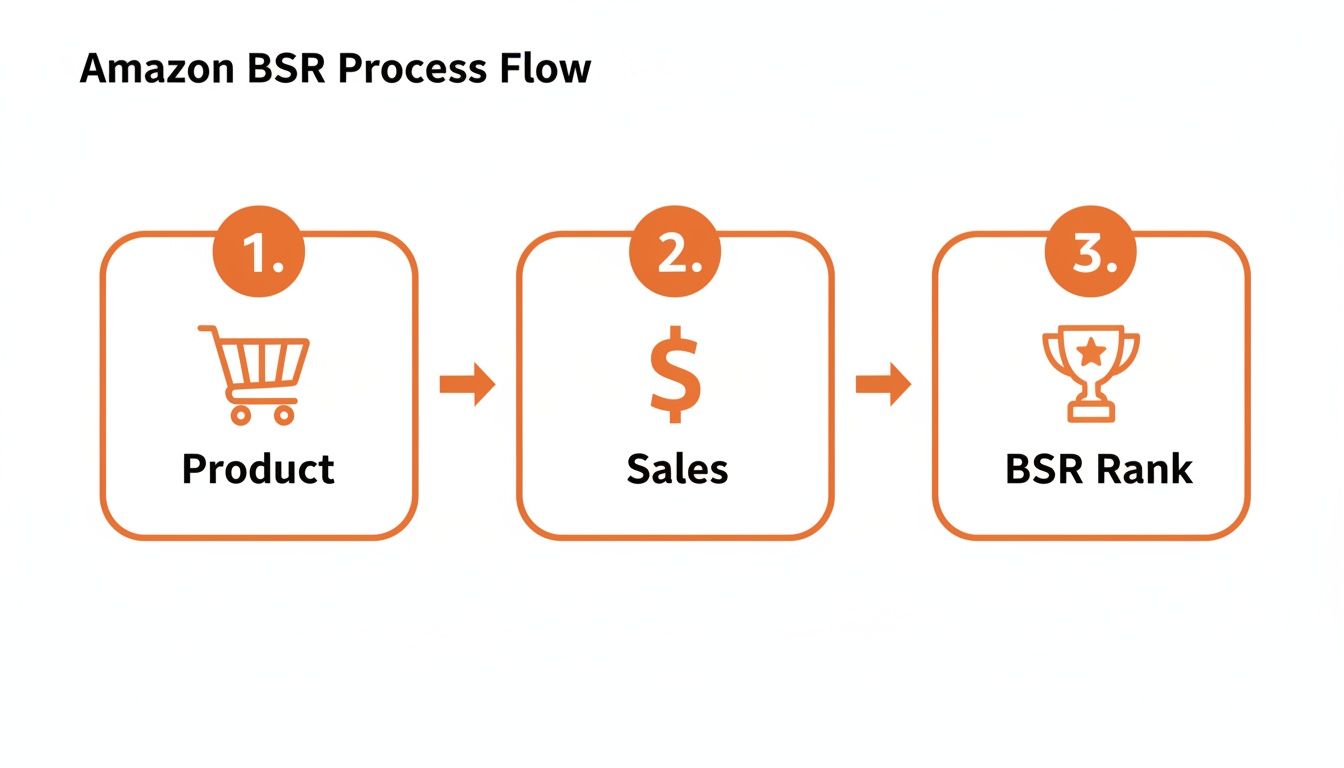
As you can see, it's a straightforward loop. More sales create more momentum, which leads to a better (lower) BSR.
The Hourly Fluctuation Explained
One of the key features of BSR is how quickly it changes. For most products, the rank updates every hour. This is why you can see big swings throughout the day, even if your own sales are steady.
It’s because BSR is a relative metric. Your rank isn’t just about your sales; it’s about your sales compared to every other product in your category. If a competitor runs a big promotion and their sales suddenly spike, your BSR can drop—even if you did nothing different.
For example, your product might have a BSR of #500 at 9 AM. But if a competitor at #600 sells 20 units between 9 and 10 AM, their rank will jump past yours. By 10 AM, you could find your BSR has fallen to #550 or worse, simply because of their success.
Understanding Historical Sales Data
While the last few hours have the biggest impact, past sales data still plays a role. Think of it as the foundation of your rank. A product with a long, consistent history of sales is more stable than a new product that just had a one-day sales spike.
This historical data acts as a cushion, preventing your rank from crashing after one slow day. It gives Amazon's system confidence that your product has ongoing demand.
Recent Sales (Last 24-48 hours): This is the most important factor. It has the biggest impact on your current rank.
Consistent Sales History: This provides a stable base and helps smooth out the daily ups and downs.
The goal is to have both: a strong sales history that provides a solid foundation, and a recent increase in orders that creates upward momentum.
A sudden drop in BSR isn't always a cause for panic. It often reflects a competitor's success rather than your own failure. The key is to monitor trends over days and weeks, not just hours.
Predictive Models and Sales Trends
There's also evidence that Amazon’s system tries to predict the future, not just react to the past. The algorithm seems to include predictive elements, anticipating which products are about to become popular. This is why you might see a rank improve slightly even before a sale is recorded—the system could be factoring in things like an increase in traffic to your page or a higher rate of "add to carts."
This predictive nature is how Amazon stays ahead of trends. As a seller, having precise data is a game-changer. When you request Amazon data and analyze these patterns, you can spot these subtle shifts for your own products and make smarter decisions.
Understanding these mechanics gives you a practical way to interpret BSR. You can turn its constant changes from a source of stress into a valuable stream of market information.
The Core Factors That Influence Your Best Seller Rank
Amazon's Best Seller Rank algorithm isn't a complete mystery. While the exact formula is a secret, the things that move the rank are surprisingly straightforward. Improving your BSR comes down to getting a few fundamentals right.
The most important factor is sales velocity. It’s not just about how many units you sell, but how fast you sell them.
This breaks down into two parts:
Recent Sales: Orders from the last few hours have the biggest impact. A sudden sales spike from a flash sale or a well-timed ad campaign can send your BSR climbing almost instantly.
Consistent Sales History: While recent spikes give you a boost, a solid history of steady sales builds a stable foundation for your rank. This keeps it from dropping dramatically after one slow day.
Driving Sales Velocity with Promotions
Promotions are the most direct tool for creating a sales spike. A strategic discount or a targeted Amazon PPC campaign can trigger the burst of orders needed to push your product up the rankings.
For example, a seller with a new coffee maker could run a 7-day coupon for 20% off. This might drive 50 extra sales in a 48-hour window, launching their BSR from #2,500 to a much more visible #300 in the ‘Coffee Makers’ subcategory. This improved rank then creates a positive cycle, leading to more organic visibility and more sales.
This is especially true in fast-moving categories. Home & Kitchen, for instance, is a top category for Indian SMEs on Amazon. For popular products, a viral trend can shoot an item from a BSR of #10,000 to #500 literally overnight. This shows sellers why constant monitoring is crucial; in this category, sellers who have optimized their listings have seen their BSR improve by 45% on average. You can learn more about how these trends are shaping top-selling categories on DHL.com.
The Overlooked Power of Category Selection
One of the most effective—and most often missed—strategies for a better BSR is smart category selection. It’s the difference between being a small fish in the ocean and a big fish in a pond.
Imagine you sell a high-quality stainless steel garlic press. You could list it in the huge ‘Home & Kitchen’ category. While accurate, you would be competing against everything from refrigerators to dish towels.
A smarter move is to place it in a more specific subcategory:
Home & Kitchen → Kitchen & Dining → Kitchen Utensils & Gadgets → Garlic Tools → Garlic Presses
By doing this, you've drastically reduced the competition. Selling five units a day might not make a difference in the main ‘Home & Kitchen’ category. But in the ‘Garlic Presses’ subcategory, those five sales could be enough to land you in the top 10.
Achieving a #10 BSR and earning the ‘Best Seller’ badge in a niche subcategory is far more valuable than being ranked #50,000 in a broad parent category. The badge builds trust and drives sales, no matter how small the category is.
The Indirect Influence of Reviews and Listing Quality
This is where many sellers get confused. Things like customer reviews, high-quality images, and detailed product descriptions do not directly affect the BSR calculation. But they are absolutely critical for what does: sales.
Think of it this way: a product with 1,000 positive reviews, sharp photos, and clear, benefit-focused bullet points will have a much higher conversion rate than one with blurry images and a vague description.
A higher conversion rate means you get more sales from the same amount of traffic. More sales mean better sales velocity. And better sales velocity is what improves your BSR. So, optimizing your product page isn't just about search—it's a critical strategy for driving the sales that determine your Best Seller Rank.
BSR vs Search Rank: Why You Need Both to Win
Many Amazon sellers use the word "rank" to mean one thing, which is a major mistake. Your Best Seller Rank and your organic Search Rank are two completely different metrics. A winning strategy requires mastering both.
They measure different things, respond to different actions, and play separate roles in how a customer finds and buys your product.
Think of it like this: your BSR is like hitting a national bestseller list. It's a public signal that your product is popular and selling fast. Your search rank, on the other hand, is like being the first book a librarian pulls when someone asks for a specific topic.
One signals popularity. The other signals relevance. To win on Amazon, you need both.
Key Differences at a Glance
Let's put them side-by-side. Understanding how each one works is the first step toward building a complete strategy. One focuses on "what's hot," while the other answers "what's relevant."
Here’s a clear breakdown of how the Best Seller Rank and your Organic Search Rank differ.
BSR vs Search Rank: A Side-by-Side Comparison
Metric | Best Seller Rank (BSR) | Organic Search Rank |
|---|---|---|
What It Measures | Sales speed compared to other products in the same category. | How relevant your product is for a specific customer search term (e.g., "waterproof running shoes"). |
Main Goal | Achieve a low number (#1 is best) to show sales dominance. | Achieve a high position (Page 1, top 3) to get the most clicks for your target keywords. |
Primary Driver | Recent and historical sales volume. | Keyword relevance in your listing, conversion rate, sales history, and customer reviews. |
Scope | Category-specific. A product has a different BSR for each category it's in. | Keyword-specific. A product has a different rank for every single search term. |
Visibility Signal | The "Best Seller" badge for top-selling products. | Your product's position on the search results page. |
This table makes it clear: while sales influence both, their functions are distinct. BSR is your sales performance score. Search rank is your keyword relevance score. To get a better handle on the search side of things, it’s helpful to understand the basics of what is rank tracking in the broader world of e-commerce.
How They Influence Each Other
Even though they're separate, BSR and search rank work together. A strong performance in one often helps the other, creating a positive feedback loop that smart sellers use to their advantage.
It starts with search. A high search rank for important keywords puts your product in front of more shoppers ready to buy. This increased visibility naturally leads to more sales. More sales, in turn, improve your BSR.
Then the loop continues. A great BSR—and especially the 'Best Seller' badge—acts as powerful social proof. When shoppers see that badge, they're more likely to click and buy, trusting that others have already validated the product. This higher conversion rate sends a strong positive signal to Amazon's search algorithm, which can reward your product with an even better search rank. You can find more strategies for this in our guide to improving SEO on Amazon.
A Real-World Example
The power of BSR is most obvious in large, fast-moving markets. For instance, in India’s competitive e-commerce scene, the electronics category recently captured a 34% market share. In a category that crowded, the Best Seller Rank is a real-time indicator of what millions of consumers are actually buying.
Top products like wireless earbuds often have a BSR under 1,000, which signals extremely high sales. Smart sellers watch these numbers not just for their own products, but to spot trends and manage inventory before their competitors do. For a closer look at these market dynamics, you can read the full analysis of Amazon's top-selling products on Shiprocket.in.
A strong BSR can help your search rank because sales velocity is a ranking factor. However, you can't rely on BSR alone. You must also optimize your listing for the specific keywords your customers are using to find products like yours.
Ultimately, focusing on just one of these metrics is not enough. A winning Amazon strategy requires a two-part approach: drive sales to improve your BSR and earn social proof, while also optimizing your listing for keywords to dominate search results. Get both right, and you create a self-reinforcing cycle of visibility and sales that leaves your competition behind.
You understand the theory behind Amazon's Best Seller Rank. You know what it is and have seen it change. But watching it is one thing; making it move in your favor is another.
Let's get practical. This is where we move past the ‘what’ and get into the ‘how’. Improving your BSR is a direct result of one thing: selling more products. Every strategy here is designed to make that happen.
We’re going to cover the specific actions you can take to generate sales, create buying urgency, and improve your BSR.

Drive Immediate Sales with PPC and Promotions
Need to improve your BSR now? The fastest way is through paid ads and limited-time offers. Amazon’s own tools are designed for exactly this, giving you a direct way to create immediate demand.
Targeted Amazon PPC Campaigns: Sponsored Products ads are your front-line tool. They put your listing right in front of shoppers actively searching for what you sell. Launch a campaign focused on your highest-converting keywords to grab quick sales. The goal here isn't long-term branding; it's about creating a burst of orders to get the algorithm's attention.
Coupons and Lightning Deals: These create a sense of urgency. A simple 15% off coupon or a 6-hour Lightning Deal can be the final push a shopper needs to click "Buy Now." The point is to concentrate sales into a short period, creating the sales spike that Amazon's BSR algorithm rewards.
For example, a seller could run a 7-day flash sale aiming for a 25% sales increase. By watching their BSR hourly, they can see the direct impact of that promotion and know, in real time, if the strategy is working.
Convert More Browsers into Buyers
Driving traffic is only half the battle. If visitors land on your product page but don't buy, all that effort and ad spend is wasted. This is where optimizing your listing becomes a critical BSR strategy.
To really move the BSR needle, you have to get better at turning visitors into customers. One of the most important things you can do is learn how to improve e-commerce conversion rates. It means looking at your entire product detail page with a critical eye.
Start by asking these questions about your own listing:
Are your images high-resolution, and do they show the product being used in real life?
Does your title grab attention while also including your most important keywords and benefits?
Do your bullet points explain how the product solves a customer’s problem, instead of just listing features?
Is your A+ Content visually engaging and easy to read? Does it answer the questions your customers might have?
Even a small increase in your conversion rate—from 5% to 6%, for example—can lead to a big increase in sales over time. This provides the consistent sales history that not only improves your BSR but also helps it stay there.
Generate External Traffic for Sales Spikes
Don't limit yourself to Amazon's ecosystem. Driving your own traffic from outside sources is a powerful way to create a sales surge that your competitors won't see coming. This gives you more control and can be very effective.
Consider these channels:
Social Media Campaigns: Run a targeted ad on Instagram or Facebook that sends followers directly to your Amazon listing, perhaps with a special promo code.
Email Marketing: If you have an email list, you have a powerful tool. Announce a new product or an Amazon-only deal to drive a burst of traffic from your most loyal followers.
Influencer Collaborations: Find a micro-influencer in your niche and have them review your product. A genuine recommendation shared with their audience can send a wave of motivated buyers to your page.
This strategy is especially effective because it brings new sales into the Amazon ecosystem—a signal the algorithm values highly.
A low BSR is not the goal itself; it is the result of a successful sales strategy. Focus on driving sales through smart advertising, listing optimization, and external traffic, and a better BSR will naturally follow.
Figuring out which of these actions to take for your specific product requires data, not guesswork. This is where modern tools become essential, as they can audit your listing to find weaknesses that hurt conversions. Instead of trying random things, you get a data-backed plan to generate more sales and achieve a better best seller rank amazon. Cosmy’s AI insights are designed for this purpose—turning the mystery of what to fix into a clear, prioritized action plan.
Your Top Questions About Amazon BSR, Answered
Even when you understand the basics of Amazon’s Best Seller Rank, it can be confusing in practice. It’s one of the most misunderstood metrics on the platform.
Let's clear things up. Here are plain, straightforward answers to the most common questions sellers have about BSR.
How Many Sales Do I Need to Get a Good BSR?
This is the question everyone asks, but there’s no magic number. The honest answer is: it depends entirely on the category.
Selling ten garlic presses might land you a top-100 BSR in a niche subcategory like "Kitchen & Dining -> Kitchen Utensils & Gadgets -> Garlic Tools -> Garlic Presses." But selling those same ten units in the massive "Home & Kitchen" parent category? You’d barely make a dent.
The only thing that matters is how your sales compare to your direct competitors in that exact category, right now. It's all relative.
Can My Product Have Multiple Best Seller Ranks?
Yes, and it absolutely will. A product gets a separate BSR for every single category and subcategory it’s listed in.
Take a high-end yoga mat, for example. It could be listed under:
Sports & Outdoors (a very broad and competitive category)
Sports & Outdoors -> Fitness -> Yoga -> Mats (a much more specific, less competitive niche)
That mat might have a BSR of #25,000 in "Sports & Outdoors" while simultaneously holding an impressive BSR of #50 in "Mats." This is exactly why drilling down into the most relevant, specific subcategories is one of the most effective strategies for securing a good rank and the visibility that comes with it.
Does a #1 BSR Mean It's the Most Profitable Product?
No. This is one of the biggest and most costly misconceptions about BSR. A #1 rank means one thing and one thing only: that product had the highest sales velocity (most units sold) in its category over the last few hours. It says nothing about profit.
A seller could be pushing hundreds of units a day at a rock-bottom price—or even at a loss—just to claim that top spot. They might be using a "loss leader" strategy to grab attention, hoping customers will buy other, more profitable items from their store.
BSR measures sales volume, not profit margin. A product ranked #50 with a healthy margin could easily be making more money than the product ranked #1.
My Sales Were Great, So Why Did My BSR Drop?
This is a frustrating but common situation. It’s the perfect example of BSR's relative nature. Your rank isn't a reflection of your sales alone; it’s a direct comparison of your sales against everyone else in the category.
If your sales were strong but your rank still fell, it’s almost always for one of two reasons:
A direct competitor had a massive sales spike—maybe from a Lightning Deal or an off-Amazon promotion—and shot past you.
Several competitors just had a slightly better day than you. Their combined momentum was enough to collectively push your product down the ladder.
Remember, BSR updates hourly. A single successful promotion by a competitor can temporarily rewrite the rankings for the entire category.
So, What's a "Good" BSR?
What counts as "good" is completely subjective and depends on your category. But as a general rule, you can think about it in these tiers:
Top 100: This is the goal. Hitting this level usually earns you the "Best Seller" badge, which acts as powerful social proof and can significantly increase your sales.
101 - 1,000: Very strong performance. You have consistent sales and are a serious competitor in your category.
1,001 - 10,000: A solid, healthy rank. Your product has decent visibility and is performing well. Most successful products live in this range.
10,000+: This can be a sign of trouble. If your rank is consistently above 10,000 in your main category, it suggests low sales and poor visibility. It's time to start optimizing.
These are just general guidelines. In a tiny, niche subcategory, a BSR of #250 might be poor. In a massive category like "Electronics," a BSR of #9,000 could be fantastic. Context is everything when you evaluate your best seller rank on Amazon.
Trying to improve your BSR is a constant battle of driving sales and outsmarting the competition. But guessing what works is a recipe for failure. You need data-backed insights to guide your strategy. Cosmy delivers AI-powered audits that show you exactly what to fix on your product listings to improve conversion, increase sales, and achieve a better Best Seller Rank.
Stop the guesswork. Start making decisions that move the needle. Get your free audit today at https://cosmy.ai.