Discover the Amazon Smart Box: A 2026 Guide for Brands

Written by

Cosmy
AI-driven eCommerce Optimization
When people talk about the "Amazon Smart Box," they aren't referring to a physical product you can buy. It's a way to describe the AI "brain" that now runs Amazon's entire product discovery system. This system has moved beyond simply matching keywords. It's now a smart system that understands the context behind a search, figures out what customers really want, and evaluates the quality of your product content.
What is the Amazon Smart Box?
The term "Amazon Smart Box" often causes confusion. Yes, Amazon sells physical devices like the Fire TV, which people might call smart boxes. But for Amazon sellers and brand managers, the term means something different and far more important. It represents the complex AI programs that decide which products shoppers see and which ones stay hidden.
For brand managers, this is the first key thing to understand. You’re not optimizing your product page for a piece of hardware. You’re creating content for a learning software system that powers everything from search results to product recommendations. This system doesn't just match search terms; it interprets the real meaning behind a shopper’s words to find the best possible product among millions of options.
From Keywords to Conversations
Not long ago, Amazon SEO was a simpler game. You could win by finding popular keywords and placing them in your product titles, bullet points, and backend search terms. While keywords still matter, their role has changed.
Today’s system, powered by AI models like Amazon Rufus and CoSMo, is all about understanding context. It's designed to answer detailed customer questions in a conversational way.
The 'Smart Box' is less like a search engine and more like a skilled salesperson. It listens to what the customer needs—not just what they type—and guides them to the right product by understanding the details in your product description.
For example, a shopper might not just search for "blender" anymore. They might ask, "What's a quiet blender that is good for making green smoothies and easy to clean?" The 'Smart Box' instantly scans product pages to find the one that best answers every part of that question. If your product page doesn't mention the noise level, how to clean it, or its power with leafy greens, your product won't show up. It becomes invisible.
To make this clear, let's compare the old way of thinking with the new reality.
Traditional SEO vs Smart Box Optimization
This table shows how much the approach has changed. The old tactics focused on ranking for keywords, while the new approach requires teaching a complex AI system about your product.
Aspect | Traditional Amazon SEO (Past) | Amazon 'Smart Box' Optimization (Present & Future) |
|---|---|---|
Primary Goal | Rank for specific keywords | Answer customer questions and solve their problems |
Core Tactic | Using lots of keywords | Explaining the product's context and how it's used |
Content Focus | Listing features (e.g., "1.5L capacity") | Describing benefits ("Makes smoothies for the whole family") |
AI Interaction | Feeding the system keywords | "Teaching" the AI what your product does |
Key Metric | Keyword rank | Showing up for conversational, specific searches |
Success Signal | High views for target keywords | High sales from traffic sent by the AI |
The shift is clear. A product page built for the 'Smart Box' is different—it's more detailed, more helpful, and structured to communicate what the product is for, not just what it's called.
Why This Matters for Your Brand
Understanding how this AI works isn't just a technical detail; it's necessary for selling on Amazon. Your product's visibility and, ultimately, your sales are now directly tied to how well your content feeds the 'Smart Box' the information it needs. A product page that fails to do this will slowly become less visible, leading to a drop in traffic and sales.
The size of Amazon's platform makes this even more important. The smart streaming device market, which includes products like the Amazon Fire TV Box, is projected to grow from $8.99 billion in 2024 to $18.3 billion by 2035. Amazon's total revenue already reached $554 billion by late 2023, with North America accounting for over 60% of net sales.
With over 250 million Fire TV devices sold, Amazon’s reach is massive. To connect with this network, your content must be structured in a way the AI can understand and recommend. You can find more details about these smart TV statistics and what they mean for the market.
Success today requires a new strategy. It’s about creating content that is not just descriptive but is genuinely helpful and detailed. By providing clear, structured information, you are directly teaching Amazon's AI why your product is the best solution for a customer's real-world problem.
Inside the Brain Powering Amazon's Smart Box
To really understand what the Amazon Smart Box is doing, you have to look at the AI running the show. This isn't just one program; it's a powerful pair of smart systems working together.
Think of it this way: you have Rufus, the expert sales assistant on the shop floor, and CoSMo, the detailed quality inspector working behind the scenes. Together, they review your product content to decide if it’s good enough for today’s shoppers.
Rufus: The Conversational Sales Assistant
Imagine Rufus as the most helpful employee in a store. It’s Amazon's conversational shopping AI, built to answer the kind of complex questions real people ask. Rufus goes beyond just matching keywords; it figures out the intent behind the search.
For instance, a shopper might ask, "Which of these air purifiers is quietest for a bedroom and best for pet dander?" Rufus doesn't just look for the words "quiet" or "pet." It digs through product descriptions, bullet points, customer Q&A, and reviews to find product pages that talk about specific noise levels (in decibels) and filtration types (like a HEPA filter for allergens).
Here’s the reality: if your content doesn't provide those specific details, Rufus simply can't recommend your product. It becomes invisible for that specific, ready-to-buy customer.
CoSMo: The Detailed Content Inspector
While Rufus is busy talking to shoppers, CoSMo (short for Core Shopping Model) is working in the background. Think of CoSMo as the manager who inspects every single item, making sure it has complete and accurate information before it goes on the sales floor.
CoSMo’s entire job is to analyze the structure and completeness of your product data. It scans your product pages for any gaps or missing information.
Does the product have all its essential details filled out?
Are the images high-quality and informative?
Is the description detailed and easy to understand?
Does the title accurately describe what the product is?
CoSMo is the gatekeeper for quality. It flags product pages that are incomplete or poorly written, making them far less likely to be considered by Rufus. A low CoSMo score effectively penalizes your product before a customer even types a question.
These two AI systems are deeply connected. This diagram shows how the 'Smart Box' needs Rufus to understand what customers want and CoSMo to confirm that your content is good enough to meet that want.
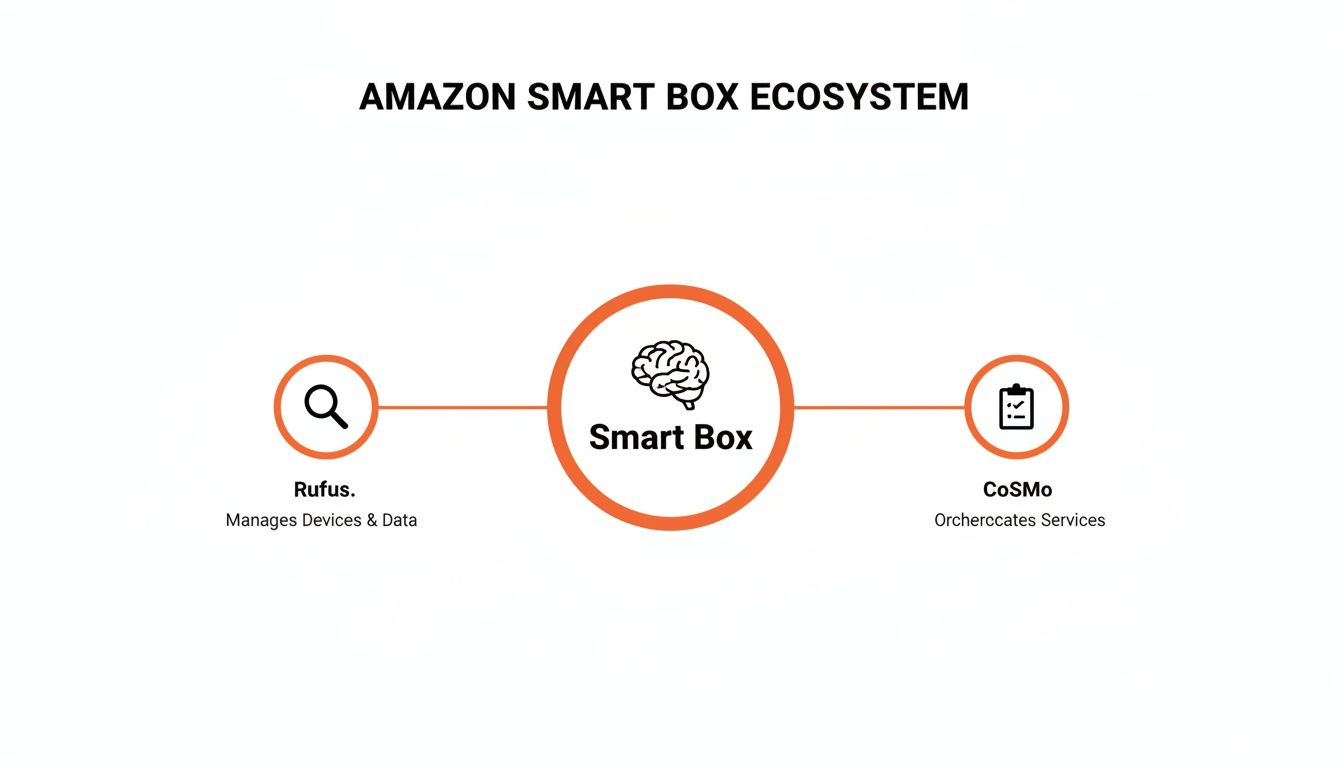
The key takeaway is that you have to satisfy both of them. High-quality, complete content (for CoSMo) makes your product eligible to be found by the conversational AI (Rufus) that’s helping your customers.
How They Work Together in Practice
Let’s walk through a real-world example. Imagine a seller is launching a new, high-end camera tripod.
CoSMo's Initial Check: First, CoSMo reviews the new product page. It checks if the seller has filled out the details: the material (e.g., carbon fiber), weight capacity (up to 8 kg), maximum height, folded length, and head type. If key data like this is missing, the product page gets a low score for being incomplete.
A Customer's Question: A photographer then asks Rufus, "I need a lightweight tripod for hiking that can support a heavy telephoto lens."
Rufus's Analysis: Rufus takes this very specific request and looks for products that fit the description. It's looking for product pages that mention "lightweight" or "carbon fiber" and have a stated weight capacity strong enough for a heavy lens.
Because our seller’s product page was detailed and complete, Rufus can confidently match the product to the photographer's exact need. But if the seller had just written "strong and durable tripod" without the specific data, their product would have been completely ignored. Understanding the role of AI in e-commerce is no longer optional—it's essential to making sure your products are seen by the right people.
How the Smart Box Impacts Your Product Visibility and Sales
The link between Amazon's "Smart Box" and your sales is direct. If your product content isn't built for this new AI system, you start losing visibility. This means you risk becoming completely invisible in both traditional search and the new conversational searches.
That directly translates to less traffic and lost sales.
Mastering platform-specific tools is what separates successful sellers from others in a competitive e-commerce market. You can see this clearly when comparing different marketplaces, as this Amazon vs Takealot seller's guide points out. On Amazon today, your ability to communicate effectively with the platform's AI has become the single most important factor for your success.
A Tale of Two Products
Let’s consider a real-world scenario. Imagine two brands are selling a new portable power bank. Both are targeting a customer who needs a reliable charger for a weekend camping trip.
Product A: The AI-Optimized Page The manager for Product A understands the new system. They've structured their entire product page to "teach" the Smart Box what their product is for. The content is detailed, specific, and answers real questions.
Title: "Portable Power Bank 20,000mAh with Solar Charging - Powers 3 Devices, IP67 Waterproof, Built-in LED Torch for Camping"
Bullet Points: They focus on benefits, not just features. Instead of just saying "20,000mAh," they write, "Holds 4 Full Phone Charges – Stay connected all weekend without needing a power outlet."
Q&A Section: They’ve proactively added questions like, "How long does it take to charge with the solar panel?" and "Is it durable enough to be dropped?"
Product B: The Outdated Page The seller behind Product B is stuck in the past, still using old keyword-focused tactics. Their content is generic and unhelpful.
Title: "Power Bank Charger, Portable Battery Pack"
Bullet Points: It’s just a dry list of features: "High capacity," "Fast charging," "Multiple ports."
Q&A Section: It's either empty or has a few unanswered customer questions.
The Moment of Truth
Now, a customer asks Rufus, "What's a waterproof power bank with a solar charger that can charge my phone multiple times on a camping trip?"
Amazon's AI instantly scans for products that match every part of that question. It finds Product A in seconds. Why? Because its content explicitly mentions being waterproof, having solar charging, and holding multiple charges for a weekend trip. The detailed, helpful content proved to the AI that this product is the perfect solution.
Product B, even if it's a nearly identical device, is invisible. The AI couldn't find the specific answers it needed in the vague, keyword-focused content. The result is a lost sale — not because the product was worse, but because its product page failed to communicate its value to the Smart Box.
The tangible cost of ignoring this shift is simple: your product will not be recommended. Even if it’s a better product, it won’t get the chance to prove it if its content doesn’t provide the AI with the detailed, structured information it needs.
This isn’t just a future trend; it's happening right now. In North America, Amazon's Fire TV Box 4K now makes up over 40% of all 4K streaming device shipments. With sales projected to reach an average of 405.82 units monthly by early 2026, it’s clear that AI-driven recommendations are shaping entire markets. You can dig deeper into the trend of Amazon Fire TV Box 4K and its impact. This data shows just how fast AI systems can influence consumer choice, making content improvements based on shopper questions absolutely essential.
A Practical Check-Up for Your Product Pages

Understanding the theory behind the Amazon smart box is one thing. Putting that knowledge into action is what drives sales. It's time to move from concepts to a real-world check-up for your products.
This is a straightforward process you can run today, without any special tools, to see how well your content is communicating with Amazon's AI. The goal is to spot the gaps where you’re failing to provide the specific information the system needs to recommend your product.
Manual Checks Anyone Can Perform
Think of this as your first review. It’s about putting yourself in the shoes of both a curious customer and the AI trying to help them. These simple exercises will quickly show how well your product page answers the questions that matter.
Start by asking Amazon's AI, Rufus, the same kinds of questions your customers would. Be specific and conversational.
Ask about how it's used: Don't just search for "yoga mat." Ask Rufus, "What is a good yoga mat for hot yoga that won't slip when I sweat?" Does your product show up? If not, your content probably lacks specific details about grip and sweat resistance.
Ask comparative questions: Try a search like, "Which of these kitchen knives is best for a beginner cook and is dishwasher safe?" This forces the AI to look for content on ease of use and cleaning instructions—details most product pages miss.
Ask about problems it solves: A great question is, "I need a power drill that isn't too heavy for small household jobs." This tests if your page addresses user-focused concerns like weight and ideal use, not just technical specs.
The results of these manual searches are your first clue. If your product is consistently absent from these conversational searches, it’s a clear sign that your content isn't providing the right answers.
Analyzing Your Competition
Your product page doesn't exist on its own. The next step is to see what your competitors are doing right—and where they’re falling short. This gives you valuable insight into the questions customers are asking in your category.
Go to the product pages of your top three competitors. Ignore the fancy images and head straight for their Customer Questions & Answers section. Look for common themes or questions that have multiple people asking the same thing.
These unanswered or frequently asked questions are extremely valuable. They represent clear content gaps in the market that you can fill. If customers are repeatedly asking about a product's compatibility or durability, it means that information is a key factor in their buying decision.
By identifying these themes, you can proactively add them to your own bullet points, A+ Content, and Q&A section. You are directly "teaching" the Amazon smart box that your product is the better solution.
This approach is vital in competitive markets. For example, North America's Android TV Box market grew from $4 billion in 2019 to USD 9.54 billion by 2024. As this market heads towards a projected USD 80.2 billion by 2032, visibility is everything. You can find more details on this market growth and its implications. Ignoring AI-driven insights from these simple checks means leaving sales on the table.
Reviewing Your Own Content for Clarity
Finally, take a critical look at your own product page. Read your title and bullet points as if you were a new customer who knows nothing about your product. Do they talk about benefits, or are they just a list of features?
Here’s a quick checklist to run through:
Is your title descriptive? Does it explain what the product is and who it’s for in one line?
Do your bullets solve problems? Instead of "5-liter capacity," try "Serves up to 6 people." That gives the feature context.
Are you addressing key concerns? If your product is clothing, have you clearly stated the material and washing instructions?
Is your content easy to scan? Are key benefits in bold? Is it easy to grasp the main points in just a few seconds?
This simple, hands-on check-up sets the stage for a targeted improvement plan. By identifying where your content falls short, you can move on to making focused changes that get you noticed by the Amazon smart box.
A Step-by-Step Plan to Optimize Your Product Pages

You’ve run your checks and you know where the content gaps are. Now it's time for the real work: fixing them. But where do you begin? Randomly changing your product page is not an effective strategy. You need a clear, prioritized plan that focuses on the most impactful changes first.
This is a structured process for teaching Amazon’s AI exactly what your product is, who it’s for, and why it’s the right choice. By tackling these areas in order, you can improve how the ‘Smart Box’ sees your product, leading to better visibility and more sales.
Start with Your Titles and Bullet Points
Your product title and bullet points are the most important parts of your product page. They are the first and most heavily weighted sources of information the AI uses to understand what your product is and what problems it solves.
Start by rewriting your titles to be descriptive and full of context. A title like "Water Bottle" is practically invisible. A much stronger, AI-friendly title is "Insulated Stainless Steel Water Bottle, 1 Liter, Keeps Drinks Cold for 24 Hours, Leak-Proof Lid for Gym & Hiking." This immediately tells the AI about its material, capacity, key benefit, and ideal uses. It’s no longer just a thing; it’s a solution.
Next, you need to transform your bullet points. Stop thinking of them as a list of features and start writing them as benefit-focused statements that solve a customer’s problem. This is how you “teach” the AI about your product's real-world value.
Before and After Example: Bullet Points
Before (Generic): Features a 1-liter capacity. This is a fact, but it has no meaning.
After (AI-Friendly): Holds a Full Day's Hydration: With a 1-liter capacity, you can fill it in the morning and stay hydrated through work, the gym, and beyond without constant refills. This version gives the feature a purpose—a clear benefit the AI can match to a customer need like "water bottle for a full day."
By focusing on these top-level elements first, you make the biggest and most immediate improvement in how the Amazon ‘Smart Box’ understands your product page.
This focus on clear, benefit-driven communication is a foundation of online sales. For brands wanting to maximize their performance, understanding how to improve e-commerce conversion rate is critical, and it starts with making your product's value instantly understandable.
Proactively Add to Your Q&A Section
The "Customer Questions & Answers" section is a direct line to Amazon's AI. The system actively scans this area to find answers for the conversational questions shoppers are asking Rufus. Don't wait for customers to ask questions—add them to the section yourself.
Put yourself in your customer’s shoes. Think about the common, complex, and comparative questions they have. For example, if you sell blenders, you should be adding and answering questions like these:
"How does this model handle frozen fruit and ice for smoothies?"
"What is the noise level like compared to other blenders?"
"Are the blades and container dishwasher-safe for easy cleaning?"
By answering these questions before they’re even asked, you are pre-loading your product page with the exact information the AI needs to confidently recommend your product over a competitor's. This turns the Q&A section from a reactive customer service tool into a powerful, proactive optimization tool.
Use A+ Content to Explain Visually
Finally, bring it all together with your A+ Content (or Enhanced Brand Content). This is where you visually reinforce the key benefits and uses you've already talked about. Words are important, but powerful images and structured layouts make complex information much easier for both customers and AI to process.
Use your A+ Content to:
Show the product in action: Display images of your water bottle on a hiking trail or at a yoga class. This visually confirms the uses you mentioned in your title and bullets.
Create comparison charts: If you sell multiple versions of a product, a simple chart comparing features like size, capacity, and color helps both shoppers and AI see the differences clearly.
Highlight key features with icons and text: Use different sections to break down important benefits, like "Leak-Proof Technology" or "BPA-Free Materials," with supporting images.
This multi-layered approach ensures your message is consistent and reinforced across every part of your page. When your title, bullets, Q&A, and A+ Content all tell the same clear, compelling story, you are giving the Amazon ‘Smart Box’ a strong reason to put your product in front of the right customers. For a deeper dive into content strategy, you can read our guide on how to choose the right product key word.
Auditing and Measuring Your Optimization Success
Manually checking your product pages is a good start, but it’s not a long-term strategy. It relies on guesswork. To compete effectively, you have to move past occasional checks and adopt a systematic analysis using a dedicated tool built for Amazon's AI, like Cosmy.
These platforms automate the manual checks we just walked through. They review your product content against the core signals that power the Amazon smart box, giving you insights based on how the AI models—Rufus and CoSMo—see your product page.
From Guesswork to Data-Backed Decisions
This process removes subjectivity from your workflow. Instead of guessing what the AI wants, you get a clear, data-backed report showing you exactly where your product page has "perception gaps"—areas where the AI is missing key information.
Imagine running a product page through a tool and, within minutes, getting a prioritized list of fixes. The platform can show you that your bullet points fail to address key customer problems that Rufus looks for, or that your content is missing critical details that CoSMo needs to understand your product.
This approach makes Amazon’s complex AI system transparent and actionable. You stop reacting to poor performance and start proactively fixing the root causes of low visibility before they become a problem.
Suddenly, your team can shift from constant guesswork to confident, data-driven action. Your resources get focused on the specific improvements that will have the biggest impact on how Amazon’s AI sees and ranks your product.
The Workflow for Measurable Growth
Using a tool-based review system creates a simple but powerful feedback loop. The workflow is straightforward and designed for one thing: measurable results.
Analyze a Product: You start by entering your product ASIN into the platform for an instant review.
Get an Action Plan: The system identifies AI perception gaps and generates a prioritized list of content changes to fix them.
Implement and Monitor: You apply the suggested fixes—rewriting titles, improving bullet points, or adding to the Q&A section. Then, you monitor the impact on visibility and ranking over the next few weeks.
This closed-loop process is essential for proving the return on your content efforts. By setting a baseline and tracking the improvement, you can clearly measure the impact of your changes. For those wanting to go deeper, knowing which metrics to watch is vital. You can learn more about the most important KPIs for e-commerce to get your whole team aligned with tangible business goals.
Ultimately, this methodical approach is what gives you a real competitive edge. It provides the structure you need to consistently create content that satisfies the Amazon smart box, driving the kind of sustained visibility and growth that occasional checks will never achieve.
Frequently Asked Questions
As brand managers adapt their strategies for what we call the "Amazon Smart Box," many questions come up. Getting clear, straight answers is what matters. Here’s what you need to know.
We’ll provide actionable information you can use right now.
How is this different from normal SEO?
The single biggest difference is the shift from keywords to context. For years, Amazon SEO was about putting the right keywords in your product page to show up in search results. Optimizing for the "Smart Box" is about teaching Amazon's AI what your product actually does and what problems it solves for a real person.
Instead of just adding "waterproof jacket," you now have to build a product page that answers questions like, "What's a good lightweight jacket for hiking in the rain?" It’s a deeper, more descriptive approach focused on how the product is used and the benefits it offers, not just a list of keywords.
Do I still need to care about keywords?
Yes, but their job has changed. Keywords are now just the starting point for the AI. They help it understand the basic category and function of your product, but they are not enough to get top placement anymore.
Think of keywords as the ticket to the game, not the way you win it. They get your product noticed, but the rich, detailed content built around them is what allows the AI to recommend you for specific customer questions.
For instance, the keyword "blender" is still essential. But to get recommended by an AI assistant, your product page also needs to talk about its noise level, how well it crushes ice for smoothies, and whether the pitcher is easy to clean. That's the context that wins.
What is the single most important change I can make?
If you only have time to do one thing, rewrite your bullet points. This is the highest-impact, lowest-effort change you can make. You need to transform them from a dry list of product features into a set of clear, benefit-focused explanations.
Here’s a perfect example for a simple laptop stand:
Old Way: "Adjustable height"
New Way: "Reduces Neck Strain: Easily adjust the height to your eye level for a more comfortable and ergonomic workday."
That small change gives Amazon's AI important context about the product's real-world value. It goes from being a piece of metal to a solution for a problem, making it far more likely to be recommended.
How quickly can I expect to see results?
Every product and category is different, but brands that systematically review and improve their content often see a measurable increase in visibility and ranking within 30 to 45 days. The impact isn't immediate; it takes time for Amazon's AI to re-crawl, re-evaluate, and re-index your updated product page.
The key is consistency. A one-time fix might give you a temporary boost, but real, sustained growth comes from treating your content as a living asset—something you constantly analyze, improve, and measure.
Ready to stop guessing and start winning in Amazon's AI-driven marketplace? Cosmy provides the actionable intelligence you need to audit your listings, diagnose visibility gaps, and prioritise fixes that deliver measurable results. Get your free audit and turn Amazon’s AI into your competitive advantage. Learn more at https://cosmy.ai.