Your Guide to Winning Amazon Cyber Monday Sales

Written by

Cosmy
AI-driven eCommerce Optimization
Amazon Cyber Monday is no longer just a day for discounts. It is a critical test of your brand's entire Amazon strategy. The sellers who succeed are not those offering last-minute deals; they are the ones who have prepared for months. Profitability and growth now depend on preparation, not just promotion.
The Modern Strategy for Amazon Cyber Monday Sales
Cyber Monday has evolved from a single day of online deals into a week-long shopping event. For Amazon sellers, the old method of simply cutting prices is no longer effective. Winning in 2026 requires a new approach based on planning, operational readiness, and a clear understanding of how shoppers find products today.
This guide provides a practical framework for the 2026 Amazon Cyber Monday sales event. We will focus on concrete strategies that treat this peak season as a crucial test of your business's flexibility. A major part of this new approach involves preparing your listings for Amazon's AI-driven shopping experience.
Preparing for an AI-Driven Marketplace
The way customers shop changed when Amazon introduced AI tools like Rufus. Customers are no longer just typing "women's running shoes." They are asking specific questions. For example, a shopper might ask Rufus, "What are the best waterproof running shoes for long-distance trail running under £150 with good ankle support?"
This is a fundamental shift. It means your product listings must be written to answer these detailed, conversational questions. Your success now depends on how well you structure your content to give Amazon's AI the exact details it needs to recommend your product. It’s about providing answers, not just including keywords.
Key Takeaway: Your Cyber Monday success is now directly linked to how well your product content matches the way Amazon's AI interprets and answers detailed customer questions. Generic content is no longer enough.
What This Guide Will Cover
This guide provides a clear, step-by-step plan. We will show you how to build a successful campaign by breaking it down into key phases:
Strategic Planning: How to use past performance and data to plan inventory and set realistic goals months before the event.
Content Optimization: A process for reviewing and improving your product titles, bullet points, and A+ Content for AI search tools like Rufus.
Smart Advertising: Aligning your advertising campaigns with your new content to attract interested shoppers without wasting your budget.
Flawless Execution: Ensuring your operations—from inventory levels to pricing—are ready for the increase in sales.
Post-Event Review: How to measure what worked and turn that data into a better strategy for next year.
By following this guide, you will learn to treat Amazon Cyber Monday sales not as a frantic promotional sprint, but as the final part of a well-planned, data-driven strategy.
A successful Cyber Monday campaign is not created in the rush of November. It is built on a solid foundation laid months in advance. The period from August to October is your critical window to get the fundamentals right, ensuring your products are visible and your operations are ready before the holiday shopping season begins.
This early phase is not about flashy deals. It's about two essential pillars: inventory management and content optimization. If you address these now, you won’t face stockouts or have invisible listings when shopper traffic increases. You will be setting the stage for a strong performance.
August: The Inventory Deep Dive
First, long before you think about discounts, you must manage your inventory. Running out of stock during a high-traffic event like Cyber Monday is a major failure. It means lost sales, a lower Best Seller Rank (BSR), and reduced visibility in search results for weeks—erasing any momentum you built.
Start by reviewing last year's Q4 sales data.
Identify your top-selling products.
Note any items that had unexpected sales increases.
Record which products went out of stock and when.
This historical data is your best forecasting tool. Don't just look at the numbers; understand the story they tell about customer demand. Use these insights to create a solid forecast for this year, and then add a buffer for growth and unexpected demand. A resource like The Ultimate FBA Holiday Prep Checklist can provide a detailed plan.
Once your forecast is ready, focus on Fulfillment by Amazon (FBA). Amazon’s fulfillment centers become very busy as Q4 approaches. To avoid delays, you must meet FBA's inventory deadlines, which are typically announced in late summer. For more information on logistics, our guide on how to master FBA covers the essentials. The goal is simple: get your stock checked in well before the cutoff dates.
Cyber Monday has changed, moving from simple price cuts to a more complex, AI-influenced shopping event.
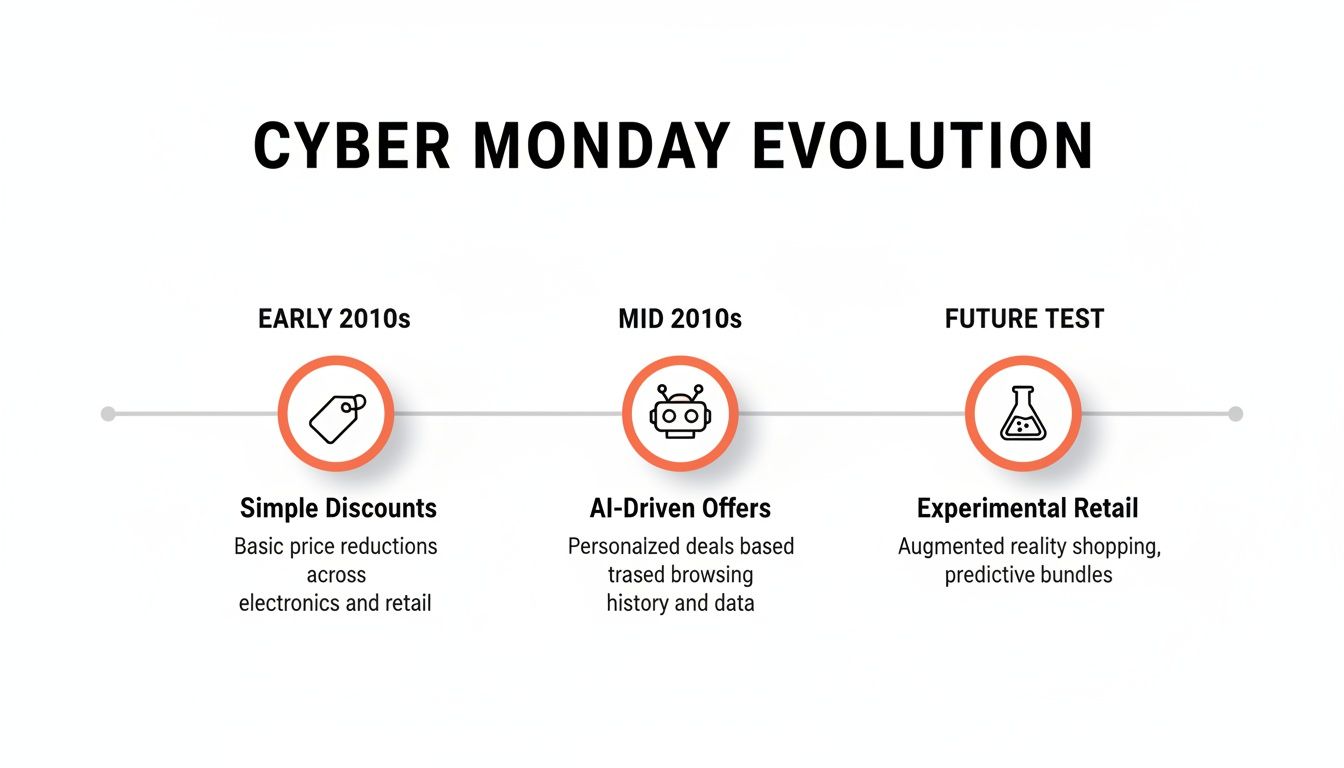
As the timeline shows, just having inventory is not enough. Your products must now be optimized for a new kind of discovery driven by AI.
September: The Content and AI Readiness Audit
With your inventory plan underway, it’s time to review your product detail pages. In the past, this meant basic keyword research. Today, it means understanding how Amazon's AI, like its shopping assistant Rufus, sees and ranks your product.
A content audit is a quick and effective first step. Using a tool like Cosmy, you can get an immediate assessment of your visibility. The platform analyzes your content against the signals Amazon's AI uses to make recommendations.
This is not guesswork; it's about data. An audit might show that your main image, which looks good to you, is overlooked in AI-generated product comparisons because it lacks key details. Or it could reveal that your bullet points do not answer the direct questions shoppers are asking Rufus.
The purpose is to find these gaps now. For example, if you sell a coffee machine, an audit might show that while you rank for "espresso machine," you are invisible for conversational questions like "best quiet espresso machine for a small apartment." This is your signal to add phrases about its quiet operation and compact size to your bullet points and A+ Content.
This table provides a summary of the critical tasks and timeline for the foundational phase of your Cyber Monday preparation.
Month | Key Focus Area | Actionable Tasks | Success Metric |
|---|---|---|---|
August | Inventory & Forecasting | Analyze last year's Q4 data, create demand forecasts, and place purchase orders. | Stock ordered with a 20%+ buffer, aligned with FBA deadlines. |
September | Content & AI Audit | Perform a full content audit (titles, bullets, images, A+). Identify gaps in AI readiness. | A prioritized list of content optimization tasks based on data. |
October | Initial Optimization | Implement high-impact content changes identified in the audit. Revise titles, bullets, and A+ Content. | Key listings updated and re-indexed by Amazon before November. |
Completing these foundational steps between August and October is what separates the brands that succeed from those that just get by during the holiday season.
October: Initial Optimizations and Setting Your Baseline
October is for taking action. Using the findings from your September audit, you will implement your first set of content changes.
Focus on the fixes that will have the most impact:
Rewrite Titles and Bullets: Add the natural language phrases and question-based keywords you discovered.
Upgrade Your Main Image: Ensure your main image clearly shows the product in use or highlights its most important feature.
Improve A+ Content: Add new modules that address the gaps your AI audit identified. Use a mix of text and images to tell a more complete story.
By making these changes in October, you give the Amazon algorithm time to re-index and "re-learn" your newly optimized listings. This establishes a strong, discoverable baseline before you start adding promotions and ad campaigns in November. Your products will be ready for maximum visibility when Cyber Monday traffic arrives.
Fine-Tuning Your Content for AI Search and Conversion

As you enter the critical October-November period, your focus should shift from setup to fine-tuning. This is where you turn your product listings into high-performance assets designed for Amazon’s new AI-driven environment.
The introduction of tools like Rufus, Amazon’s conversational shopping assistant, has changed how customers find products. The old methods are no longer effective.
Simply filling your title with keywords was once enough. Not anymore. Success during the amazon cyber monday sales now depends on how well your content is structured to answer the complex, conversational questions shoppers are asking. Your titles, bullet points, and A+ Content must work together to give Rufus the precise information it needs to recommend your product over a competitor's.
The Shift from Keywords to Conversational Answers
Consider the change in shopper behavior. A few years ago, someone wanting a coffee machine would type "espresso machine."
Today, they are more likely to ask Rufus, "What's the best espresso machine for a small kitchen that is also quiet?" or "Show me espresso makers under £200 that are easy to clean."
This is a significant shift from keywords to concepts. Amazon's AI no longer just matches words—it understands intent, features, and context. If your listing doesn’t explicitly mention “quiet operation” or its “compact footprint” for small kitchens, you are essentially invisible to that interested shopper.
A practical audit can clearly expose these gaps. For example, if you sell a high-end coffee grinder, a content audit might reveal that a competitor is appearing in AI-generated answers for "best grinder for coarse french press coffee," while you are not—even though your product is perfect for it. This is a content structure problem, not a keyword problem.
Your product detail page is no longer just a sales pitch for a person. It is a structured data file for an AI. You must create content that serves both, combining persuasive writing with the specific, factual attributes an AI can understand.
Real-World Scenario: Winning on Durability
Let's look at a common example. You sell a travel backpack. Sales are flat, even though your price is competitive. A content audit shows your main competitor is getting sales from shoppers asking questions like, "What is the most durable backpack for a two-week trip to Europe?"
You examine their listing and understand why. Their A+ Content is a great example of addressing durability. They have:
A close-up image showing reinforced stitching with the text, "Ripstop Nylon Fabric Prevents Tears."
A comparison chart that highlights their YKK Zippers versus the "standard zippers" on other bags.
A lifestyle image of the backpack in a rugged setting, reinforcing the theme of toughness.
Your A+ Content, on the other hand, talks about style and capacity. You never mention the specific materials or construction that make your bag just as durable. You are losing the sale before the customer even considers the price.
How to Reclaim the Narrative
With that insight, you can take direct action to revise your content and own the "durability" narrative before the Cyber Monday rush. Your goal is to give Amazon's AI the exact data points it needs to see your product as the answer. For a more detailed look at making your content discoverable by AI, see this complete guide to AI search visibility.
Here’s a simple, actionable plan:
Revise Your Bullet Points: Instead of a generic bullet like "High-quality materials," be specific. Change it to: "Built to Last with Abrasion-Resistant 900D Cordura Fabric and Reinforced Stitching." This gives the AI a concrete fact to use.
Add a New A+ Content Module: Create a "Comparison Chart" module. In one column, list your backpack's features: YKK Zippers, Water-Resistant Coating, Padded Laptop Sleeve. In the other, list "Competitor Backpacks" with generic terms like "Standard Zippers" and "Basic Fabric." This highlights the difference for both the customer and the AI.
Update Your Imagery: Add an image module showing a close-up of the backpack’s zipper with a text overlay that reads, "Heavy-Duty Zippers for Years of Reliable Use."
These changes are not about adding filler. They are about adding specific, factual attributes to your listing in a structured way. This approach creates an informative page that persuades a human shopper and gives Amazon's AI the structured data it needs to recommend your product for durability-related searches. To learn more about identifying which attributes to focus on, you might be interested in our guide to product keyword research.
By applying this method to your top products, you ensure your listings are ready to compete not just on price, but on relevance and visibility during the critical amazon cyber monday sales event.
Time to Execute: Your Promotional and Ad Playbook

With your product listings optimized for both AI search and human customers, it's time to launch your promotions. The focus now shifts to driving high-intent traffic and creating a sense of urgency.
A successful promotional plan for the Amazon Cyber Monday sales event is not about offering the lowest price. Cutting margins is a common mistake. Instead, it’s about creating a strong sense of value where your deals, ads, and content all work together to increase your sales.
Your goal is to build a cohesive campaign that not only earns clicks but also guides shoppers to a quick and confident purchase. Every promotional element must align with the story you’ve built into your product content.
Structuring Promotions That Create Value
Cyber Monday shoppers see a lot of deals. To stand out, your promotion needs to be more than just a price cut. It needs to be visible, simple, and offer a clear benefit.
Move beyond the simple "20% off" mindset. On Amazon, your most powerful tools are Lightning Deals, Coupons, and Prime Exclusive Discounts. Each has a specific purpose.
Lightning Deals: Use these to create a large, concentrated spike in sales. Their time-sensitive nature creates a fear of missing out (FOMO). Use them on your top products where a quick sales burst can boost its Best Seller Rank (BSR), giving you better organic visibility long after the deal ends.
Coupons: The green coupon badge is a visual magnet in search results and can increase your click-through rate. A simple £5 or 10% off coupon can often attract more attention than a deeper price cut that is not as visually prominent.
Product Bundles: This is a great way to increase average order value (AOV). If you're selling a coffee machine, create a "virtual bundle" by advertising it with your coffee grinder or espresso cups. Your ad copy could say, "The Perfect Home Barista Setup," encouraging shoppers to buy the whole package.
The most successful promotions don't just offer a discount; they create the feeling of a smart, limited-time opportunity. A Lightning Deal on a coffee maker combined with a coupon on a matching grinder feels like a more complete and valuable offer than a single discounted item.
Aligning Ad Campaigns With Your Content Strategy
Your ad campaigns drive traffic to your newly optimized listings. The message in your ads must match the answers you built into your product content.
This alignment is essential. If your content audit revealed an opportunity to attract shoppers searching for "quiet coffee machines," then your ad campaigns must use that exact language.
For example, your Sponsored Brands headline should not just be "Premium Espresso Machines on Sale." It needs to be something like, "Enjoy Barista-Quality Espresso, Silently." This headline speaks directly to the shopper's specific need, making your ad highly relevant.
Your ad targeting needs to be just as precise.
Sponsored Products: Target specific, long-tail keywords like "quiet espresso machine for apartments" that your content is now set up to answer.
Sponsored Brands: Use video ads that show the machine's quiet operation. Prove it, don't just say it.
Sponsored Display: Retarget shoppers who viewed your product but did not buy. Use ads that remind them of its unique quiet-running feature.
The goal is to create a seamless journey. The shopper sees an ad that solves their problem, clicks to a page that confirms the solution, and is met with a compelling offer that encourages a purchase. For a deeper dive into making these ad types work together, check out our guide on advertising with Amazon.
Setting Budgets and Monitoring Performance
The Cyber Monday weekend is a competitive advertising environment. You must be prepared to increase your budgets, but do so smartly. A "set it and forget it" strategy can waste money.
Plan to increase your daily campaign budgets by 3x to 5x starting the Friday before Cyber Monday. Monitor your performance in real-time. Keep a close watch on your Advertising Cost of Sale (ACoS) and conversion rates throughout the day. If a campaign is performing well, add more budget. If another is getting clicks but no sales, pause it and reallocate that spending to a more successful campaign.
This high-stakes shopping period is a global event. While Cyber Monday 2025 in the US reached $14.25 billion in online sales, India's D2C brands saw a parallel 58% GMV growth. This shows how massive these events have become on platforms like Amazon.in. Amazon Business India reported 35% YoY sales growth, driven heavily by tier 2 and 3 cities. This data proves that a well-executed strategy can capture enormous demand, regardless of customer location.
Once the last Cyber Monday orders are shipped, most sellers relax. This is a mistake. The days after the event are when you can turn this year’s performance data into next year’s growth strategy.
Just looking at total sales or overall Advertising Cost of Sale (ACoS) gives you an incomplete picture. The most valuable information is found by looking deeper. Your goal is to create a clear feedback loop where you can connect your pre-event actions to your post-event results.
Moving Beyond Surface-Level Metrics
First, take a broader view of your account’s health. The sales velocity from a successful Cyber Monday can have a "halo effect" that benefits your entire brand on Amazon.
Here’s what to analyze:
Best Seller Rank (BSR) Fluctuations: Don't just look at the BSR on Cyber Monday. Track how it changed for your key products in the one to two weeks after. A sustained improvement means the sales spike was large enough to give you a lasting boost in organic visibility.
Organic Keyword Ranking Shifts: Did your rank for your target keywords improve? If you optimized for "quiet espresso machine," did you see a jump in your organic position for that term? This is how you directly measure the return on your content work.
Customer Review Analysis: Read new reviews for feedback. Did customers mention the "durability" you highlighted in your A+ Content? Are they praising the "quiet operation" that was central to your ad copy? This is direct confirmation that your messaging was effective.
Connecting Content Optimizations to Conversion
The most powerful analysis connects specific actions to specific results. You need to verify if the content changes you made actually delivered. This is where your performance data and content strategy come together.
Let’s return to the example of optimizing a backpack listing for durability. Your post-event review needs to answer one question: Did the A+ Content changes addressing 'durability' lead to a higher conversion rate?
To find the answer, isolate the performance data for ad campaigns that targeted durability-related keywords. If those campaigns show a higher-than-average conversion rate compared to your general campaigns, you have strong evidence your content change worked. A tool like Cosmy can help you run this audit, connecting the AI signals you targeted to the sales you generated.
By isolating performance data this way, you move from "I think it worked" to "I know it worked." This process validates your strategy and provides a repeatable framework for future optimizations, creating a cycle of continuous improvement.
This kind of deep analysis is becoming more critical as shopping habits change. In India, for example, the eCommerce market saw a 58% year-on-year surge in D2C sales during its Black Friday and Cyber Monday period. Total orders jumped 63%. A fascinating trend is the rise of a 'Vampire Economy,' with nearly 10% of all orders placed between midnight and 6 AM. This is forcing brands to rethink their marketing schedules. You can explore the full report on this trend to see how consumer habits are shifting.
This data highlights the need for content that performs 24/7. An AI-optimized listing that clearly answers customer questions is essential for capturing these late-night shoppers, especially in growing markets where you need to build trust quickly.
Building Your Playbook for Next Year
Your final task is to summarize all these findings in a post-event report. This report is your guide for the next major sales event. Do not skip this step.
It should clearly outline:
What Worked: Which promotions had the highest return on investment? Which content changes led to a measurable increase in conversions? Be specific.
What Didn't Work: Which ad campaigns wasted money? Which products did not sell well? Be honest.
Key Learnings: What surprising customer behaviors did you observe? Did a new competitor take over a key search term?
Action Items for Next Year: A clear checklist of strategic moves to make, such as investing more in video ads, focusing on different product bundles, or overhauling a specific product's A+ Content.
This document turns the chaos of Cyber Monday into structured intelligence. It ensures that hard-won knowledge is not lost and that you enter the next sales cycle smarter, more prepared, and ready to build on this year's successes.
Your Amazon Cyber Monday Questions Answered
We’ve covered the strategy, but Cyber Monday can be intense. I get the same questions every year from sellers. Here are straightforward answers based on what works.
How Far In Advance Should I Prepare for Amazon Cyber Monday Sales?
You should start preparing 3-4 months in advance. This means starting in August. This is not an exaggeration; it’s a strategic necessity. Your Q4 inventory needs to be planned and shipped to FBA well before the holiday season creates significant delays. You cannot wait until October.
More importantly, this gives you time to audit your content, implement AI-driven optimizations, and see the results. Making major changes in November is too late. Your listing won't have time to re-index, and you will miss the window when Amazon's algorithms are paying the most attention.
What Is the Biggest Mistake Sellers Make During Cyber Monday?
The biggest mistake is running out of stock. It is the single most destructive and costly error you can make. A stockout on a high-traffic day like Cyber Monday not only costs you sales but also harms your Best Seller Rank (BSR) and can lower your organic search position for weeks, erasing your momentum.
A close second is focusing only on ads and discounts while your content is not optimized for AI search. If your listing isn't designed to answer the questions shoppers are asking Rufus, you are effectively giving high-intent traffic to your competitors.
Key Insight: Success isn't about the biggest discount. It's about being visible and available when it matters most. A fully stocked, well-optimized product with a modest discount will outperform a heavily discounted item that no one can find or that goes out of stock early.
Should I Lower My Price Significantly for Cyber Monday?
Not necessarily. Competing on price alone is a losing game that reduces your profit margins and devalues your brand. Instead of focusing on price, focus on perceived value.
Cyber Monday is an ideal time to run deals on your higher-priced items, as shoppers are often looking to make bigger purchases. For example, last year, the Breville Barista Touch Impress, a premium coffee machine, was a popular seller with a significant $500 discount off its usual $1,500 price. This is a strong value proposition, not just a simple discount.
A well-timed Lightning Deal combined with a visible coupon and a perfectly optimized listing is almost always more effective than just slashing your price.
How Do I Measure the True Success of My Cyber Monday Campaign?
If you're only looking at revenue and ACoS, you're getting an incomplete picture. A successful Cyber Monday campaign should act as a launchpad for Q1, not just a one-day sales spike.
Here’s what to really look for:
The "Halo Effect": Did the sales surge lead to a sustained improvement in your organic rank for key search terms in the following weeks? That’s the real prize.
Conversion Rate Improvement: Did the A+ Content and listing changes you made actually increase your unit session percentage?
Share of Voice: How did your visibility for top keywords compare to your main competitors before, during, and after the event?
A truly successful Amazon Cyber Monday sales campaign doesn't end on Tuesday. It builds lasting market share and sets you up for a strong start to the new year.
Ready to see how your listings measure up against Amazon's AI? Cosmy provides a sharp, actionable content audit that identifies visibility gaps and connects shopper questions to AI responses. Get a free audit and start implementing data-backed optimizations with confidence. See what Cosmy can do for you at https://cosmy.ai.