Your Guide to Launching an Amazon Best Seller Book
Written by

Cosmy
AI-driven eCommerce Optimization
Forget the myth of a lucky launch day. Becoming an Amazon best seller book is no longer about chance. It's a strategic process of understanding how Amazon's system works and giving it the right signals. This guide offers a professional, step-by-step roadmap, not generic advice.
The Modern Blueprint for an Amazon Best Seller
Earning the '#1 Best Seller' badge on Amazon isn't about a single, explosive burst of sales. While a strong launch week is important, the path to the top is a marathon, not a sprint. It requires a methodical approach that aligns with how Amazon’s algorithms discover and recommend books to millions of readers.
Instead of guessing what might work, this plan provides a clear view of the three pillars that drive success. We will break down how to build a strong foundation that attracts both readers and Amazon's search system, long before you click "publish."
Understanding How Amazon's Platform Works
Amazon's search and recommendation tools are constantly learning from shopper behavior. They look for specific signals to determine if a book is relevant and high-quality.
Your job is to provide those signals consistently. This means thinking like a brand manager for your book, not just an author. Every part of your Amazon presence—from the product page to your ads—sends a message to the platform's system.
Successful authors today don't just write a great book; they build a complete strategy around it. They understand that visibility on Amazon is earned through deliberate, data-driven actions over time, not just a single promotional push.
This guide will demystify that process. We’ll explore practical tactics that turn Amazon’s complex system into your biggest asset, driving the discoverability and sales needed to reach the top.
The Three Pillars of Success
To create a sustainable Amazon best seller book, you must master three core areas. Neglecting one can undermine your entire launch. Excelling at all three creates powerful, compounding momentum.
Our approach is built around these three pillars:
Careful Pre-Launch Preparation: This is where the foundation is laid. It involves researching the right categories and keywords, writing a book description that converts visitors into buyers, and setting up your product page for success from day one.
A Data-Informed Launch Week: Your first seven days are critical. This is your chance to send a strong signal to Amazon that your book has momentum. This phase focuses on executing a coordinated promotion plan and securing early reviews to trigger the algorithm in your favor.
A Strategic Post-Launch Plan: Earning the badge is one thing; keeping your book visible is another. This is where you analyze sales data, refine your advertising, and find new ways to maintain sales velocity and stay on the bestseller list.
By focusing on these three pillars, you're not just launching a book; you're creating a repeatable system for success on the world's largest bookstore.
Building Your Foundation Before You Launch
Your book's journey to becoming an Amazon best seller begins long before you hit ‘publish’. A successful launch is the direct result of methodically laying the groundwork to attract both readers and Amazon's algorithms.
This foundational work is what separates breakout hits from books that disappear. It ensures that from the moment your book goes live, it’s positioned for visibility and sales.
Think of your book’s product page as its digital storefront. Every element—from your categories to your description—must be deliberately designed to turn browsers into buyers. Neglecting this is like opening a store with no sign on the door.
Choosing Your Categories Wisely
One of the most common and costly mistakes authors make is choosing overly broad categories. For example, listing a new thriller under the massive "Thrillers & Suspense" category places it against tens of thousands of other books, including global bestsellers with huge ad budgets.
A smarter approach is to find specific, less crowded niche categories where you have a real chance of ranking. Hitting #1 Best Seller in a smaller category is more achievable and just as valuable for building credibility. The orange badge is a powerful psychological trigger for buyers and a strong signal to Amazon's discovery system.
Look at books similar to yours. Where are they ranking? What other, more specific categories are they listed in? Your goal is to find two or three categories where just a few dozen sales a day could propel you to the top.
For example, instead of the broad "Business & Money," you could target:
Books > Business & Money > Small Business & Entrepreneurship > Home-Based Business
Books > Business & Money > Marketing & Sales > Web Marketing
This strategic positioning dramatically improves your odds of earning the best seller badge.
Uncovering the Right Keywords
Keywords are the language of Amazon search. They are the exact words and phrases shoppers type into the search bar. Your job is to identify these terms and incorporate them into your book's listing.
Start by thinking like your ideal reader. What problem are they trying to solve? For instance, a reader searching for a "fast-paced spy thriller with a female protagonist" is giving you a valuable keyword phrase.
Use the Amazon search bar's autocomplete feature. Type in a broad term like "fantasy romance" and see what suggestions appear. These are direct clues from Amazon's data about what people are actively searching for. For a deeper dive, our guide on creating a solid https://blog.cosmy.ai/amazon-kdp-account can provide additional context on setting up your author profile for success.
A book's success depends on more than just good writing; it's also about its online placement. The right category and keywords can make all the difference in helping your book reach its ideal audience.
Once you have a list, use these keywords in your book title, subtitle, and description. You also have seven backend keyword slots in KDP. Use this space for terms you couldn’t fit naturally into your main listing, such as competitor author names, alternative genre descriptions, or character archetypes. Use all the available character space and avoid repeating words.
Crafting a Compelling Book Description
Your book description has one job: convince a potential reader to click ‘buy’. It needs to be clear, persuasive, and answer the reader's main question: "Is this book for me?"
Start with a powerful hook—a question, a bold statement, or an intriguing premise. Then, lay out the core conflict or promise of the book. Use short paragraphs, bullet points, and bold text to make your description easy to scan, especially on mobile devices.
Most importantly, speak directly to your reader's needs. If you wrote a productivity book, don't just list the chapter topics. Frame it in terms of benefits, like "Stop procrastinating and finally complete your most important projects."
Designing Your A+ Content
A+ Content is a powerful tool for visual storytelling. This section appears below your book description and allows you to add custom images, graphics, and comparison charts. It’s your chance to create a rich, engaging experience that goes beyond plain text.
Use A+ Content to:
Introduce the author: A professional headshot and a short bio build trust.
Showcase interior pages: Give readers a sneak peek of your book’s layout or key diagrams.
Highlight key themes: Use compelling graphics to bring your book's world to life.
Compare your book: Use a simple chart to show how your book differs from others in its genre.
This foundational work is not glamorous, but it is the most critical part of your launch. By optimizing your categories, keywords, description, and A+ Content, you set the stage for a powerful debut and give your book the best possible chance of becoming an Amazon best seller book.
Optimizing Your Book for Amazon's AI Search
Amazon's search bar is now powered by sophisticated AI that interprets shopper questions to guide them to the right products.
This changes the game. Old SEO tactics are no longer enough to land on the Amazon best seller book list. To succeed now, you must optimize your book listing for how this AI thinks. This isn't about tricking the system. It's about understanding that Amazon's AI aims to replicate a great bookstore employee: listening to a customer's request and recommending the perfect book. Your job is to make it easy for the AI to choose your book.
The AI measures relevance through a new set of signals. It analyzes your book's title, description, reviews, and even the text in the 'Look Inside' preview to understand its content. The more clearly you answer potential reader questions within your listing, the more confident the AI becomes in recommending it.
Decoding Shopper Intent for the AI
To work with the AI, you first need to understand what real people are asking it. Think about the conversational, natural-language questions your ideal reader would ask.
A reader probably isn't searching for "dystopian sci-fi with political themes." They are more likely to ask:
"Find me a book like The Hunger Games but with more focus on political strategy."
"I need a fast-paced thriller I can finish in a weekend."
"What's a good cookbook for a beginner who wants to learn Italian food?"
These questions are valuable clues. Your mission is to find them and strategically weave the answers into your book's product page. This makes your book the most logical result for the AI to present. This is a core part of effective marketing a book on Amazon, ensuring these signals reach the right audience.
AI Content Optimization Checklist
Use this checklist to review your book's page and ensure it's ready for Amazon's AI search.
Optimization Area | Action Item | Why It Matters for AI |
|---|---|---|
Title & Subtitle | Include a key benefit or solve a reader's problem. | AI matches solution-oriented phrases to user questions. |
Book Description | Structure it with hooks and bullet points that answer "Why should I read this?" | AI scans bullet points for key features and benefits, seeing them as direct answers. |
A+ Content | Use visuals (charts, comparison tables) to answer questions graphically. | Visuals with clear text help AI understand complex ideas quickly. |
'Look Inside' | Ensure the first chapter establishes genre, tone, and promise immediately. | AI uses the opening pages as a primary signal for classifying the book's content. |
Customer Reviews | Encourage detailed reviews that mention specific feelings or use cases. | AI analyzes review sentiment to validate your listing's claims. |
Backend Keywords | Use long-tail phrases and synonyms that reflect conversational questions. | This provides the AI with alternative ways real people might search for your book. |
By systematically checking these boxes, you're building a comprehensive profile that the AI can easily understand and trust.
Weaving Answers into Your Content
Once you've identified the core questions your readers are asking, it's time to integrate the answers naturally. Clunky, keyword-stuffed sentences are a red flag for both readers and modern AI. The focus should be on providing genuine value and clarity.
Here’s a practical framework for embedding these answers:
Book Description: Don't just summarize the plot. Lead with a hook that answers the unspoken question, "Why should I spend my time and money on this?" Then, use bullet points to highlight key benefits that satisfy common reader desires, like "A gripping mystery that will keep you guessing until the final page."
A+ Content: This is your visual real estate. Create modules that answer questions like, "What's unique about this author's world?" or "What will I actually learn from this book?" For a nonfiction book, a graphic showing "Who This Book Is For" can directly answer a common shopper question.
'Look Inside' Feature: The first few pages are a critical signal. Your introduction or first chapter needs to immediately establish the genre, tone, and central promise of your book. It must answer the reader's implicit question: "Is this the kind of story I'm looking for?" You can get more ideas by checking out our guide on choosing the right product key word strategy.
By shifting your mindset from "listing features" to "answering questions," you align your book's entire presence with the logic of Amazon's AI. This helps future-proof your listing, ensuring that as the AI gets smarter, your book becomes more visible.
Executing a Powerful Launch Week Strategy
The first seven days your book is live are crucial. This period is about sending a concentrated blast of positive signals to Amazon’s algorithms. You have one week to convince the system your book is worth promoting. A strong launch can set off a chain reaction that makes achieving Amazon best seller book status much easier.
Your goal is to orchestrate a flurry of activity—sales, downloads, and early reviews—that tells Amazon to pay attention. Understanding how to promote your book with this algorithmic goal in mind is key.
This timeline gives you a high-level view of how to approach optimizing your book for Amazon's AI, covering the critical phases from research to post-launch auditing.
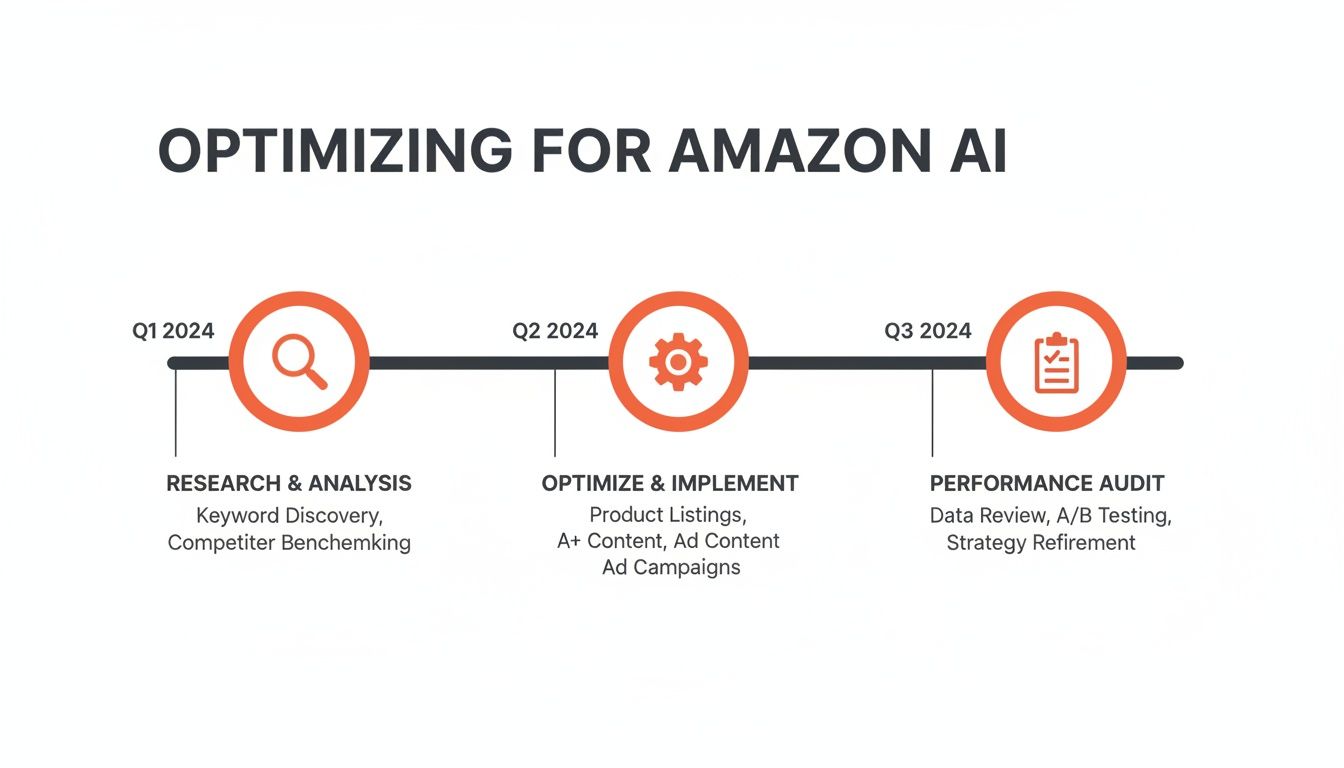
Success is not a single-day event. As the visual shows, it’s a deliberate process of smart preparation, tactical execution, and continuous review to stay aligned with how Amazon's AI discovers and ranks content.
Stacking Your Promotional Efforts
Launch week requires a coordinated, multi-channel plan. Think of it as a carefully planned symphony, not a chaotic jam session.
Your primary mission is to drive consistent traffic to your Amazon page from external sources. Amazon values this because it brings new customers to its platform. The most effective launch campaigns use a "stacked" promotional schedule.
Here’s what a stacked promotion looks like in practice:
Days 1-2: Announce the launch to your core audience—your email list and private reader groups. Offer a special launch price or bonus content to trigger an immediate wave of purchases from your most loyal fans.
Days 3-4: Launch targeted social media campaigns and collaborate with influencers or bloggers in your niche. Their endorsements introduce your book to new, relevant audiences.
Days 5-7: Now, amplify your efforts. Activate paid book promotion sites. Services like BookBub (if you can get a Featured Deal), Fussy Librarian, or Bargain Booksy can drive a massive wave of traffic and sales, pushing you up the charts.
This layered approach creates sustained sales velocity throughout the week, which is a more powerful signal to the algorithm than a single-day spike.
The Critical Role of Early Reviews
Sales get the algorithm's attention, but reviews provide the social proof that convinces hesitant buyers. Reviews are also a major data point for Amazon's discovery systems. Books with a healthy number of early, positive reviews are seen as more credible and are more likely to appear in "Also Bought" sections and search results.
Getting those first reviews is often the biggest hurdle. You cannot buy reviews or offer direct payment for them, as this can lead to account suspension.
Powerful launch weeks are built on trust. You're not just selling a book; you're inviting readers into an experience they'll want to talk about. Those initial, authentic reviews are what truly ignite visibility.
Instead, you need a system for encouraging them ethically:
Assemble an Advance Reader Team: Weeks before launch, gather a group of dedicated fans. You can also use services like Booksprout to find readers willing to receive a free Advance Reader Copy (ARC) in exchange for an honest review.
Communicate Clearly: Give your ARC team a firm deadline, asking them to post their review on or just after launch day. Send friendly reminders, but never pressure them or suggest what to write.
Activate Your Email List: In your launch announcement, politely ask readers to leave a review after they've finished the book, and explain how much it helps other readers find your work.
Just 10-15 genuine reviews within the first few days can significantly impact your conversion rate, signaling to Amazon that your book is a hit with real readers.
Leveraging Amazon Ads from Day One
While external promotions drive traffic to Amazon, Amazon Ads help you capture buyers who are already on the platform. Starting a small, targeted ad campaign from day one is essential for visibility. For a deeper dive, check out our guide on getting started with Amazon Ads for KDP.
Focus your initial budget on highly specific "Sponsored Products" campaigns. Target the long-tail keywords and precise categories you identified during your pre-launch research. Instead of a broad term like "fantasy," target a specific phrase like "epic fantasy with dragons and magic schools."
During launch week, your ad goal is not immediate profitability but sales velocity and data collection. Every click and sale teaches Amazon's algorithm more about your ideal reader, which enhances your book's organic discoverability for months to come.
Sustaining Momentum After the Launch
The orange '#1 Best Seller' badge is a great achievement, but it's a snapshot in time. The real challenge is converting that launch week momentum into consistent, long-term sales.
The work you do after the launch is what separates a one-hit-wonder from a lasting success. It’s time to shift from launch week tactics to a smarter, data-driven growth strategy.
Reading the Signals in Your KDP Dashboard
Your Kindle Direct Publishing (KDP) dashboard is your new command center. It provides the hard data that tells you what’s actually happening with your book.
Your KDP dashboard gives you a clean, unfiltered look at your book's performance, from daily sales to royalty reports.
This data is your feedback loop, showing you what's working so you can double down and what's failing so you can make adjustments.
Focus on these three metrics:
Sales Rank (BSR): Your Best Sellers Rank is a real-time indicator of your book's sales velocity compared to everything else on Amazon. A lower number is better. A consistently low BSR signals to Amazon's algorithms that your book is popular, prompting them to show it to more new readers.
KENP Reads: If your book is in KDP Select, Kindle Edition Normalized Pages (KENP) Read shows how many pages Kindle Unlimited subscribers are reading. High KENP reads mean readers are engaged, which influences your royalty payout and tells Amazon your book delivers on its promise.
Advertising Cost of Sales (ACoS): For your Amazon Ads, ACoS tells you how much you're spending to earn each dollar in sales. During launch, a high ACoS might be acceptable. Post-launch, the goal is profitability. You need to get your ACoS to a level where every ad dollar brings in more than a dollar of revenue.
"A book's success isn't just about how well it's written. It’s also about where it lives online. The right category can make a world of difference, and making small adjustments to metadata, keywords, and book descriptions can help your book reach its ideal audience."
This is even more critical after the launch. Your data will show you which keywords are converting, allowing you to make continuous tweaks that keep your book well-positioned.
Scaling Your Marketing Efforts Intelligently
With real sales data, you can stop guessing and start making precise decisions.
First, analyze your Amazon Ads performance. Identify the keywords and campaigns that drove sales at a profitable ACoS. Scale up the budget for these winners. Turn off the campaigns that are just burning cash. This helps you build a lean, profitable advertising machine.
Next, look for new promotional opportunities. Now that your book has a sales history and reviews, you may be eligible for promotions like Kindle Deals or inclusion in Prime Reading. Landing one of these can trigger a second wave of visibility and sales.
Finally, think about the long game. Every new book you release is a marketing event for your previous titles. A reader who loves your latest release is likely to buy your other books. This creates an ecosystem where each book supports the others, turning a single launch into a career-building engine. This is the difference between aiming for a one-time amazon best seller book and building a lasting author career.
Common Questions About Becoming an Amazon Best Seller
Even with a solid plan, aiming for the Amazon best seller badge can feel complex. Here are straightforward answers to common questions from authors.
How Many Sales Do I Need to Become a Best Seller?
There is no magic number. It depends on your category. I’ve seen books hit #1 with just 50-100 sales in a day, while others needed thousands. The goal is to outperform every other book in your specific category within a short time frame, usually 24 hours.
This is why strategic category selection is so important. In a small, niche category, you might only need a handful of sales. In a major category like "Thrillers & Suspense," you'll need a much higher volume, potentially several thousand sales in a single day.
Does a Best Seller Badge in a Small Category Count?
Absolutely. The orange '#1 Best Seller' badge is a powerful marketing asset. It provides instant social proof, telling readers your book is popular and vetted.
It doesn't matter if you hit #1 in "Post-Apocalyptic Dystopian Fiction for Young Adults" or "Business Mentoring & Coaching." The badge functions the same way: it builds reader trust, boosts conversion rates, and can be used in all your marketing materials.
A smart launch strategy often involves targeting less competitive categories first. You secure the badge, build momentum, and then use that credibility to gain visibility in broader genres.
Can a Free Book Promotion Get Me a Paid Best Seller Badge?
No. A free promotion will not earn you a badge on the paid bestseller charts. Amazon maintains separate lists for paid and free books.
A KDP Select free book promotion is an excellent tactic for driving mass visibility and downloads, which can help you top the 'Top 100 Free' list. However, this does not directly translate to a paid ranking.
The real value comes after the free promotion ends. The surge in downloads often leads to a wave of new reviews and follow-on paid sales from people who missed the free window. That new sales velocity is the fuel you need to start climbing the paid bestseller charts.
At Cosmy, we provide the AI-driven intelligence to help you identify the right categories and optimise your content for maximum visibility. Instead of guessing, get a data-backed audit of your product listing and see exactly how to align with Amazon's discovery algorithms. Start with a free audit at https://cosmy.ai.