A Practical Guide to Amazon Ads for KDP Authors
Written by

Cosmy
AI-driven eCommerce Optimization
Amazon Ads are a powerful tool for self-published authors. They allow you to place your book directly in front of readers at the exact moment they are looking for something new to read. This guide will walk you through setting up and running effective ad campaigns in plain English, using practical examples.
Build a Strong Foundation for Your Amazon Ads
Before you spend any money on amazon ads kdp, you must ensure your book's product page is ready to sell. Think of your ad as an invitation to a party. Your book page is the party itself. If the page isn't compelling, no one will buy the book, no matter how good the ad is.
Every part of your book's listing—cover, description, and keywords—must work together to convince a reader to buy. Understanding the basics of Amazon PPC marketing can provide a solid overview of how these pieces fit together.
Your Book Cover as a Thumbnail
Your book cover is your most important sales tool. On Amazon, it first appears as a small thumbnail, often next to dozens of others. It has to stand out.
A good cover is professional, easy to read, and clearly communicates its genre, even at a tiny size. For example, a thriller cover might use dark colours and bold, sharp fonts. A romance cover will likely use a different style, with softer tones and specific imagery. Test your cover by shrinking it down to the size of a postage stamp. Can you still read the title? Does the design still make sense?
Crafting a Compelling Book Description
Your book description is not a plot summary; it's a sales pitch. It should create an emotional connection that makes a reader want to know more. A strong description typically includes:
A strong opening: Start with a question or a dramatic statement that grabs attention.
The central conflict: Introduce your main character and the problem they face.
The stakes: Explain what will happen if they fail. This creates tension and encourages readers to buy.
Your ad gets the reader to your book page. Your book page must convince them to buy. Spending money on ads that point to a weak product page is a waste of money.
Selecting the Right Backend Keywords
Behind the scenes, Amazon gives you seven keyword slots for your book. These are hidden from customers but are crucial for telling Amazon's search engine what your book is about. Use them to describe your book in ways a reader might search.
Think like a reader. What words would they type into the search bar? Consider character types ("gritty detective"), unique settings ("post-apocalyptic Chicago"), or similar authors ("books like Tana French"). This helps readers find your book organically and makes your ads more effective.
If you are considering different ways to promote your book, our article on https://blog.cosmy.ai/amazon-kdp-select might offer useful insights.
Choose the Right KDP Ad Campaign for Your Goals
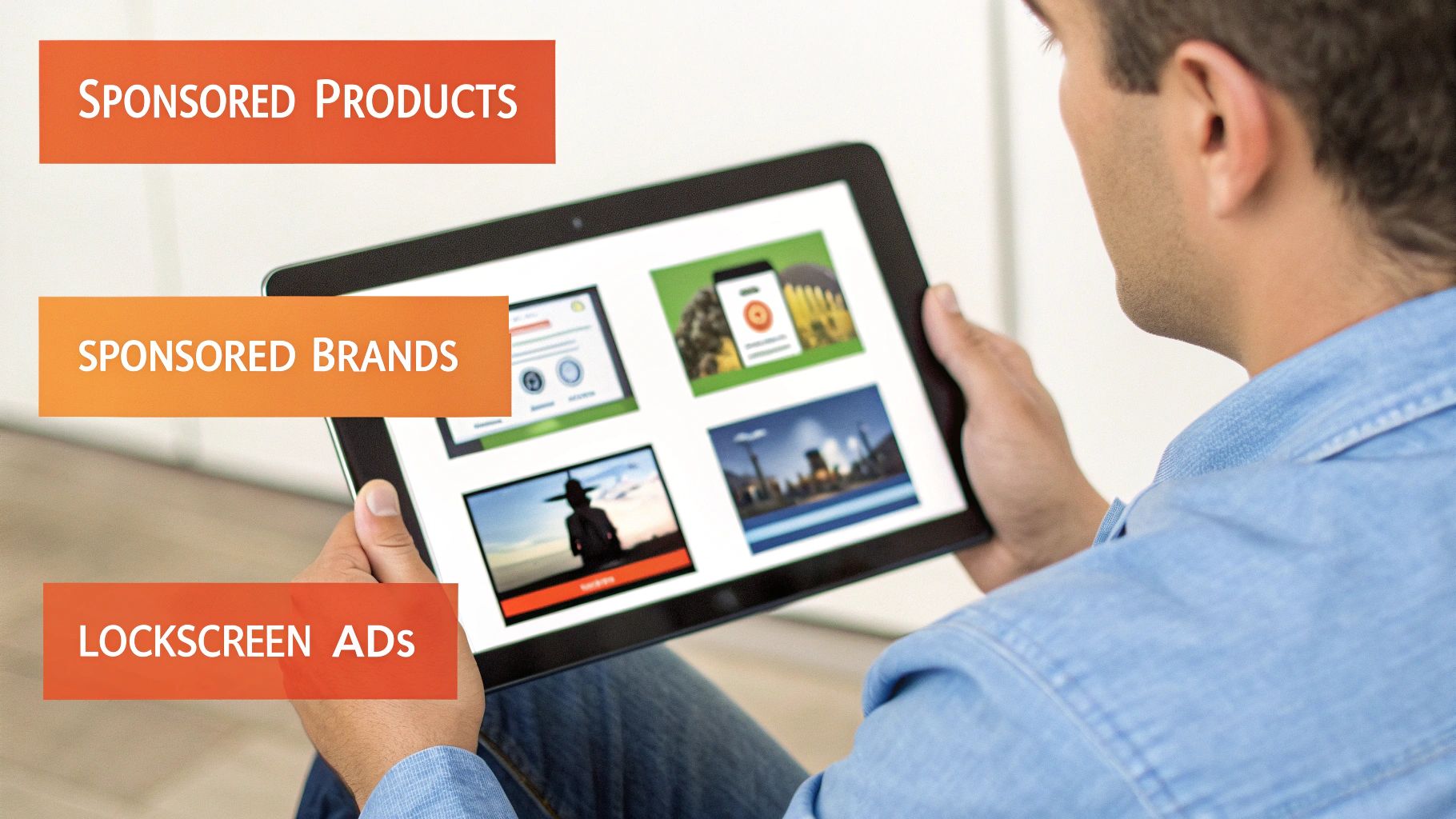
The Amazon Ads KDP dashboard offers several types of campaigns. For most authors, three are particularly useful. Choosing the right one helps you focus your budget and avoid spending money on ads that don't align with your goals.
Each ad type has a specific purpose. Understanding how they work is the first step toward building a profitable advertising strategy. Let's look at each one and when you should use it.
Start with Sponsored Products
Sponsored Product ads are the most common and versatile option for KDP authors. These are the individual book listings that appear within search results and on the product pages of other books. They are the most direct way to drive sales for a specific title.
When you are starting out, use a Sponsored Product ad with automatic targeting. With this setting, you don't choose any keywords. Instead, you let Amazon's algorithm show your ad to shoppers it thinks will be interested in your book.
This first campaign is a research tool. It will show you the exact search terms readers use to find and buy your book. This data is invaluable for creating more targeted campaigns later.
Best For: Your first ad campaign or promoting a new book.
Example: You just published a historical fiction novel set in ancient Rome. An automatic campaign will show you if readers are finding it by searching for "novels about Roman legions" or "historical fiction similar to Conn Iggulden."
Build Your Name with Sponsored Brands
Once you have published several books, especially a series, Sponsored Brands ads are an excellent tool. These are the banner ads that appear at the top of search results, featuring your author logo, a custom headline, and up to three of your books. They are designed to promote your author brand, not just a single book.
These ads help establish you as an author in a particular genre. For example, if a reader searches for "cozy mystery series," your branded banner could appear, showcasing the first three books of your series. This builds credibility and encourages readers to explore your entire catalog.
Get Direct with Lockscreen Ads
Lockscreen Ads place your book's cover directly onto the screensavers of Kindle e-readers and Fire tablets. This allows you to reach readers in a quiet, dedicated space away from the busy search results page.
With this ad format, your book's cover is the entire ad. This highlights why a professional, genre-appropriate cover is absolutely essential for advertising success.
These campaigns are effective for showing your ad to readers who previously viewed your book's page but didn't buy. You can also target readers who enjoy books by similar authors. Given that Amazon holds a dominant position in the e-book market, this direct approach is a valuable way to stand out. You can explore more data on Amazon's ebook market dominance to understand the scale of the platform.
Amazon Ad Types for KDP Authors at a Glance
Here is a simple comparison of the three main ad types. A well-rounded ad strategy will likely use a mix of all three over time.
Ad Type | Best For | Key Advantage |
|---|---|---|
Sponsored Products | Driving sales for a specific book. Essential for all authors. | Direct Sales Impact. The clearest path from a reader's search to a purchase. |
Sponsored Brands | Building author recognition and selling a series. Requires at least 3 books. | Brand Authority. Helps establish you in your genre and promotes your backlist. |
Lockscreen Ads | Reaching interested readers and targeting fans of similar authors. | High Visibility. Your cover gets prominent placement directly on a reader's device. |
For nearly every author, the best place to start is with a simple Sponsored Product campaign. Once you are comfortable and have collected some data, you can expand to other ad types to build a more comprehensive strategy.
Master Keyword and Product Targeting
Effective ad targeting is what separates profitable campaigns from expensive experiments. It ensures your ad is shown to the right readers. With Amazon Ads KDP, you have two main ways to do this: keyword targeting and product targeting.
Keywords help you reach readers as they search for books. Product targeting lets you place your book on the product pages of similar books, including those by your competitors. Using both is key to a solid ad strategy.
Use Keywords to Think Like a Reader
Keyword targeting is about understanding what words and phrases your potential readers type into the Amazon search bar. Don't just think in broad terms like "thriller." Get more specific.
For example, a reader looking for a particular type of thriller might search for:
"psychological thriller with a female detective"
"legal thriller like John Grisham"
"fast-paced spy novel"
A great way to find effective keywords is to run a low-budget automatic Sponsored Products campaign for a week or two. Amazon will provide a report showing the exact search terms shoppers used before clicking your ad. These terms are proven to be effective.
Once you find search terms that lead to sales in an automatic campaign, create a new manual keyword campaign. Add these proven terms to the manual campaign. This gives you more control over your bids for the keywords you know work.
This approach turns guesswork into a data-driven process. Tools like an Amazon suggestion expander can also help you discover additional keywords you might not have considered.
Leverage Products and ASINs to Find Your Audience
Product targeting, also known as ASIN targeting, is a more direct method. Instead of bidding on keywords, you choose specific book pages where you want your ad to be displayed. This lets you appear in the "Sponsored products related to this item" section on a competitor's page.
For example, if you've written a science fiction novel about first contact with aliens, you could target the pages of other popular books in that subgenre. When a reader is considering buying a similar book, yours will appear as an alternative, capturing a highly relevant customer at the ideal moment.
Here's a simple method for finding products to target:
Direct Competitors: List the top 10-20 bestselling books in your specific category.
Comparable Authors: Identify authors who write in a similar style and target their books.
"Also Boughts": Look at the "Customers who bought this item also bought" section on your competitors' pages to find more targets.
The self-publishing market is crowded. Ads have become essential for visibility. Only a small fraction of authors earn significant revenue without them, making targeted advertising a critical tool for success. By strategically targeting relevant books (ASINs), you can turn your competitors' visibility into your opportunity.
Manage Your Ad Budget and Bids Intelligently
A common concern for authors starting with Amazon Ads KDP is the fear of wasting money. This is understandable. However, managing your ad spend is about setting clear limits and starting small.
Your daily budget is a safety control. It is the maximum amount Amazon can spend on your campaign in one day, but it often spends less, especially with a new campaign.
Starting with a small budget, like £5 or £10 per day, is a sensible approach. This allows you to gather data and learn how the system works without a significant financial risk.
Protect Your Budget with Smart Bidding
When you set up a campaign, you will be asked to choose a bidding strategy. For beginners, the best choice is Dynamic bids - down only.
This setting instructs Amazon to automatically lower your bid if a click seems unlikely to result in a sale. It is a built-in safety measure that helps prevent you from overpaying for clicks.
You should only consider more aggressive bidding strategies after a campaign has proven to be consistently profitable. The initial goal is to protect your budget while you learn.
Understanding Your Target ACOS
To run profitable ads, you need to understand your break-even point. The key metric for this is ACOS (Advertising Cost of Sale). ACOS is a percentage that shows how much of your sales revenue is spent on advertising.
The calculation is simple: (Ad Spend ÷ Ad Sales) x 100.
A lower ACOS is better, as it means you are spending less to generate sales. Your target ACOS should always be lower than your book's royalty percentage.
Here's a practical example. If your e-book costs £4.99, you earn a royalty of approximately £3.50 (at the 70% royalty rate). To make a profit, your ACOS must be below 70%. If your ACOS is 75%, you are losing money on every sale from that ad.
Knowing this number helps you make informed business decisions. For more details on the financial side of advertising, our guides on Amazon pay-per-click strategies can be helpful.
Setting your first bid can be tricky. A reasonable starting point for most fiction genres is between £0.25 and £0.40 per click. After launching your campaign, let it run for at least a week without making changes. Amazon's system needs time to gather data.
After a week, review the performance. If you have impressions but no clicks, your bid may be too low. If you have clicks but no sales, the issue is likely with your book page (cover, description, or reviews), not the ad itself. Adjust one element at a time and monitor the results.
Analyse Your Ad Performance and Optimise for Profit
Launching an ad is just the beginning. The real work is in analyzing the results and making adjustments to improve profitability. The Amazon Ads dashboard presents a lot of data, but you only need to focus on a few key metrics to understand how your campaign is performing.
These metrics tell a story about your ad's effectiveness. Your job is to read that story, identify problems, and make changes to fix them. This is a continuous cycle of analysis and refinement.
Decode Your Key Ad Metrics
Your ad's performance can be understood through a few key numbers. The most important are Impressions, Clicks, Spend, Sales, and your Advertising Cost of Sale (ACOS).
Impressions: The number of times your ad was displayed. High impressions indicate that your targeting is working and Amazon is showing your ad to shoppers.
Clicks: The number of people who clicked on your ad. This is the first test of your book cover and ad copy.
Spend and Sales: The amount of money you have spent on ads compared to the revenue generated from those ads.
ACOS: The percentage of sales revenue spent on advertising. A low ACOS is the primary goal for profitability.
The advertising process is a loop: you set a budget and bids, then analyze the ACOS to determine profitability. This analysis informs your future decisions about budgets and bids.
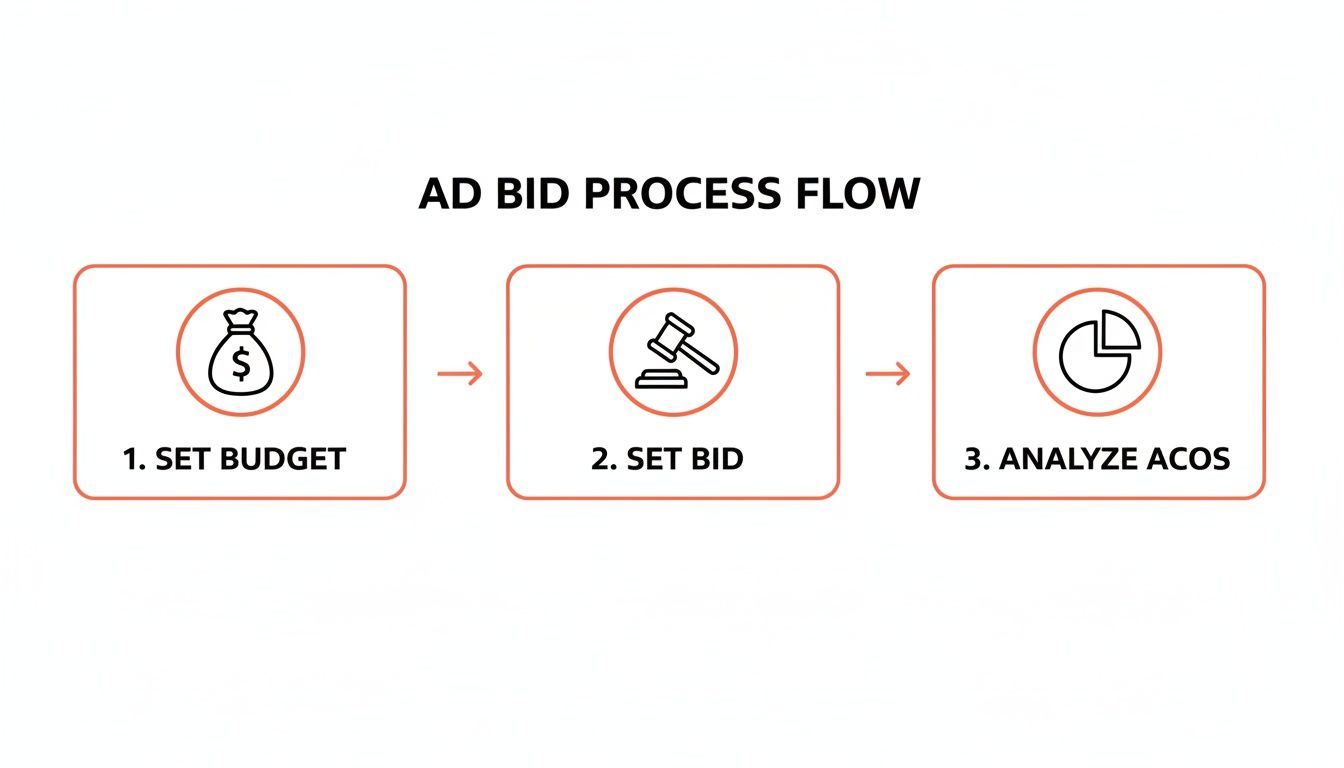
Effective advertising is not a "set it and forget it" activity; it requires ongoing monitoring and adjustment.
Turn Data Into Actionable Insights
Understanding the numbers is only useful if you know what to do with them. Here are two common scenarios and how to address them.
High Impressions, Low Clicks: If many people see your ad but few click on it, the problem is likely your ad's visual appeal. Your book cover may not be compelling as a small thumbnail, or your ad headline (if applicable) is not engaging enough.
High Clicks, Low Sales: If you are getting plenty of clicks but few sales, the issue is on your book's product page. Your description may not be convincing, your reviews might be poor, or the "Look Inside" preview is not strong enough to persuade readers to buy.
The self-publishing market is highly competitive. Effective advertising is no longer optional; it is a critical component of a successful book launch and long-term sales strategy.
Improving your ad performance is similar to learning how to increase website conversion rate. In both cases, you are driving traffic to a page and need that page to convert visitors into customers. By systematically diagnosing and fixing issues, you can turn a money-losing campaign into a profitable one.
Got Questions About Amazon KDP Ads?
Even with a clear plan, starting with Amazon Ads can raise some questions. Most authors encounter the same issues when they launch their first campaigns. Let's address some of the most common ones.
How Long Does It Take for an Ad to Be Approved?
Amazon typically reviews and approves ads within 24 hours. However, during busy periods like the holiday season, it can take up to 72 hours.
If your ad is still "in review" after three days, it is reasonable to contact KDP support. In most cases, however, you just need to be patient.
How Long Should I Run a Test Campaign?
One of the biggest mistakes authors make is stopping an ad campaign too soon. Amazon's algorithm needs time to learn which shoppers are most likely to click on your ad.
You should let any new campaign run for at least 7 to 14 days before making any significant changes or decisions.
This period provides enough data to see initial trends. Pausing a campaign after only a couple of days is like judging a book by its first sentence—you are making a decision based on incomplete information.
You cannot properly evaluate a campaign with only a few days of data. Consider the initial ad spend an investment in learning what works for your book.
What Is a Good ACOS for a Book?
There is no single "good" ACOS. The right ACOS depends entirely on your goals and your royalty rate.
For a single e-book to be profitable, your ACOS must be lower than your royalty percentage. For example, if you earn a 70% royalty, an ACOS under 70% means you are making a profit on each ad-driven sale.
However, sometimes a higher ACOS is acceptable for strategic reasons. Here are two examples:
Launching a New Book: During a launch, the primary goal is often to gain visibility and sales momentum, not immediate profit. A higher ACOS can be a worthwhile investment to help your book climb the sales charts.
Selling Book 1 of a Series: You might be willing to lose money advertising the first book in a series, knowing that you will profit when readers buy the subsequent books.
Before launching a campaign, define your goal. This will help you determine what an acceptable ACOS is for your specific situation.
At Cosmy, we're obsessed with helping brands and authors make sense of the Amazon ecosystem. Our AI-powered platform delivers the actionable intelligence you need to boost your visibility and find more readers. Stop guessing and start gaining a competitive edge by visiting https://cosmy.ai to get started with a free audit.