A Guide to Affiliate Marketing Through Amazon for Brands

Written by

Cosmy
AI-driven eCommerce Optimization
When you hear "affiliate marketing through Amazon," you probably think of bloggers and YouTubers earning a cut for recommending products. You're right. It's a system where creators—or "affiliates"—earn a commission when a shopper clicks their unique link and buys something on Amazon.
For brands, this setup creates a powerful advantage: a motivated sales force that has already built trust with specific audiences. These affiliates drive interested customers directly to your product pages.
Building Your Foundation for Amazon Affiliate Success
Many brands misunderstand affiliate marketing; it's not a passive channel where you wait for creators to discover your products. You have to make your products an easy and profitable choice for them to promote.
Think of the Amazon Associates program from your perspective as a brand. You don't earn the commission, but you make it possible for affiliates to earn one.
Success starts with following the rules. Amazon's policies are strict because their primary focus is protecting the customer experience. For instance, every affiliate must clearly state they might earn from purchases. This rule affects how they present your brand, and you need to be aware of it.
Defining Your Affiliate Marketing Goals
First, decide what you want to achieve. A clear goal guides your strategy. Are you trying to launch a new product, or are you focused on building steady traffic from content that will last for years? These two goals require different approaches.
Driving Initial Sales: This is a short-term goal focused on getting your product in front of as many relevant people as possible, quickly. For example, you might partner with deal sites or influencers who can create a surge of interest right at launch.
Building Long-Term Traffic: This is a long-term goal. The aim is to get your products featured in lasting content, like detailed product reviews or "how-to" guides that will show up in search results for months or even years. This approach creates a consistent stream of qualified customers.
A clear goal separates a scattered effort from a strategic plan. It determines which types of affiliates you want to attract and how you need to design your product pages to meet their audience’s needs.
Understanding the Brand’s Role
As a brand, you don't directly participate in the Amazon Associates program. You don't choose who links to your products. Your job is to create an environment where the best affiliates want to promote you.
This means your product listing must be optimized to convert visitors into buyers.
Top affiliates are smart business operators. They track their performance closely. If they send traffic to a product that doesn't sell well, they will stop promoting it. A low conversion rate directly hurts their earnings.
Think of it this way: your product page is the final step in the affiliate's process. They build trust, create content, and drive traffic. Your job is to make sure that when a potential customer lands on your page, the path to the "Add to Cart" button is as smooth and convincing as possible. This preparation is the true foundation of a successful affiliate marketing strategy on Amazon.
Finding the Right Channels to Promote Your Products
Success in affiliate marketing through Amazon comes down to showing up in the right places, in front of the right people. This means understanding the different types of partners who can promote your brand, from niche bloggers to large deal websites.
The key is not just finding channels with big audiences, but finding channels with the right audience. A person clicking from a detailed product review is usually closer to buying than someone who scrolled past a mention on social media. One is actively researching, while the other is browsing. Matching your product to the right platform is critical.
Matching Products to Affiliate Channels
Different affiliate channels serve different purposes. A YouTuber unboxing a gadget is perfect for an audience that needs to see a product in action. A technical blogger writing a long guide attracts readers looking for in-depth information. Choosing the right partner means aligning your product’s strengths with the channel's style and its audience's expectations.
Let's look at the most common types of channels.
Affiliate Partner Channel Comparison
This table breaks down common affiliate channels to help you match your product to the right platform.
Channel Type | Primary Audience | Best For | Key Consideration |
|---|---|---|---|
Niche Blogs & Content Sites | Readers seeking expert advice and in-depth information. | Products that require detailed explanation, such as electronics or specialized equipment. | Builds long-term, organic traffic. Conversions may be slower but are often from highly interested buyers. |
YouTube & Video Creators | Visual learners who want to see products in action. | Gadgets, fitness equipment, beauty products—anything that can be demonstrated. | Demonstrations build trust. Your product needs to be visually appealing with a clear use case. |
Deal & Coupon Sites | Bargain-hunters ready to buy immediately. | New product launches, seasonal promotions, or clearing out inventory. | Drives high sales volume quickly but can lower your brand's perceived value if overused. |
Social Media Influencers | Engaged communities following a specific lifestyle or interest. | Visually appealing products in fashion, home decor, beauty, and wellness. | Provides authentic recommendations to a loyal audience. Best for brand awareness and impulse buys. |
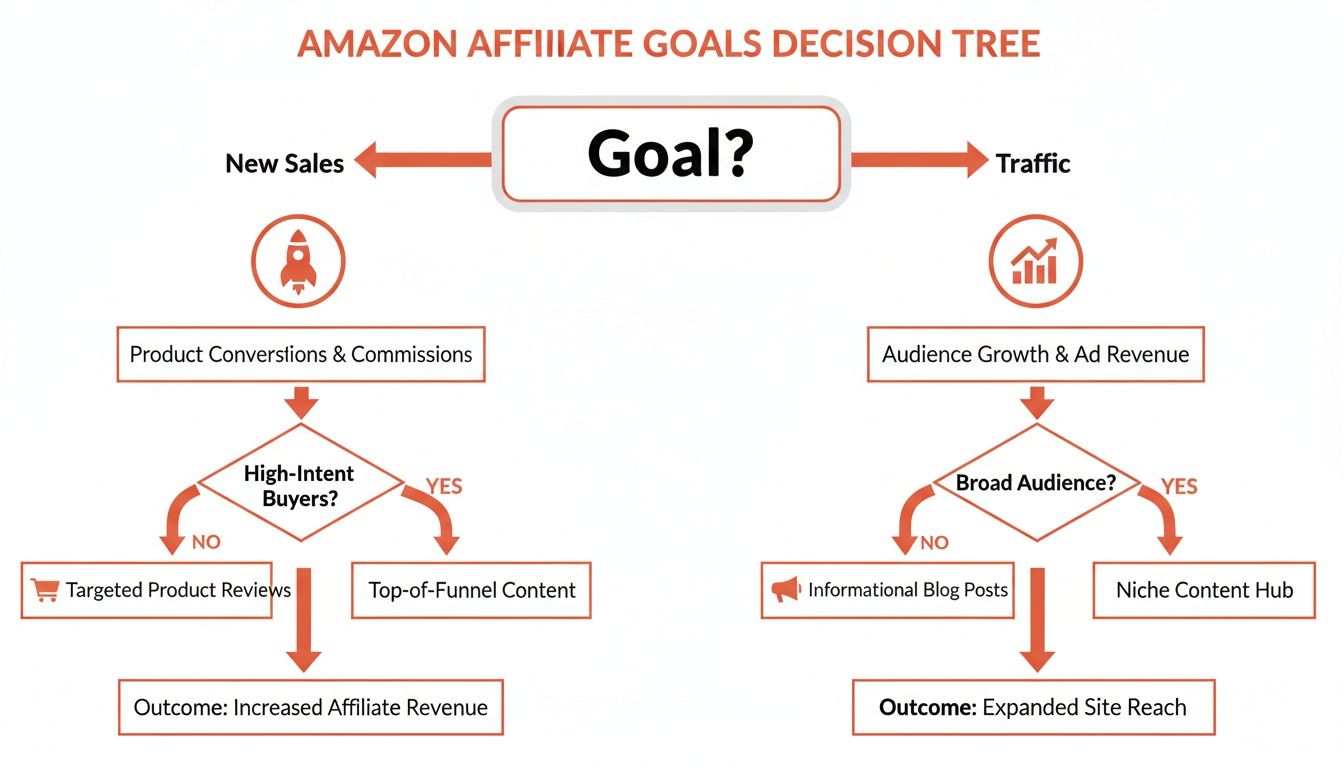
Ultimately, the right channel depends on your goal. Are you aiming for a sales spike for a new launch, or are you building a steady stream of traffic for the long haul?
This decision tree helps visualize that choice. For immediate sales, you’ll likely use deal sites and influencer campaigns. For long-term traffic, content from blogs and YouTube channels is your best bet.
Identifying High-Potential Partners
Your goal is to make your products an obvious choice for top-performing affiliates. The Amazon Associates program has over 900,000 active partners. Finding the best ones requires a smart approach.
The best affiliate partnerships feel like a genuine collaboration. When a creator truly believes in a product, their recommendation is authentic and more powerful.
A good place to start is searching for your product category on Google and YouTube. See who is already creating high-quality reviews and guides for similar products. These are your prime targets.
Many affiliates use multiple channels. For example, they might master Amazon Influencer Marketing programs alongside their blog or YouTube channel.
Understanding their methods helps you position your products more effectively. You can also improve your product's visibility by using tools like the Amazon suggestion expander. The right channel places your product in a context where it provides real value, leading to quality traffic that is genuinely interested in what you sell.
Optimizing Product Pages to Convert Affiliate Traffic
Getting a click from an affiliate's link is only the first step. The real work begins when a potential customer lands on your Amazon product page. Your listing is the final step in the process, and its purpose is to turn that interested visitor into a buyer.
Consider the customer's journey. They just read a blog post or watched a review that convinced them to click. They arrive on your page looking for confirmation that they’ve made the right choice. Your page needs to provide a seamless experience that reinforces the trust the affiliate has already built.
This is where your Amazon Standard Identification Number (ASIN) is most valuable. Each ASIN for Amazon represents a unique product listing, and its performance directly impacts your success.
Crafting Titles That Align with Affiliate Content
The product title is the first thing a visitor sees. It must instantly confirm they are in the right place while highlighting the product's main benefit. Focus on clarity, not just keywords.
For example, if an affiliate promotes your "noise-canceling headphones for frequent flyers," a title like "EchoWave Pro Noise-Canceling Headphones - 40Hr Battery, Ideal for Travel" is more effective than "EchoWave Pro Model X7 Headphones." The first title speaks directly to the solution the visitor is looking for.
Using Bullet Points to Answer Pre-Sold Questions
When someone clicks an affiliate link, they are already interested. They are looking for answers to final questions. Your bullet points are the perfect place to address these.
Structure your bullet points to connect features to real-world benefits:
Old Way (Feature-focused): "Equipped with advanced multi-mic noise cancellation technology."
Better Way (Benefit-focused): "Silence the Cabin Drone: Enjoy crystal-clear audio on flights with our noise-cancellation, designed to block out low-frequency engine sounds."
The second example doesn't just list a technical feature; it solves the exact problem the visitor has. Each bullet point should address a potential concern or reinforce a key selling point mentioned by the affiliate.
Building Trust with High-Quality Visuals
Online, your visuals represent the physical product. Low-quality images can destroy the trust an affiliate worked to build. High-resolution photos and videos are essential.
Show your product from every angle, in use, and with close-ups of important details. For instance, if you sell a leather wallet, include macro shots of the stitching and a video showing how cards fit inside. This level of detail provides proof of quality and makes the purchase decision easier.
Remember, a referred customer arrives with a higher level of trust. Your product page must honor that trust, making the purchase feel like the next logical step.
Today, 50% of all affiliate sales happen on mobile phones. This means your images, videos, and text must be optimized for smaller screens, as partners increasingly drive traffic from mobile-first platforms like Instagram and TikTok.
Aligning Descriptions with the Customer Journey
Your product description is your chance to tell a complete story. Use this space to expand on the benefits mentioned in the bullet points.
Mirror the language used by top affiliates in your niche. If they praise your product's durability for outdoor adventures, your description should highlight its rugged construction. This creates a consistent narrative from their content to your page.
For example, understanding how brands use ASIN-level launch strategies can offer insights into optimizing your own pages. This alignment makes your product the clear and trustworthy choice for the customer.
Understanding Your Performance and Affiliate Impact
Getting an affiliate to feature your product is just the beginning. The real work is understanding what happens after the link is live.
Effective affiliate marketing on Amazon is driven by data. You need to connect specific affiliate activities to your sales, even without direct reporting from Amazon.

While Amazon’s reports don't show which specific affiliate drove a sale, they leave clues. Your job is to interpret the data you can see and turn those numbers into an active strategy.
Key Metrics to Monitor in Your Seller Central Account
You can't see which affiliate drove a sale, but you can spot trends that indicate an affiliate is sending you quality traffic.
In your "Sales and Traffic" reports in Seller Central, look for these patterns:
Page Views and Sessions: A sudden, sustained increase in traffic to a single product page is a big clue. If it doesn't match your advertising campaigns, it’s likely a new affiliate link is performing well.
Unit Session Percentage (Conversion Rate): This is a critical metric. If traffic increases but your conversion rate drops, the affiliate's audience may not be a good match. But if both traffic and conversion rate climb, it's a sign of a high-quality, well-aligned promotion.
Total Items Shipped: Tracking the number of units shipped tells you exactly which products are popular with the audiences being sent to your page.
Your goal is to be a data detective. Look for unexplained increases in traffic or conversions and trace them back to potential affiliate content. This lets you figure out what’s working without direct attribution from Amazon.
Interpreting the Data to Find Winning Products
Here's a practical example. Imagine you sell kitchen gadgets. You notice that traffic to your high-end espresso machine has tripled in the last week, and its conversion rate has jumped from 8% to 12%.
This is a strong signal that an influential source is sending motivated buyers to your page.
A quick search on Google or YouTube for "best espresso machine" might reveal a popular new review video featuring your product. Now you have identified the exact type of content that sells your machine.
You can now take these steps:
Refine Your Product Page: Go back and optimize the espresso machine's title, bullet points, and A+ Content. Use the same language the reviewer used. If they mentioned its "quiet operation," make sure that phrase is on your listing.
Inform Future Content: You've learned that in-depth video reviews drive high-converting traffic for this product. Use this data to guide your future marketing investments.
Cross-Promote Accessories: If people are buying the espresso machine, make sure your page cross-sells related accessories like coffee beans, frothing pitchers, or cleaning kits.
Learning to access and analyze this product-level data is key. For a deeper look into the technical side, it’s worth learning about the Amazon Product Advertising API and how it can be used to gather this kind of information.
By consistently monitoring these performance indicators, you can turn your affiliate channel into a predictable growth engine.
Advanced Strategies for Scaling Your Affiliate Channel
Once your affiliate marketing efforts are generating steady traffic, it's time to scale. To move from a passive income stream to a powerful growth channel, you need a more advanced approach. Stop hoping affiliates find you and start actively building a predictable channel.
The shift is from being reactive to proactive. You are no longer just a brand with a product; you are a strategic partner for the top creators in your niche.
Proactive Outreach and Relationship Building
The best affiliates are trusted advisors to their audience. Your goal is to build that same level of trust with them. Identify high-performing content creators in your category and reach out to them.
A search on Google or YouTube for your product type will show you who the key players are. When you contact them, make your approach personal and valuable.
Offer Exclusive Information: Give them a preview of an upcoming product feature or a behind-the-scenes look at how your products are made. This provides them with unique content for their audience.
Provide Early Access: Send them new products before they launch. This allows them to create timely reviews and positions your brand as an innovator.
Share Performance Insights: If one of their videos caused a noticeable sales spike, tell them. Sharing that data reinforces the value of the partnership and encourages them to feature you again.
By treating top affiliates like partners, you build a relationship that goes beyond a simple transaction. You become a go-to source for them, making them more likely to promote your products over competitors.
The affiliate marketing industry is growing rapidly. As more brands invest in affiliate channels, competition for top creators will increase. Strong relationships are your best advantage. You can discover more insights about affiliate marketing's growth on postaffiliatepro.com.
Turning Performance Data into Product Development
Your affiliate channel is a direct line to your customers' needs. The data you gather from affiliate performance should inform your product development and content strategy. When you see which products are popular with affiliate audiences, you are getting direct market feedback.
For example, imagine you sell outdoor gear. In your Amazon reports, you notice that affiliates focused on "ultralight backpacking" are driving a lot of traffic to your lightweight tent, while your heavier models get little attention.
This is a clear signal of market demand in a specific niche.
Here’s how you can act on that insight:
Refine Your Content: Update the product page for the lightweight tent. Use phrases like "perfect for thru-hiking" or "shed pounds from your pack" to match the language these affiliates are using.
Guide New Product Development: This data indicates a market opportunity. Could you develop other ultralight products, like a lighter sleeping bag or a minimalist backpack?
Create Bundles: Offer a bundled package on Amazon for the "ultralight backpacker," combining the tent with other relevant gear. This makes your brand an even more compelling choice for affiliates.
When you use performance data this way, you create a feedback loop. Affiliates show you what's working, you improve those products and develop new ones to meet that demand, and in return, you give them even better products to promote.
Common Questions About Amazon Affiliate Marketing
Here are straightforward answers to common questions brands have about affiliate marketing through Amazon.
How Much Does It Cost to Start?
For brands already selling on Amazon, there are no direct upfront costs for the Amazon Associates program. It is a performance-based system.
You only pay when an affiliate's link leads to a sale. The commission is part of the referral fees you already pay as a seller. Your main investment is the time and effort you put into optimizing your product pages and building relationships with creators.
Can I Choose Which Affiliates Promote My Products?
No, you cannot directly choose, approve, or block affiliates. The Amazon Associates program is an open network.
Once an affiliate is approved by Amazon, they can create a link to any product on the site. This means you don't have direct control over who promotes you. However, you can heavily influence who chooses to promote you.
Your real power comes from making your product the most profitable choice for an affiliate. Top creators are data-driven; they promote what converts because high conversion rates mean more income for them.
Your control is indirect. By creating a highly optimized product page with great images, clear benefits, and persuasive copy, you make your listing a magnet for the best partners.
How Long Does It Take to See Results?
The time it takes to see results from affiliate marketing varies. It is rarely an overnight success.
An influential creator could feature your product and cause an immediate sales spike, but those moments are unpredictable.
Building a consistent stream of affiliate traffic takes longer.
Initial Traction (1-3 Months): Affiliates need time to find your product, test it, and create content like a blog post or YouTube review.
Steady Growth (3-6 Months): You will likely start to see a more noticeable and steady flow of traffic and sales from different sources. By now, the content they created is starting to appear in search results, creating a reliable stream of customers.
Think of it like planting seeds. The initial work may not show immediate results, but over a few months, it can grow into a steady source of high-quality traffic and sales.
Ready to stop guessing what works on Amazon? Cosmy gives you the AI-powered insights to diagnose content gaps, prioritise fixes, and see a measurable lift in your organic discoverability. Replace uncertainty with a clear, data-backed action plan. Start with a free audit and see how your products truly stack up by visiting https://cosmy.ai.