Affiliate Marketing on Amazon: A Practical Guide
Written by

Cosmy
AI-driven eCommerce Optimization
If you've considered making money online, you have likely heard of Amazon affiliate marketing. The idea is simple: you recommend products sold on Amazon using a special link. If someone clicks your link and buys anything within 24 hours, you earn a small commission. This is a common way for bloggers, YouTubers, and other content creators to generate income.
Why Amazon Affiliate Marketing Is Still a Good Choice
With talk of lower commissions and more competition, many wonder if partnering with a giant like Amazon is still worthwhile. The short answer is yes.
The official program, called Amazon Associates, remains one of the best starting points for affiliate marketing. This is mainly because of trust and convenience.
When you send a potential customer to Amazon, you are directing them to a familiar and trusted website. They probably already have an account, their payment information is saved, and they understand the checkout process. This familiarity removes major barriers to making a purchase, which helps increase the chances of you earning a commission.
Leveraging a Trusted Marketplace
The biggest advantage of working with Amazon is its strong reputation. Customers feel safe buying there. Your job is not to convince them that the store is legitimate, but to give them a good reason to click your link and look at a product.
This existing trust is a significant benefit:
Universal Brand Recognition: You don't need to explain who Amazon is. Everyone knows the brand.
Easy Buying Process: Features like one-click ordering make it simple for people to buy on impulse, which can increase your earnings.
Vast Product Selection: No matter your niche, you can find relevant products to promote, from tech gadgets and kitchen tools to specialized books and clothing.
To help you understand what the program involves, here is a summary of its main features.
Amazon Associates Program Key Features
This table outlines the essential aspects of the Amazon affiliate program that new marketers should know.
Feature | Description |
|---|---|
Commission Structure | Rates differ by product category, generally from 1% to 10%. |
Cookie Duration | When a user clicks your link, a 24-hour "cookie" is activated. You earn a commission on anything they purchase in that period. |
Universal Cart Commission | You earn a commission on the customer’s entire order, not just the specific product you linked to. |
Payment Threshold | You must earn at least $10 in commissions before Amazon pays you (via direct deposit or gift card). |
Product Variety | Access to millions of products in almost every imaginable category. |
Reporting Tools | Dashboards are provided to track your clicks, earnings, and conversion rates. |
Link Types | You can use simple text links, image links, and custom shopping ads. |
Understanding these basics is important because they will influence your strategy, from the products you select to the content you create.
Market Dominance and Commission Structure
Amazon's large presence in affiliate marketing is significant. Amazon Associates is the market leader, controlling 46-48% of the global affiliate marketing industry. This provides a stable platform for you to build on.
While Amazon's commission rates are not the highest available, the high volume of sales can compensate for this.
The real benefit of the Amazon Associates program is not just the commission on the one product you linked. If someone clicks your link for a $20 kitchen gadget but also buys a $1,000 television in the same 24-hour period, you get a commission on the entire purchase. This can make a big difference.
Before you start, it's helpful to understand the basics of affiliate marketing. If you are new to this, spending some time on a guide like How to Start Affiliate Marketing can be very useful. Learning how to choose a niche, create content, and build an audience will help you succeed in the long run.
How to Get Approved for the Amazon Associates Program
Joining the Amazon Associates program should be straightforward, but many applicants are rejected for simple mistakes. The key is to show Amazon that your platform—whether it's a blog, social media profile, or app—provides real value and isn't just a collection of affiliate links.
Amazon’s review team looks for partners who have an existing audience and create original content. Before you apply, evaluate your platform. A new website with only five blog posts or a social media page with no engagement will likely be rejected. They need to see that your platform is active.
Preparing Your Platform for Approval
Think of your application as a proposal and your website as the proof. Amazon wants to see that you are a content creator first and a marketer second. This means meeting a certain standard of quality before they will consider you.
Here is what you must have:
Original Content: You need a good amount of unique, helpful content. For a blog, aim for at least 10-15 quality posts that relate to the products you plan to promote.
Clear "About Us" and Contact Pages: These pages show that you are a real person or business, which builds trust.
An Established Audience: While there's no specific number, your platform needs to show signs of activity, such as consistent website traffic, real comments on your posts, or a growing social media following.
The process is a cycle: you build trust, which brings traffic, which leads to sales, and that earns you commissions.
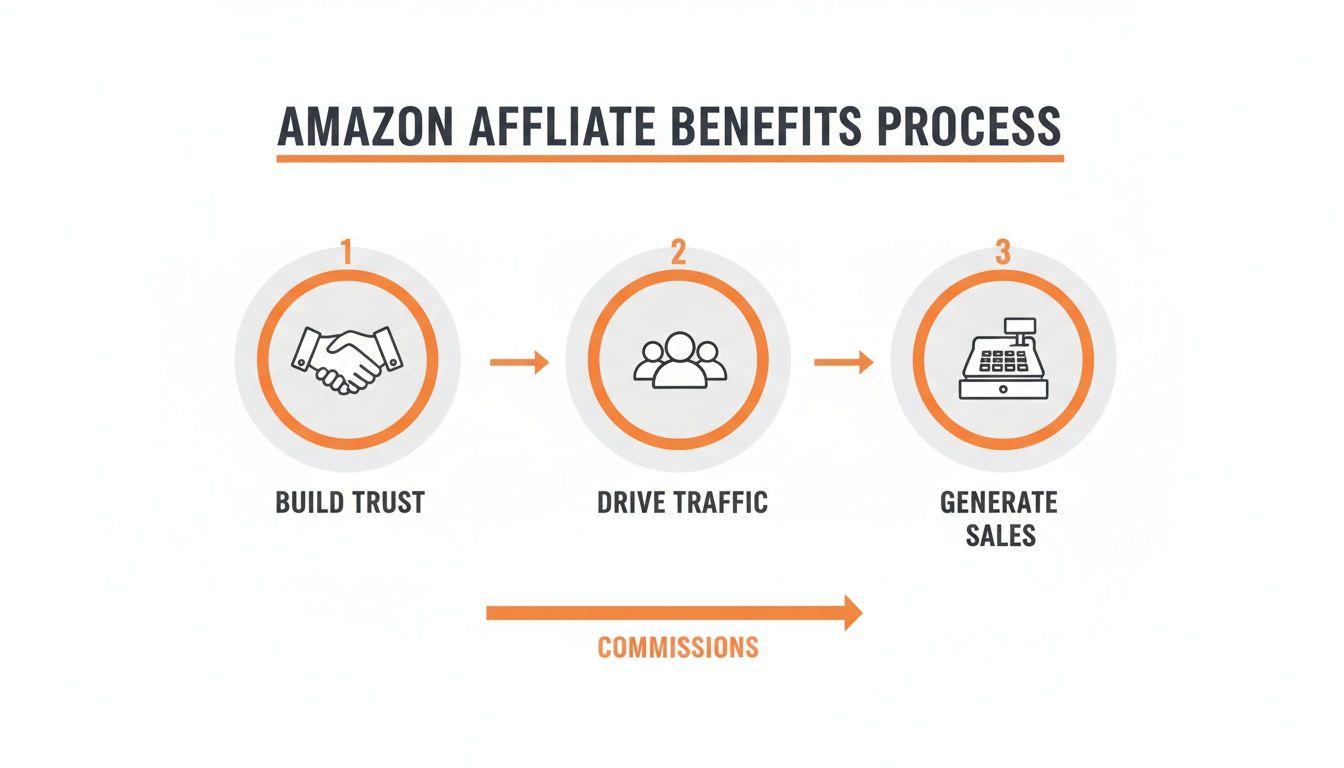
As you can see, everything starts with building credibility. Without it, you won't get the traffic needed to make sales.
Completing Your Account and Profile Information
Be precise when you fill out the application form. When asked to describe your platform, avoid vague descriptions like "a lifestyle blog." Instead, be specific. For example, "A blog for new parents focusing on sustainable and non-toxic baby products" is much better.
Pay close attention to the section on traffic sources. Amazon needs to know how you plan to bring visitors to your content. Be honest about your primary methods, whether it’s through search engines, Pinterest, or your email list.
Your goal is to give the Amazon review team a clear understanding of your platform. A well-defined niche and a clear content strategy show them you have a plan, which greatly improves your chances of being approved.
You must also list every website, mobile app, and social media page you plan to use. Do not omit any. People have had their accounts suspended for posting affiliate links on a platform they did not declare during signup.
Meeting the Initial Sales Requirement
Once you receive provisional approval, you have 180 days to make at least three qualifying sales. This may seem challenging, but it is Amazon's way of filtering out inactive accounts. If you fail to meet this requirement, your account will be closed, and you will have to reapply.
To meet this goal, focus on creating content that solves a real problem for your audience. A well-researched product review or a "best of" guide will perform much better than just adding links to old posts. Remember, purchases you make for yourself do not count. You need to drive real purchases from your audience.
Creating Content That Drives Sales
Once you are approved for Amazon Associates, the real work begins.
Your success depends on the quality of your content. Simply adding affiliate links to generic articles will not be effective. To earn a meaningful income, you need to create content that helps people make purchasing decisions.
The best affiliate content is a solution, not a sales pitch. You are answering the questions people are typing into search engines and acting as a trusted guide. This is how you build credibility and drive sales.
Three Types of High-Converting Affiliate Content
To consistently turn readers into buyers, you should focus on three main content formats. Each one targets a customer at a different stage of their buying process.
In-Depth Single Product Reviews: This is a detailed look at one specific item. It is ideal for someone who has already heard of the product and is looking for a final confirmation before buying.
“Best Of” Roundup Posts: Articles like "The 5 Best Coffee Grinders for French Press" attract a lot of traffic. They appeal to buyers who know they have a problem (e.g., they need a grinder) but haven't decided on a specific product yet.
Direct Comparison Articles: Comparing two or three products, such as "Ninja Blender vs. Vitamix," is very effective. You target shoppers who are at the final stage of their decision-making process and need help choosing a winner.
By creating a mix of these three types of content, you can attract buyers at every stage of their journey.
How to Structure a Powerful Product Review
A good product review tells a story and solves a problem; it doesn't just list features. Knowing how to write product reviews that drive sales is what separates successful affiliates from the rest. Your review should guide the reader from their problem to your recommended solution.
Start with an introduction that addresses the reader's problem. For example, instead of "Today, I'm reviewing the Anker PowerCore 10000," try something more engaging: "If you travel often and are tired of your phone dying, the Anker PowerCore 10000 might be the most useful gadget you own." This immediately connects with their needs.
Next, explain the product's features and translate them into practical benefits.
Feature: "It has a 10,000mAh battery."
Benefit: "Its 10,000mAh battery can charge an iPhone 14 twice, so you can stay connected all day while traveling."
Your personal experience is what makes your review unique. Do not just rewrite the Amazon product page. Include your own photos or videos. Describe how the product feels, what you liked, what you disliked, and any quirks you noticed. This is how you build trust.
Key Takeaway: Authenticity is crucial. Readers can easily recognize a generic product description. Sharing your real experience—both good and bad—is the quickest way to build credibility.
Finally, provide a clear conclusion and a call to action. Summarize who the product is best for and give your final recommendation. Then, make it easy for them to proceed: "If you think this is the right portable charger for you, you can check the current price on Amazon here."
Creating "Best Of" Roundups That Are Actually Helpful
Roundup posts are often the main source of traffic for affiliate websites. Your role here is to be a curator, saving your readers hours of research.
Be transparent about how you chose the products. Did you test them yourself? Are your recommendations based on extensive research of user reviews? Let your readers know.
A good roundup should have a clear structure:
The Introduction: Explain the problem you are solving and the criteria you used to select the products. For example: "We researched over 20 different models, focusing on durability, ease of use, and grind consistency to find the best coffee grinders."
A Comparison Table: Place a simple, scannable table near the top of the article so readers can quickly compare your top picks.
Individual Mini-Reviews: For each product, write a brief summary. Highlight its best features, any potential drawbacks, and who it is best suited for (e.g., "Best for Beginners," "Best for Espresso Lovers").
A Buyer's Guide: At the end, include a section explaining what features to look for when shopping for this type of product. This adds value and establishes you as an expert. For an extra advantage, use a tool like the AMZ Suggestion Expander to discover what customers are truly searching for.
When you provide this level of detail, your roundup becomes a valuable resource, and people will be more likely to trust your recommendations and make a purchase.
Getting Traffic to Your Affiliate Content
Creating great content is only half the battle. Without a consistent stream of visitors who are actively looking for solutions, even the best review will go unnoticed. Your main task is to create reliable ways to guide potential customers to your articles.
While social media can provide short-term traffic, Search Engine Optimization (SEO) is the most effective strategy for long-term success. SEO is the process of getting your content to appear at the top of Google's search results, which can bring a steady flow of qualified visitors.
Finding Keywords That Drive Sales
Effective SEO starts with keyword research. This means understanding the exact words and questions your audience is typing into search engines. The goal is to find phrases that indicate someone is close to making a purchase.
Consider the intent behind these two searches:
"drones": This is very broad. The person could be looking for news, photos, or general information.
"best beginner drone under £200": This is specific. The user has a clear need (they are a beginner), a budget (£200), and is actively looking for a product recommendation. This is a high-intent keyword.
Focusing on these longer, more specific phrases, often called "long-tail keywords," is where you will find the most success. They typically have less competition, making it easier for a new site to rank, and the traffic they generate is more likely to result in a sale.
How to Find Winning Keywords
You don't need expensive tools to start. Begin by thinking like a customer. Go to Amazon and type in a broad term like "air fryer." Pay attention to the auto-suggestions that appear, such as "air fryer for family of 4" or "air fryer dual basket." These are real searches from real people.
Next, focus on question-based keywords, which often start with "what," "how," or "best." For example, instead of just targeting "espresso machine," you could create content around more specific needs:
"best espresso machine for small kitchens"
"how to clean a De'Longhi espresso machine"
"is a manual espresso machine worth it"
Each of these targets a specific user problem, creating a perfect opportunity to recommend a product.
A Practical Tip: Don't just focus on Google. YouTube and Pinterest are also powerful search engines. People use YouTube for visual reviews and how-to guides, while Pinterest is a major platform for discovering products related to hobbies, home decor, and style.
Expanding Your Reach Beyond Google
While SEO should be your main focus, diversifying your traffic sources can make your business more resilient. Think of other platforms as ways to amplify the great content you are already creating.
Using Pinterest for Visual Discovery
Pinterest is a visual search engine where users go to find ideas and products. It is well-suited for niches like home improvement, cooking, and fashion. The strategy is to create eye-catching vertical images, called "Pins," for each of your articles.
For example, if you wrote a roundup of "The 5 Best Stand Mixers for Baking Bread," you could create several different Pins for that one article, each linking back to your blog post to drive targeted traffic.
Leveraging YouTube for In-Depth Reviews
If you are comfortable on camera, YouTube is an excellent platform for building trust. Seeing a product in action can be the final push someone needs to make a purchase. You can create companion videos for your blog posts, such as an unboxing or a hands-on demo.
In your video description, you can link to your full written review (with your affiliate links) and also include individual Amazon affiliate links for the featured products. This creates a powerful connection between your blog and video content.
Building a Simple Email List
Never underestimate the power of an email list. It is the only traffic source you truly own. You can start by adding a sign-up form to your website, perhaps offering a free checklist or guide in return.
Once you have subscribers, you can email them whenever you publish a new review or roundup. This sends an immediate burst of traffic to your new content and keeps your audience engaged.
Optimizing Your Links and Tracking Performance
How you manage and track your affiliate links is just as important as the content you create. A disorganized approach can lead to missed opportunities. A data-driven strategy, on the other hand, shows you exactly what is working so you can focus your efforts there.
The starting point is Amazon's built-in SiteStripe tool. Once you are logged into your Associates account, this toolbar appears at the top of any Amazon page. It allows you to instantly generate text, image, or text-and-image links for any product without leaving the page.
Choosing the Right Link for the Job
Different types of links serve different purposes. The type you choose should fit naturally into your content to feel authentic and achieve the best results.
Here is a breakdown of your options:
Text Links: These are the most common and often the most effective. A simple hyperlinked phrase is perfect for in-line recommendations ("I use this specific camera for all my travel shots"), call-to-action buttons, and comparison tables.
Image Links: When you want a product to stand out, an image link is a great choice. These work well in "best of" roundups where you want to show readers what each product looks like.
Text + Image Links: This format creates a small box with the product image, title, price, and a "Buy Now" button. It is a good option for highlighting a product within an article or in a sidebar.
Using Tracking IDs to Understand Your Data
This is how you move from guessing to knowing. Amazon allows you to create up to 100 unique Tracking IDs in your Associates account. Think of them as custom labels you can attach to your links to see exactly where your clicks and commissions are coming from.
Without Tracking IDs, all your earnings are combined, making it difficult to analyze performance. With them, you can answer important questions like:
Which blog post is generating the most income?
Do links in comparison tables perform better than those in the introduction?
Is my YouTube channel driving more sales than my email newsletter?
By assigning a unique Tracking ID to each traffic source or type of content, you get a clear view of your performance. This simple step helps you understand what your audience responds to, allowing you to focus on the strategies that deliver the best results.
For example, you could structure your IDs like this:
yourblog-reviews-21: For all links in your single product reviews.
yourblog-roundups-21: For all links in your "best of" listicles.
youryoutube-21: For all links in your YouTube video descriptions.
By checking your Amazon Associates earnings report and filtering by these IDs, you can see which channels are most effective. This data allows you to improve your strategy and grow your affiliate income. You can gain further insight by learning how to check Amazon price history, which can help explain sales trends.
Common Questions About Amazon Affiliate Marketing
When you are new to Amazon's affiliate program, you will have questions. Here are some straightforward answers to common queries to help you get started with confidence.
How and When Do I Get Paid?
Amazon pays commissions approximately 60 days after the end of the month in which you earned them. For example, earnings from January will be paid around the end of March.
This delay is to account for any product returns or canceled orders. Before you receive your first payment, you must also meet a minimum payout threshold, which is typically £10 for direct bank transfers or Amazon gift cards. If you don't meet the minimum in one month, the balance will roll over to the next.
You have a few payment options:
Direct Deposit: The most common method. The money is sent directly to your bank account.
Amazon Gift Card: A good option if you shop frequently on Amazon.
Cheque: This is an older method that often has a higher payout threshold (e.g., £50) and takes longer to arrive.
Can I Promote Products to an International Audience?
Yes, you can, but you must set it up correctly to avoid missing out on commissions. Your standard Amazon Associates account is tied to a specific country. For example, if you have a UK account and a reader from the US clicks your link and buys from Amazon.com, you will not earn a commission.
The solution is Amazon's OneLink tool. Setting up OneLink connects your different international Amazon accounts (e.g., UK, US, Canada).
Once activated, OneLink automatically detects your visitor's location and directs them to their local Amazon store. This is a simple, one-time setup that ensures you earn commissions from your global audience without needing different links for each country.
What Happens if My Account Gets Banned?
Having your account banned is a serious issue. Amazon is very strict with its policies, and once an account is banned, it is usually permanent. A ban typically occurs due to a clear violation, such as failing to display a proper affiliate disclosure, cloaking your links, or placing affiliate links directly in emails. If this happens, you will also lose any unpaid commissions.
The best way to avoid this is to prioritize compliance from the start. Read and understand Amazon's Associates Program Operating Agreement. Pay close attention to the rules on disclosures, link placement, and content quality. For a more detailed guide on building a compliant and successful site, our article on affiliate marketing through Amazon is a valuable resource.
Do I Earn a Commission on Everything in a Customer's Cart?
Yes, you do, and this is one of the program's most powerful features. When a visitor clicks your affiliate link, a 24-hour cookie is set in their browser. You earn a commission on everything they add to their cart and purchase within that 24-hour period.
This means you could recommend a £20 book, but if that same customer also buys a £500 television during their shopping session, you will earn a commission on the entire £520 order. This "universal cart" feature is a major reason why Amazon often converts so well. It rewards you just for bringing the customer to the site.
Instead of guessing how Amazon’s AI search sees your products, let Cosmy show you. Our platform gives you actionable intelligence to diagnose visibility gaps, map shopper questions to AI responses, and prioritise fixes that improve your rankings and conversions. Start with a free audit and turn Amazon's opaque ecosystem into your competitive advantage. Learn more at https://cosmy.ai.