A Straightforward Guide to Advertising with Amazon in 2026
Written by

Cosmy
AI-driven eCommerce Optimization
If you think a strong keyword bid and a good product are still enough to win on Amazon, you’re using an outdated playbook. That strategy stopped being effective around 2023. Today, success means mastering a far more complex advertising system, one now heavily influenced by AI shopping assistants like Amazon Rufus that are fundamentally changing how customers discover products.
To compete, you have to understand the tools at your disposal and, more importantly, how to use them together in a cohesive strategy. Let's break down the core ad formats. Think of them less as individual options and more as a connected toolkit for guiding customers from discovery all the way to checkout.
Amazon Ad Types at a Glance
Before we dive deep, here’s a quick-reference table to get you oriented. Each ad type serves a distinct strategic purpose. Using them together is what separates winning brands from those just burning through their ad budget.
Ad Type | Primary Goal | Where It Appears | Best For |
|---|---|---|---|
Sponsored Products | Immediate Sales (Conversion) | Search results, product detail pages | Targeting shoppers actively searching for specific products. This is the workhorse of most ad accounts. |
Sponsored Brands | Brand Awareness & Category Ownership | Top of search results (headline banner), product pages | Introducing your brand and promoting a curated product line. For example, a coffee brand showing off its best-selling roasts. |
Sponsored Display | Retargeting & Audience Expansion | On and off Amazon (third-party sites/apps) | Re-engaging shoppers who viewed your products but didn't buy. Also useful for reaching new, similar audiences. |
Amazon DSP | Full-Funnel Reach (Top of Funnel) | Amazon-owned sites (IMDb, Twitch) & a massive ad network | Large-scale brand-building campaigns to reach broad audiences, even before they start their search on Amazon. |
Understanding what each tool does is just the first step. The real advantage comes from knowing when and why to use each one.
The Four Core Amazon Ad Types
Your entire advertising framework will be built on these four pillars. Mastering how they interact is the key to managing your budget efficiently and hitting your growth targets.
Sponsored Products: These are the most common ads on Amazon. They appear directly in shopping results and on product pages, often looking nearly identical to organic listings. This is your primary tool for capturing existing demand. When someone searches for "running shoes," the Sponsored Product ads at the top are your chance to grab that click and make a sale. They are essential for driving immediate revenue.
Sponsored Brands: These ads tell a bigger story. They appear as prominent headline banners at the top of search results, showcasing your brand logo, a custom headline, and up to three products. For instance, a shopper looking for "organic coffee" might see a Sponsored Brand ad from a specific roaster, inviting them to explore the brand's world, not just a single product. It's your billboard for establishing a presence in a product category.
Sponsored Display: This is where you get to follow up. Sponsored Display lets you retarget shoppers who visited your product pages but left without buying. You can remind them of that coffee machine they were considering as they browse other websites or apps. It’s a powerful way to stay top-of-mind with customers who are still deciding.
Amazon DSP (Demand-Side Platform): This is the advanced tool for reaching customers early in their shopping journey. DSP allows you to buy ad placements across a massive network, including Amazon’s own properties like IMDb and Twitch, as well as other major publishers' websites. The goal isn't an immediate sale; it's about building brand awareness at scale, reaching audiences long before they even think to type a search query into Amazon.
Simply bidding higher on keywords is a losing strategy. A modern approach coordinates these ad types to create a system that guides a shopper from the first moment of awareness straight through to purchase.
This integrated model is no longer optional. With ad costs rising and competition getting smarter, brands that align their advertising with how customers shop will gain a significant advantage. The following sections provide a step-by-step guide to building just that.
Building a Scalable Campaign Foundation
Guesswork doesn't build a profitable ad strategy; a logical, scalable campaign structure does. Without a clear framework, you can't be sure what’s working, you'll lose control of your budget, and you'll hit a growth ceiling—fast. This is a practical guide to structuring your campaigns for clarity and control from day one.
A messy ad account is like a house built without a foundation. It might stand for a while, but it will eventually crack. A well-planned structure lets you add new products and scale your strategies with confidence. Getting this right is crucial for preventing wasted ad spend.
A common mistake is lumping different products into a single campaign. For example, a kitchenware brand shouldn't have chef's knives and silicone spatulas competing for the same budget and keywords. This approach makes it impossible to manage performance effectively.
Instead, your campaigns need to be segmented.
Structuring by Product and Goals
The first layer of organization is always by product category and business objective. Are you launching a new product that needs maximum visibility, or are you defending the profitability of a bestseller? These are different goals that demand different campaign setups.
Let's stick with that kitchenware brand. A smart structure would look something like this:
High-Margin Chef Knives: These are premium products that drive profit. The goal here is pure profitability. Campaigns should be precise, focusing on specific, high-intent keywords like "Japanese steel chef knife" with a low, tightly controlled Advertising Cost of Sale (ACoS) target.
Volume-Driving Silicone Spatulas: These are lower-priced, high-volume items. The goal might be to maximize sales to boost organic rank, even if it means accepting a slightly higher ACoS. Campaigns for these can be broader to capture more traffic and build momentum.
New Product Launch - Air Fryer Liners: For a new product, the goal is awareness and data collection. You’d build dedicated campaigns to discover what search terms customers are using and to generate initial sales.
This separation gives you immediate, precise control over your budget. You can direct more money to a new launch or pull back on an underperforming category without disrupting your entire ad account.
The most powerful campaign structures create a constant feedback loop. You use broad, automated campaigns to discover what works, then you funnel those winning search terms into highly profitable, manual campaigns. This is how you systematically turn data into profit.
This infographic shows how your advertising efforts should guide a shopper from initial awareness all the way to the final purchase.
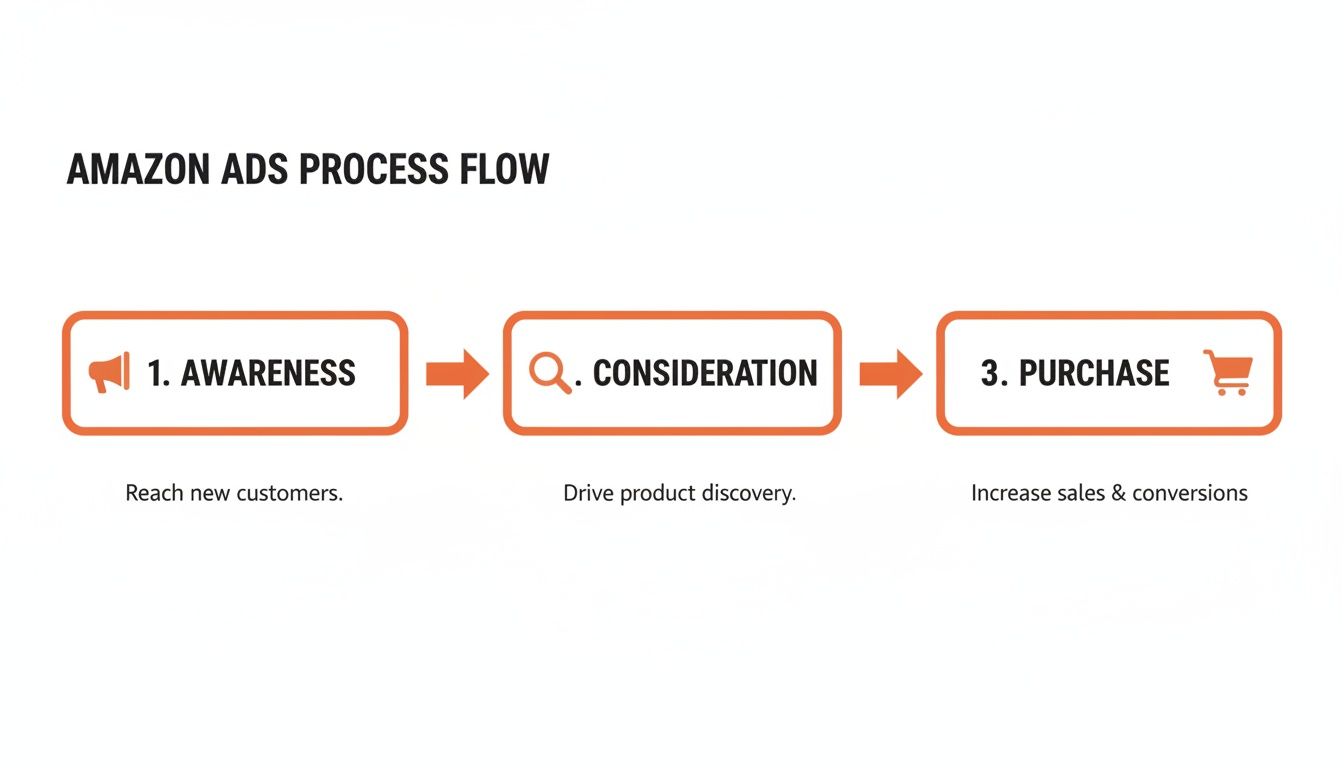
This process is a reminder that your ads must meet customers at every stage of their buying journey, from broad discovery to specific product consideration.
The Auto-to-Manual Feedback Loop
One of the most effective and scalable structures is the auto-to-manual method. It’s simple in theory but powerful in practice. You create two types of Sponsored Products campaigns for the same group of products: one automatic and one manual.
The Automatic Campaign (The Explorer): You set up an automatic campaign and let Amazon's algorithm find relevant search terms and product pages where your ad gets sales. Its job is to explore the market. You need to check the Search Term Report for this campaign regularly to find valuable keywords.
The Manual Campaign (The Hunter): This is where you take control. You take the exact, converting search terms from your automatic campaign's report—the ones you know lead to sales. You add these proven keywords to your manual campaign as exact match keywords. This allows you to bid more confidently on terms that generate revenue.
At the same time, you add those same high-performing terms as negative exact match keywords back in your automatic campaign. This is a critical step many sellers miss. It stops your two campaigns from bidding against each other and forces the auto campaign to keep exploring for new, undiscovered keywords.
This creates a powerful, self-sustaining cycle. The "Explorer" campaign continuously finds new opportunities, and the "Hunter" campaign capitalizes on them for maximum profitability. This system ensures your Amazon advertising becomes more efficient over time, adapting to new customer behaviors and market trends. It turns your ad spend from a cost into a predictable growth engine.
Smart Bidding and Budgeting in a Competitive Market
Throwing more money at Amazon ads and hoping for the best no longer works. As ad costs climb and the marketplace gets more crowded, success now hinges on a smarter approach to bidding and budgeting. It’s about moving past guesswork and making every dollar you spend deliver the maximum possible return.
The days of setting a bid and walking away are long gone. The marketplace is dynamic, and your bidding strategy needs to be as well. Amazon gives you a few options, but picking the right one depends on what you’re trying to achieve with a specific campaign.
Decoding Amazon's Bidding Strategies
For your Sponsored Products campaigns, the main choice is between dynamic or fixed bids. Understanding the difference is critical for controlling your spending and hitting your performance goals. Each one serves a different purpose.
Dynamic bids – down only: Think of this as your safety net. Amazon will automatically lower your bid—by up to 100%—if it thinks a click is less likely to turn into a sale. This is the best option for campaigns where profitability is the top priority and you need to keep a tight rein on your Advertising Cost of Sale (ACoS).
Dynamic bids – up and down: This is the aggressive growth option. Amazon can increase your bid (by up to 100% for top-of-search placements) if a click seems highly likely to convert, or lower it if it doesn't. Use this when your main goal is getting as much visibility and as many sales as possible, such as during a new product launch or a major event like Prime Day. Be prepared for a higher spend.
Fixed bids: This strategy gives you the most control. Amazon will use your exact bid every time, without making real-time adjustments based on conversion likelihood. It's a useful tool for experienced advertisers who are testing specific bid levels or for brand-defense campaigns where you absolutely need to appear for a certain keyword.
A classic mistake is leaving "up and down" bidding enabled on a mature, profitable campaign. This often inflates your cost-per-click (CPC) without a matching lift in sales, which eats into your margins. Always match your bidding strategy to your campaign's goal.
Your bidding strategy isn't a "set it and forget it" choice. It's a lever you should adjust based on your campaign's immediate objective. Use 'down only' to protect profit, 'up and down' to chase growth, and 'fixed' for precise control.
Setting Realistic Budgets and ACoS Targets
Your daily budget and ACoS target can't be arbitrary numbers. They must be based on your product's actual financials. Before you set a budget, you have to know your break-even ACoS.
This is the point where your ad spend equals your profit margin. To calculate it, you need to know your product's selling price and all associated costs (cost of goods, Amazon fees, shipping). For example, if you make a £10 profit on a £40 product, your profit margin is 25%. Your break-even ACoS is 25%. Any ACoS below that number means you are making a profit on your ad spend.
This is where the challenge of rising competition becomes clear. In some competitive categories, the cost of getting noticed is climbing steeply. For example, in the Amazon India marketplace, ad costs have soared. The average cost-per-click for top-of-search placements reached around $1.18 USD (roughly ₹100) in 2026, a significant jump from pre-2020 levels of about $0.71. This surge is fueled by intense competition in saturated categories like electronics. This data shows why generic keyword strategies are no longer effective and why data-driven insights are essential to keep costs under control.
Proactive Management in a Competitive Arena
With CPCs on the rise, you have to be proactive. You can't afford to let underperforming campaigns bleed your budget. This means getting into a regular routine of checking your performance data and making quick, decisive changes.
Here’s a practical framework to follow:
Review Performance Weekly: Check your key metrics—spend, sales, ACoS, and clicks.
Identify Winners and Losers: Pinpoint which campaigns, ad groups, and keywords are driving profitable sales and which are just wasting money.
Shift Budget Accordingly: Don’t be afraid to cut the budget on poor performers and move that money to your winners. This simple action can dramatically improve your account’s overall profitability.
For more advanced strategies, advertisers often turn to platforms like algofuse that use algorithmic approaches. These tools can help automate the tedious process of data analysis and bid adjustments, freeing you up to focus on the bigger picture. If you're looking for more details on managing campaigns, check out our guide on Amazon Pay-Per-Click.
By actively managing your bids and budgets based on real performance data, you stop treating ad spend as a necessary cost and start turning it into a powerful, predictable engine for growth.
Optimizing Your Content for Amazon's AI
Your ads are only as good as the product pages they lead to. You can drive thousands of clicks, but if your landing page doesn’t convert, you’re just paying to disappoint shoppers. This section connects your ad campaigns to your product detail page, showing you how to optimize for Amazon's AI-powered shopping experience.
It's no longer about simply stuffing keywords into your listing. Amazon's conversational AI, Rufus, recommends products based on the relevance and quality of your content, not just your ad bids. It tries to answer customer questions before they're even fully asked. Your job is to make sure your product page provides those answers clearly and compellingly.
Decode What Shoppers Are Really Asking
First, you need to uncover the real questions shoppers are asking. Don't guess. Dive into your own customer reviews, your competitor's reviews, and the "Customer questions & answers" section on similar product pages.
What are the recurring themes? If you sell a blender, are people constantly asking if it can crush ice, if it's easy to clean, or if it’s noisy? These are not just questions; they are potential reasons a customer might not buy. You have to address them directly.
This is where tools can help. They are built to analyze these signals from Amazon, showing you precisely what questions are most important for your product category and giving you a data-backed roadmap for your content.
Weave Answers Directly Into Your Listing
Once you know the questions, you must weave the answers into your listing. Make the important information impossible to miss.
Product Title: This is your most valuable real estate. A great title should include the brand, product type, a key feature, and a primary use case. For example: "KitchenPro Stainless Steel 1.5L Blender for Smoothies and Ice Crushing". Right away, you've answered two potential questions.
Bullet Points: Think of these as a mini sales pitch. Each bullet should lead with a benefit and follow with the feature. Instead of "1.5L capacity," try "Make Enough for the Whole Family: The large 1.5L pitcher is perfect for morning smoothies or batch-prepping soups."
A+ Content: This is your chance to tell a visual story. Use a mix of text and lifestyle images to show your product in action. For example, show the blender on a clean kitchen counter next to a glass of a freshly made smoothie. Use comparison charts to answer more complex questions, like how your blender model compares to others.
A well-optimized page, with clear, benefit-driven copy and high-quality lifestyle imagery, directly improves ad conversion rates. This lowers your Advertising Cost of Sale (ACoS) and, in turn, boosts your organic rank. It’s a positive feedback loop.
This all works together to create a seamless journey, from the moment someone clicks your ad to the moment they hit 'Add to Cart'. You're satisfying both the shopper's needs and the algorithm's criteria for a high-quality listing. If you're new to the topic, you can learn more about how to find the right product keywords in our detailed guide.
Your Images Are Your Product
Let's be clear: your content isn't just words. In an online store, your images are the product until it arrives at the customer's door. Low-quality, uninspired images will hurt your conversion rate, no matter how good your copy is.
High-quality visuals are non-negotiable. Investing in professional Amazon product photography can dramatically boost your listing's appeal and conversion rates, which is a massive positive signal for Amazon's algorithm.
Think of your image block as a visual representation of your bullet points.
Main Image: A crystal-clear shot of your product on a pure white background. No exceptions.
Lifestyle Images: Show real people happily using your product in a realistic setting.
Infographics: Use text overlays to call out key features and benefits visually.
Comparison Charts: Show exactly how your product stacks up against others.
By optimizing your product page content, you're not just improving one listing; you are making your entire "advertising with amazon" strategy more effective. You're ensuring that the traffic you pay for has the highest possible chance of converting into a sale.
How to Measure Performance and Optimise for Growth
If you're judging your Amazon ad performance on clicks and impressions, you're flying blind. To know if your campaigns are actually making you money and building your brand, you need to focus on the numbers that matter to your bottom line.
This isn't about getting lost in spreadsheets. It's about building a simple, repeatable review process that turns raw data into smart, profitable decisions. Let's focus on the metrics that actually drive growth.
The Core Profitability Metrics
Your entire analysis should hinge on just a few key performance indicators (KPIs). These are the numbers that tell the real story of your advertising's impact on your business.
Your baseline metric is Advertising Cost of Sale (ACoS). This tells you the direct efficiency of your ad campaigns. It is calculated as (Ad Spend ÷ Ad Sales) x 100. For every dollar you make in sales from ads, how much did you spend to get it? A lower ACoS means your ads are more efficient.
But ACoS is only half the story. The real game-changer is Total Advertising Cost of Sale (TACOS). This is the strategic metric that reveals the health of your entire Amazon business. It measures your total ad spend against your total sales—both ad-driven and organic. If your TACOS is trending down over time, it means your ads are successfully lifting your organic rank and sales. That's the ultimate goal.
Finally, your Conversion Rate (CVR) tells you what percentage of shoppers who click your ad actually buy. A low CVR, even with tons of clicks, is a massive red flag. It’s often a sign that the problem isn’t your ad—it’s your product detail page. Poor images, weak copy, or bad reviews can ruin a perfectly good campaign.
A Framework for Weekly and Monthly Reviews
Consistency is everything. Setting aside time each week and month to review your ad performance is the single best habit you can adopt. It allows you to fix problems before they waste your budget and to double down on what’s working.
Your weekly check-in is for quick, tactical adjustments:
Campaign Budgets: Are any campaigns hitting their daily budget cap too early? That's a clear signal of high demand. You may need to increase the budget for that campaign to capture all available sales.
Keyword Performance: Look for "bleeder" keywords—the ones with high spending but zero sales. Add them to your negative keyword list immediately to stop the waste.
High-Performing Keywords: Identify the keywords driving high sales at a low ACoS. These are your winners. Consider carefully increasing the bid to get more of that valuable traffic.
Your monthly review is more strategic. This is your chance to zoom out and analyze the big picture.
The most valuable insights come from analyzing trends over time. A single week can be an anomaly; a month’s worth of data reveals the real story of what’s working and what isn’t.
In this review, you should be asking bigger, more strategic questions:
Is my TACOS trending down? If your ad spend is steady while total sales are climbing, your strategy is paying off.
How are new product launches doing? Do they have the sales momentum they need, or is it time to put more budget and visibility behind them?
Which campaigns drive the most long-term value? Look past ACoS. See which campaigns are having the strongest positive effect on your overall brand growth.
This structured approach gives you the confidence to act. For instance, a platform like Cosmy can help automate this diagnosis by surfacing signals from Amazon's AI, like when your product content isn't aligned with what shoppers are asking. This helps you instantly see if a conversion drop is due to a keyword mismatch or a product page weakness, pointing you to the right fix, faster. You can dive deeper into the metrics that count by reading our guide on the most important KPIs for eCommerce.
By focusing on these core metrics and establishing a regular review cycle, you transform your Amazon advertising from a mysterious cost into a predictable engine for business growth.
Common Questions About Advertising With Amazon
When it comes to Amazon advertising, the same few questions come up again and again. These are the issues that can stall campaigns, waste budgets, and leave marketers feeling stuck.
Here are straightforward answers to the most common challenges.
Is My Ad Budget Big Enough to Compete?
This is often the first question people ask, and it’s framed the wrong way. It's not about having the biggest budget—it’s about having the smartest one.
A small, efficient budget of even £500 a month can outperform a poorly managed £10,000 budget. The key isn't spending power; it's precision.
Start small. Focus on a handful of your most important products. Funnel your budget into a tight, exact-match manual campaign using keywords you know have high purchase intent. You can run a low-budget automatic campaign alongside it, purely for discovering new, profitable search terms.
The goal is to become profitable on a small scale first. Once you have a model that works, you can reinvest the returns with confidence and begin to scale. It’s far better to dominate a few niche keywords than to spread your budget so thin that it becomes invisible across hundreds of broad ones. A small budget forces discipline, which is a competitive advantage.
Why Is My ACoS So High?
A high Advertising Cost of Sale (ACoS) isn't the problem itself—it's a symptom. It's a signal that something is broken in your strategy. Before you panic and slash your bids, run through this diagnostic checklist.
Are your keywords the problem? Dive into your search term report. You’re almost certainly paying for broad, irrelevant clicks that generate zero sales. Add these as negative keywords immediately.
Is your product page actually converting? You can run the world's best ad, but if it points to a listing with weak images, vague copy, or bad reviews, you're paying for traffic that will never convert. A low conversion rate is often a content problem, not an ad problem.
Are your bids too aggressive? Using "up and down" bidding for a profitability-focused campaign is a good way to inflate your costs. Try switching to "down only" to protect your margins and stop overpaying for clicks.
A high ACoS is rarely caused by a single issue. It's almost always a combination of imprecise targeting and a product detail page that isn't optimized to close the sale.
A high ACoS is a signal to investigate, not to panic. Your ad account is telling you exactly where the inefficiencies are. Fix the root cause—whether it’s keywords or content—and your ACoS will naturally improve.
How Long Does It Take to See Results?
On Amazon, you'll get data like clicks and impressions almost instantly. But don't confuse data with meaningful results. Real, strategic growth takes time and happens in phases.
The First 1-2 Weeks (Data Collection): This initial period is all about gathering information. You'll see some sales, but the primary goal is to learn which keywords are winners and which are just wasting money. Don't make any drastic changes here. Let the data build up.
The First Month (Initial Optimization): With a few weeks of data, you can start making smart moves. This is when you'll add negative keywords, start increasing bids on your top performers, and shift the budget away from the losers.
30-90 Days (The Positive Feedback Loop): Here's where the real progress happens. Consistent, optimized advertising starts to lift your product's organic ranking for the keywords you're targeting. You should see your Total ACoS (TACOS) begin to drop as your organic sales grow.
Patience is a strategic advantage. Trying to force results too quickly leads to wasteful spending and abandoning good strategies before they have a chance to work. Sustainable growth is a marathon, not a sprint.
Ready to replace guesswork with a clear, data-backed strategy for your Amazon content? Cosmy uses proprietary signals from Amazon’s AI to show you exactly what to fix on your product pages to improve visibility and conversion. Get your free audit and start making smarter decisions today at https://cosmy.ai.